Charlotte-Mecklenburg Historic Landmarks Commission

Month: October 2016

Carolina Cadillac Company

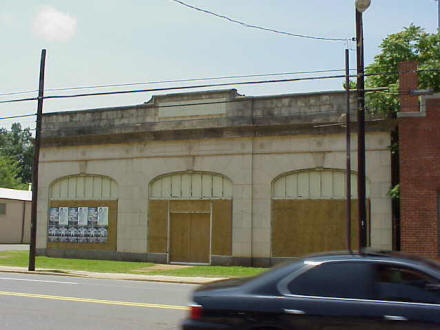
Carolina Cadillac Building

  1. Name and location of the property: The Property known as the Carolina Cadillac Company is located at 1310 South Tryon Street, Charlotte, North Carolina.
  2. Name and address of the present owner of the property: The present owner of the property is:

Capstone Property Group, Inc.

1043 East Morehead Street

Charlotte, NC 28204

  1. Representative photographs of the property: This report contains representative photographs of the property.
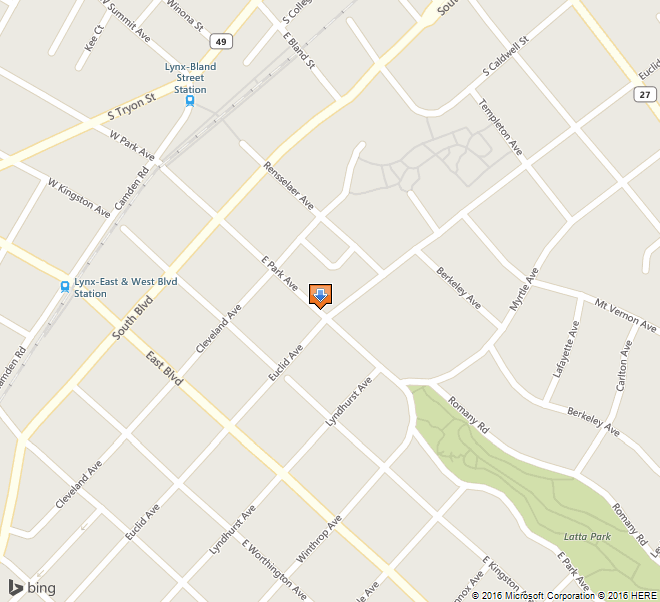
  2. Maps depicting the location of the property: This report contains a map depicting the location of the property.
  3. 5. Current deed book and tax parcel information for the property: The current deed for the property is found in Deed Book 04665, page 268, and the Tax Parcel number for this property is 07307208
  4. UTM coordinates: 17 513249E 3897221N
  5. A brief historical sketch of the property: This report contains a brief historical sketch of the property.
  6. 8.   A brief architectural description of the property: This report contains a brief           architectural description of the property.
  7. 9. Documentation of why and in what ways the property meets criteria for designation set forth in N. C. G. S. 160A-400.5:
  8. Special significance in terms of its history, architecture, and/or cultural importance:  The Commission judges that the property known as the Carolina Cadillac Company does possess special significance in terms of Charlotte-Mecklenburg.  The Commission bases its judgment on the following considerations:
  • Constructed in 1926, the building was designed by local architect, M.R. Marsh, who was also responsible for a number of downtown commercial buildings during the early twentieth century.
  •  The building is notable for the elegant, classical design of its facade, which was meant to attract an upscale clientele.
  • The building is also remarkable for its sophisticated and varied use of concrete in both the structure of the building and the decorative elements.  The side and rear elevations have walls made of rough-faced, concrete bricks while the facade features a concrete surface, scored and polished to resemble cut sandstone.
  • The Carolina Cadillac Company was the first Charlotte automobile dealer to build an automobile showroom on the outskirts of the central business district.
  • The Carolina Cadillac building is a now rare and well-preserved example of an early twentieth century automobile showroom in Charlotte and is one of the last examples of a 1920s commercial style building remaining on South Tryon Street
  1. Integrity of design, setting, workmanship, materials, feeling and/or association:  The Commission contends that the physical and architectural  description that is included in this report, demonstrates that the Carolina Cadillac Company meets this criterion.
  2. Ad Valorem tax appraisal: The Commission is aware that designation would allow the owner to apply for an automatic deferral of 50% of the Ad Valorem    taxes on all or any portion of the property which becomes a designated “historic landmark.” The current appraised value of the building is $257,700,0 and features are appraised at $9100.00. The current appraised value of the lot is $567,900. The current total value is $834,700.


Carolina Cadillac Company Building

Historical Essay

The Carolina Cadillac Company held its grand opening in its new building at 1108 South Tryon Street on March 7, 1927.  The company, originally located at 520 South Tryon, was the first to build an automobile showroom on the outskirts of the central business district.[1] The unveiling of the new showroom was planned to showcase the nationwide introduction of the LaSalle, Cadillac’s latest model.[2] The presentation of the new building and the new Cadillac occurred in the final months of the prosperity associated with the 1920s, a period of post-war boom, modernization, and mass-produced goods.

By the 1920s, the automobile was firmly entrenched in American culture. At the turn of the century, individually crafted automobiles, such as the early Packards, were expensive toys for the wealthy elite and royalty. However, assembly line mass production made cars affordable to middle class incomes, and by the 1920s, many ordinary families owned one. The automobile was a major transforming influence of the early twentieth century and has been credited with redefining residential patterns, commercial districts, and a variety of social conventions from touring to courtship. A car was also a clear status symbol.  Those who owned cars did not have to rely on public transportation and flocked to suburbs built out of the reach of extant trolley lines.[3]

Automobiles, trolleys, and pedestrians competed for space in downtown Charlotte as early as the first decade of the twentieth century. The earliest automobile dealer in Charlotte appears in 1903. Osmond Barringer, a hardware merchant, also sold Oldsmobiles, and later, was also an agent for White Steamers, and Baker Electrics.[4] Within a decade, Barringer and ten other dealers had set up shop within the downtown business district, and with the exception of a small car lot on Mint Street, all of the dealers were located within a five-block radius of the intersection of Trade and Tryon Streets.[5]  In 1906, there were only 76 registered cars in the city; by 1912 this number increased to 259, and to 1757 by 1917. Corresponding to the statewide trend, by 1925 the number of registered vehicles in the city increased to 22,159.[6] There were twenty-five automobile dealers in Charlotte that year.[7]

Unlike other categories of center city businesses and institutions, auto showrooms were not sequestered in a particular section of the business district, but were distributed along a number of the city’s major arteries:  North and South Tryon Streets, West Trade, South Church, and Mint. A number of the early showrooms were located on the city’s grand avenues leading out of town.  As houses on these key, busy streets came on the market in the late 1910s and 1920s, they were razed, and the resulting vacant land provided plenty of room for car dealers. For example, C.C. Coddington built a fine Buick showroom on West Trade Street and Oscar J. Thies built the showroom for the Roamer Automobile Sales Agency at 500 North Tryon in 1921.Ultimately, many of these residential streets would evolve into commercial strips, with showrooms and other auto-related businesses at the vanguard of establishments moving to peripheral locations along major traffic arteries convenient to the automobile. [8]

 
Neil Somers Alexander purchased a Cadillac for $3540.30 in 1922.  A large home in Myers Park in 1929 would have cost $10,000.

Prior to Charlotte’s suburban expansion after World War II, the central business district was home to showrooms for a wide variety of auto manufacturers, from the enduring giants Ford and General Motors to long forgotten brands such as Nash, Hudson, Essex, Oakland, Studebaker, Pierce Arrow, Packard, Willys, and Hupmobile. By the 1920s, most of the automobiles sold in the Carolinas passed through Charlotte distributors. Model A and Model T Fords were manufactured a few miles from the retail district at an assembly plant on Statesville Avenue.[9] The plant opened in 1925 and made 300 Model Ts a day.[10]

The Carolina Cadillac Company is located on what was once a residential block of South Tryon Street. The company had been in Charlotte for twelve years and had grown steadily from a small office on Sixth Street to a larger facility on the 500 block of South Tryon Street until the construction of the impressive edifice on the 1100 block.[11] The new building displaced a corner butcher shop and the home of a clerk who was employed at the Hornets’ Nest Electric Company. The blocks to the north and south were similarly constituted of a mixture of working class residences and neighborhood businesses. Carolina Cadillac was the first automobile dealer to relocate to a large lot outside of the perimeter of the central business district, and although a couple of other dealers would follow suit by 1931, there was no ensuing trend for car lots to locate to farther reaches of town until the 1960s.[12]

The segment of South Tryon that coursed four blocks from the Square was once part of a fashionable office corridor, but the street became more distinctly residential as it flowed south from its intersection from Morehead Street. Through the 1950s, this section of South Tryon Street remained a mixture of residential and small businesses. Most of these were small neighborhood businesses such as grocers, barbers, and cafes. By the 1950s, this segment of South Tryon began to lose its residential character, and slowly gave way to distributing houses, repair shops, and supply companies. The Carolina Cadillac Company was the only auto dealership to locate this far south on Tryon Street, and perhaps owing to the Great Depression, no others followed, leaving most of the showrooms clustered along North Tryon, South Church, and West Trade, leaving the Carolina Cadillac site in a comparatively isolated location.[13]

The new Cadillac showroom was built at a time when strong manufacturing and sales trends were predicted for the year. The president of the Peerless Motor Corporation proudly asserted:

This country has become so prosperous that its ability to consume goods is far greater than many people can imagine. When some people read that the automobile industry is planning to produce over 4,000,000 cars in 1927 they are staggered by the figures. Some even say the automobile manufactures are too optimistic. But the fact remains that more people can afford cars than ever before and it is generally known that it costs much less to own and operate a car today than it did in 1919.[14]

The grand opening of the new Cadillac facility was open to the public and was advertised as a gala event. Festivities began at seven thirty in the evening with music provided by the Spanish Troubadours Orchestra, speeches by company representatives, the unveiling of the LaSalle, followed by music and dancing.[15] The Spring Salon received special attention in The Charlotte Sunday Observer with a special section devoted to all things Cadillac and information about the new building.[16]  The architect, M.R. Marsh, incorporated elaborate use of concrete construction and metal decorative elements, into the new showroom designed for the automobiles preferred by the upper middle classes. The Charlotte Sunday Observer praised the architecture of the building, describing it as “unique” and “highly attractive”:

The interior is most startlingly different from the usual motor company office construction. A ceiling of antique wood tinted in restful green is one of the first features to strike the visitor. All woodwork is of antique appearance and fixtures are of wrought iron. Every detail harmonizes with the luxury and artistry characteristic of the Cadillac itself and the showroom is as appropriate to the product it houses as a well-selected frame is to a charming picture.[17]

The contractor was the Southeastern Construction Company. The building permit was registered on September 7, 1926 showing an estimated cost of construction at $53,000.00.[18]

The newspaper referred to the grand opening as the coming out party for Charlotte’s newest debutante.  The “debutante” was located in the center of the showroom and was heavily veiled by an opaque canvas and guarded by two young men in military uniform until the appointed hour of her presentation. Twelve young ladies dressed in white acted as hostesses and pinned a flower to each guest. After the unveiling ceremony, guests were invited to dance the night away on the hardwood floor of the main office and the tiled floor of the showroom, assured “the orchestra will be kept busy until the last guest has danced himself-or herself-to the point of exhaustion. Punch will be served.”[19]

The upscale Cadillac line was not within the price range of the average citizen. In 1927, prices in the Standard Line ranged from $2995 to $3435; the Custom Line began at $3250 fro the Roadster Model to $4485 for the Seven Passenger Imperial. The new LaSalle line ranged from $2495 to $2685.  The Great Depression adversely affected the sale of luxury goods, and the Carolina Cadillac Company suffered repercussions from the catastrophic events of the 1930s. The company left the building in 1934 and relocated as Thomas Cadillac-Oldsmobile at 500 West Trade Street. Sanders Mack Motors, distributors for Hupmobile, Nash, and LaFayette, occupied the building until 1936. The building was vacant for a year and was occupied by Heath Motor Company, a Ford dealership, until 1941. Park McLain Used Autos used the building for approximately one year, and C.W. Upchurch, Charlotte’s Packard dealership occupied the building from 1942-1946. [20]

In the early twentieth century, Packard made the ultimate luxury car. The company had difficulty remaining solvent during the Depression and resorted to manufacturing lower priced mass produced cars, a practice that allowed Packard to limp through the 1930s. The company received large government contracts during the Second World War, and its efficient wartime operations made Packard one of only two auto manufacturers in the world to enter post war production with no debt. However, the company was stymied by bad styling decisions and reckless managerial practices creating damage sufficient to send Packard on a downward spiral resulting in its ultimate demise as a recognizable model by the late 1950s and its disappearance as a company by 1962.[21] It is ironic that the last automobile dealer to occupy showroom was once a well-respected manufacturer of high-end luxury vehicles, and by the time C. W. Upchurch used the space, the Packard line and the building’s purpose as an elegant showroom were both in decline.

The next tenant of 1310 (formerly1108) South Tryon Street was the Henry Walke Company, distributors of mill machinery and supplies. The Henry Walke Company occupied the building from 1947-1962. From 1963-1968, the building briefly returned to its original purpose housing Gaithings Imported Cars. An Electrical Supply Company used the building until the mid-1980s, and from 1984 until recently, the building was occupied by Carroll Aligning and by Charlotte Floral Supply.[22]

The Carolina Cadillac Building is one of a few extant automobile showrooms dating from the early twentieth century.  Most of the early showrooms and car lots were located within four to five blocks from the Square and relocated to larger lots on the fringes of town during the 1960s and 1970s. Their urban footprints have long since been replaced by new construction. The only extant automobile showroom currently designated as a local landmark is the Thies Building, located at 500 North Tryon, formerly the home of Charlotte Flint, Hipp Chevrolet, Carolina Oldsmobile and Folger Motor Company.[23]  The Carolina Cadillac building is rare surviving, well-preserved example of an early-twentieth-century auto showroom in Charlotte.   

[1] Charlotte City Directory, 1925. The original business address was listed as 1108 South Tryon, and changed to 1310 South Tryon, the current address, by 1931.

[2] “LaSalle Result of Demand by Cadillac Friends Over Period of Several Years,” The Charlotte Observer, March 6, 1927. The LaSalle was named for explorer Robert Cavalier de LaSalle, peer to Antoine de la Mothe Cadillac, also a 17th century explorer.

[3] Jakle, John A. and Keith A. Sculle, The Gas Station in America.  Baltimore:  The Johns Hopkins University Press, 1994, 3, 5-6, 8, 163, 228)

[4] Thomas Hanchett, Sorting Out the New South City. Race, Class, and Urban Development in Charlotte, 1875-1975, (Chapel Hill, UNC Press, 1998), p. 185.

[5] Charlotte City Directory, 1913.

[6] Hanchett, Sorting Out the New South City, p. 200.

[7] Charlotte City Directory, 1925.

[8] Hanchett, Sorting Out the New South City, p. 192.

[9] Ibid, p. 185.

[10] Sarah Woodward, Sherry Joines Wyatt, David Gall, Industry, Transportation, and Education Survey.

[11] The Charlotte Sunday Observer. Special Cadillac-LaSalle Section, March 6, 1927.Chalrotte City Directory, 1925.

[12] Sanborn Fire Insurance Maps, Charlotte, 1911,1929; Charlotte City Directories: 1925, 1931, 1935, 1940, 1945, 1950, 1955.  In addition to the Carolina Cadillac Company, the Charlotte Franklin Company was located at 833 East Trade, the Lockerbie Motor Company at 820 South Mint, and the Wilson Motor Company at 720 South Tryon.

[13] Charlotte City Directories, 1935, 1940, 1945, 1050, 1955.

[14] “Buying Season for Motor Cars,” The Charlotte Observer, May 1, 1927.

[15] Advertisement, The Charlotte Observer, March 5,1927.

[16] Special Cadillac-LaSalle Section, The Charlotte Sunday Observer, March 6, 1927.

[17] Ibid. Other buildings designed by Marsh include: schools in Charlotte and Cabarrus and Iredell Counties, the Firestone Tire and Rubber Company Building, The United States Rubber Company Building, a gymnasium for the Thompson Orphanage, the Jefferson Apartments, the Harris Apartments, and the residences of T. C. Guthrie and I. Hechenbleikner.

[18] Application for Building Permit, September 7,1926, Permit No. 7133. Public Library of Charlotte and Mecklenburg County.

[19] The Charlotte Sunday Observer, March 6, 1927.

[20] Charlotte City Directories, 1931-1946.

[21] Robert E. Turnquist, The Packard Story, (New Jersey: A.S. Barnes & Co. Inc., 1965); James A. Ward, The Fall of the Packard Company, (Stanford: Stanford University Press, 1995).

[22] Charlotte City Directories, 1947-2003.

[23] Survey and Research Report, Oscar J. Thies Automobile Sales and Service Building, http://www.cmhpf.org/S&RR/thies.html


Carolina Cadillac Company Building – Architectural Description

Site Description

Situated along South Tryon Street, southwest of downtown, the Carolina Cadillac Company Building is located in an area just northwest of Charlotte’s first streetcar suburb, Dilworth.  This portion of South Tryon is separated from Dilworth by a rail corridor, along which industrial and retail enterprises located in the late nineteenth and early twentieth centuries.  A number of these small scale factories, warehouses, and stores have survived and after years of underutilization and some demolition, the area is currently undergoing much rehabilitation and redevelopment, spurred by center city revitalization, the presence of nearby Bank of America stadium, and the proposed light rail line which will share the historic rail corridor, one block to the southeast.

Exterior

This one story, masonry building was built in 1926 to house the Carolina Cadillac Company showroom.  The building has a rectangular plan with offices and showroom in the front and a long service area to the rear, a plan typical for numerous small factories, warehouses, and auto showrooms dating to the early twentieth century.  A small, concrete block ell was added to the northwest corner of the rear elevation sometime during the postwar period.  The Carolina Cadillac building is notable for its almost exclusive, and elaborate, use of concrete construction and metal decorative elements, making the building largely fireproof.  The façade has a granite base with walls of concrete block composed, polished, and scored to resemble cut sandstone.  The side and rear elevations have concrete walls executed in a more utilitarian, but nonetheless unusual, manner, with concrete fashioned as bricks, rather than the typical concrete blocks.

The classical façade is divided into three, elliptically arched bays, all of which are now boarded over.  The center entrance bay is flanked by storefront windows, and all three openings are edged with delicate rope molding, fashioned from metal, and capped by scrolled concrete brackets.  The fanlights and windows have slender, finely detailed classical columns, also executed in metal, dividing the lights.  Above the door and windows are a classical frieze and parapet.  Also made of concrete, the frieze is ornamented with panels and stylized rosettes and capped by a boldly molded cornice.  The paneled parapet has a molded cap and a central nameplate that is now covered over.

The utilitarian side and rear elevations have concrete brick walls, capped at the roof line by terra cotta coping, and punctuated by banks of steel sash factory windows and pedestrian doors.  The rear elevation has a central loading bay with a modern overhead door and a boarded over window.  The northwest corner of the rear elevation is contiguous with the added rear wing.  The concrete block addition has a gable roof and several loading bays.

Interior

The interior of the building is divided between a front showroom and a service area that occupies roughly seventy-five percent of the building.  The showroom was originally a tall, open display room with several small office and service rooms lining the rear wall that separates the showroom from the service area.  In the postwar era, the showroom was subdivided with the addition of partition walls and dropped acoustical tile ceilings although much of the original fabric remains under these additions.  The showroom retains a beautiful terrazzo floor of black and tan checks with a stylized Art Deco border, tiled walls beneath the front windows, rough stucco walls elsewhere, two panel doors, and molded chair railing, cornices, and door reveals.  There is also an original restroom in the rear with checkerboard tile walls and original plumbing fixtures.  The steel sash front windows are intact and visible from the interior.

A mezzanine level was added to the rear half of the showroom to contain offices on both the first floor and the mezzanine level.  An enclosed, carpeted staircase leads from the center of the room to the mezzanine.  The offices and stairwell are constructed of pine paneling, which appears to date to the 1950s.

Several pedestrian doors lead from the showroom to the service area, and a concrete ramp along the north wall allowed for the movement of cars into the showroom.  The long, open service area has exposed brick walls and steel sash windows, which have been infilled on the north elevation.  The windows have concrete sills and lintels.  The flat roof is notable for its construction, reinforced concrete slabs within a steel I-beam grid, all of which is supported by metal roof trusses.  The slab roof is punctuated by a flat roofed monitor which extends for much of the length of the building.  The service area is open except for a concrete block restroom block that projects from the south wall.  Despite the addition of the small, rear wing and some interior partitions, the Carolina Cadillac Company Building retains sufficient architectural integrity to merit local landmark designation.


 

This report was written on September 5, 1984

1. Name and location of the property: The property known as the Old Carnegie Library Building at Johnson C. Smith University is located on the campus of Johnson C. Smith University, 100 Beatties Ford Rd., Charlotte, North Carolina.

2. Name, address and telephone number of the present owner of the property:

Johnson C. Smith University
100 Beatties Ford Rd.
Charlotte, N.C. 28216

Telephone: 704/378-1000

3. Representative photographs of the property: This report contains representative photographs of the property.

4. A map depicting the location of the property: This report contains a map which depicts the location of the property.


5. Current Deed Book Reference to the property: There is no individual deed to this property listed in the Deed Books of Mecklenburg County. The Tax Parcel Number of this property is 078-201-06.

6. A brief historical sketch of the property: This report contains a brief historical sketch of the property prepared by Dr. William H. Huffman, Ph.D.

7. A brief architectural description of the property: This report contains a brief architectural description of the property prepared by Lisa A. Stamper.

8. Documentation of why and in what ways the property meets the criteria set forth in N.C.G.S. 160A-399.4:


a. Special significance in terms of its history, architecture, and/or cultural importance: The Commission judges that the property known as the Old Carnegie Library Building at Johnson C. Smith University does possess special significance in terms of Charlotte-Mecklenburg. The Commission bases its judgment on the following considerations: 1) the Old Carnegie Library Building at Johnson C. Smith University, erected in 1911-12 and designed by the Charlotte architectural firm of Hunter and Gordon, is one of the older examples of the Neoclassical style that survives locally; 2) Hunter and Gordon were influential architects in Charlotte in the first quarter of the twentieth century; and 3) the building served as the library of Johnson C. Smith University from 1912 until 1978 and continues to contribute to the success of this important black institution of higher education.

b. Integrity of design, setting, workmanship, materials, feeling, and/or association: The Commission contends that the attached architectural description by Miss Lisa A. Stamper demonstrates that the Old Carnegie Library Building at Johnson C. Smith University meets this criterion.

9. Ad Valorem Tax Appraisal: The Commission is aware that designation would allow the owner to apply for an automatic deferral of 50% of the Ad Valorem taxes on all or any portion of the property which becomes “historic property.” The Old Carnegie Library Building possesses no individual Ad Valorem Tax Assessment. However, the entire 44.24-acre campus has an appraised value of $575,120 for the land and $11,607,330 for the improvements, or a total appraised value of $12,182,450.

Date of Preparation of this Report: September 5, 1984

Prepared by: Dr. Dan L. Morrill
Charlotte-Mecklenburg Historic Properties Commission
1225 S. Caldwell St. Box D
Charlotte, N.C., 28203

Telephone: 704/376-9115


Historical Overview
 

Dr. William H. Huffman
January, 1983

One of the finest examples of its style of architecture in the area is the solid, timeless Carnegie Library building on the campus of Johnson C. Smith University in Charlotte. This handsome edifice is also one of the earliest surviving Neo-classical buildings in the county. For more than seventy of the school’s one-hundred and fifteen-year history, it has been a landmark feature of the campus along with Biddle Hall.

Johnson C. Smith University began as a post-Civil War theology school which was set up under the Committee on Freedmen of the Presbyterian Church, USA. The purpose of the school was to train young, newly-freed blacks to become ministers and teachers throughout the South. Under the direction of two white ministers sent from the North, the first session opened May 1, 1867, with eight or ten students, in a church at Fourth and Davidson Streets.

A Philadelphia resident, Mrs. Mary D. Biddle, responded to an appeal in the church paper for funds by donating a total of $1,900.00. One thousand dollars of this sum was given in honor of her husband, Major Henry J. Biddle, of the prominent Philadelphia family of that name, who was killed in action in 1862, and an additional $400.00 was presented with the stipulation that the school be chartered as “The Henry J. Biddle Memorial Institute.” She later added another $500.00 to the total. In addition to this gift, the Freedmen’s Bureau of the United States contributed another $3000.00 to the fledgling enterprise.

In seeking to establish its own quarters, one of the school’s directors, Reverend S. C. Alexander, bought the old Confederate Navy building on Trade Street between College and Brevard for $150.00, with the intention of reconstructing it near Seventh and Caldwell in First Ward. Legend has it that as the materials were being loaded on a wagon, Colonel William R. Myers, one of Charlotte’s leading entrepreneurs whose rank was from Confederate Army service, upon discovering the purpose of their labor, offered the school eight acres of farmland he owned to the northwest of the city, provided they could raise the money to purchase it. The offer was cheerfully accepted, and the now-loaded wagon turned around to head west instead of east. Once the money was raised and offered, Colonel Myers reportedly refused it, thereby donating the land, since he was now convinced that the school had sufficient funds to continue operating in the new location. Eventually seventy-five acres were purchased from Colonel Myers.

Thus in 1869, Biddle Memorial Institute was opened in its new hilltop quarters and the following year, Reverend Dr. Stephen Mattoon (1815-1886), a native of New York State with outstanding missionary service, was elected the first president. Under Dr. Mattoon’s leadership, the Institute, which had a faculty of three and a student body of eighty at the beginning of his tenure, became firmly established on the road to becoming one of the foremost black colleges in the nation, and also became a significant part of Charlotte’s development. Around it grew Biddleville, aided by Dr. Mattoon’s purchase of land in the vicinity which he sold to faculty members, and the opening of the streetcar line in 1903.

In 1876, the school was chartered as Biddle University by the state legislature, which gave the institution the authority to grant degrees. Two years later, in 1878, a disastrous fire destroyed the combined president’s house/administration building/library which also contained all the school’s early records. A new brick house was built for the president, and after a drive to raise $40,000 for a new administration building, to which local residents contributed generously, a fine three-story brick building was opened in 1883. The elegant new structure, Biddle Hall, contained twelve classrooms (one of which doubled as a library) and a large lecture hall; it is now on the National Register of Historic Places.

About 1904, during the tenure of Biddle’s first black president, Reverend Daniel J. Sanders (served 1891-1907), the need for a new library was quite clear, and so Dr. Sanders wrote to the philanthropist Andrew Carnegie requesting a gift for that purpose. Dr. J. S. Fisher, of Pittsburgh, head of the Presbyterian Freedmen’s Committee, also endorsed the request. The Pittsburgh tycoon responded that he would give the school $12,500 for a new library if they could raise an equal amount for an endowment to maintain it. Before the challenge could be met, Dr. Sanders died in 1907. That year, Dr. Henry L. McCrorey was elected president of the university, and he guided the institution’s growth and change for forty years to one of the leading black colleges in the nation. He was himself a graduate of the school’s preparatory department and theological seminary (1895) and had served as a professor in the college of arts and sciences and the seminary. 1 At the top of Dr. McCrorey’s priority list for the university was completion of the drive for the new library. Three years later, success was announced in the Charlotte Evening Chronicle on October 29, 1910: The money had been raised, and the architectural firm of Hunter and Gordon was commissioned to draw up plans and specifications for the new campus building. The proud announcement goes on to say,


The news of the good fortune of Biddle University will be received with a marked degree of pleasure not only by the colored people but by the white people of Charlotte and this section. Probably no colored college institution in the South is better known or has done a more valuable work than has Biddle with the exception of the larger and richer institute of Dr. Booker T. Washington at Tuskeegee, Ala. 2

The following April, 1911, the construction contract was awarded to the R. N. Hunter Company of Charlotte. The building cost was now projected to be $15,000, necessitating a further $2,500 for completion, which was also successfully raised. 3

The architects of the library, Hunter and Gordon, were very active during this period of boom times in New South Charlotte. Leonard LeGrand Hunter (1881-1925) was born near Huntersville in Mecklenburg County, and came to Charlotte about 1905. He died suddenly at the age of 43 after living twenty years in the city. 4 Frank Gordon (1870-1930), a Maine native, came to Charlotte the same year as L. L. Hunter and was first employed as the supervising architect of the Selwyn Hotel. 5 About four years later, Hunter and Gordon formed their partnership (until about 1917). Among a number of important commissions, the two designed Charlotte’s Mercy Hospital, the E. C. Marshall mansion in Myers Park, and the Chalmers A.R.P. Church on South Boulevard. 6 Robert N. Hunter (1878-1927), the contractor, was not directly related to the architect.

On November 15, 1911, a gala occasion took place on the campus: the cornerstone-laying ceremony for the new library. Dr. McCrorey was master of ceremonies, and in his address to the gathered faculty, students and distinguished guests, he recounted the work of the school, its beginnings, and generous support, including the gifts of Colonel Myers and Mrs. Biddle. Another address was given by Heriot Clarkson, a prominent Charlotte attorney and former Solicitor for the 12th Judicial District (which includes Charlotte) in which he praised the school and its graduates. Also present was Daniel Augustus Tompkins (1852-1911), who was one of the leading industrialists of Charlotte and the Piedmont Carolinas, primarily in textile mills, mill machinery manufacturing and related industries. After 1882, he was also the major owner of the Charlotte Observer. In his address, President McCrorey lauded Mr. Tompkins for his unselfish interest in the prosperity of the school. Tompkins thought that


… Biddle is a model school and that it would well repay those who are interested in the solution of the race questions existing everywhere throughout the world to visit this place and study the methods that have made this institution one of the most conservative influences in the land.

Among the papers deposited in the cornerstone was an address by Andrew Carnegie on “The Negro in America,” which had been delivered before the Philosophical Institution in Edinburgh, Scotland on October 16, 1907.” 8

As Dr. McCrorey had hoped, the Carnegie Library was ready for its dedication at the forty-fourth commencement, May 30, 1912. A “large number” of people attended the ceremony and heard the principal speaker, Dr. C. C. Hayes, pastor of the First Presbyterian Church of Johnstown, Pa. 9 By the fall term, 1912, the library was open and ready for use. On the lower level, there was a lecture room and storage space. The main floor had sixteen-foot ceilings, and included a reading room, a board room and a stack room. The latter had a capacity of 5,000 volumes in the wall stacks and an additional 11,000 volumes in floor stacks to be constructed as needed. Additionally, the lighting and central heating were the most modern of the time. 10 At the time of its opening, the library already boasted a collection of 8,000 volumes. 11

In 1921, another fire in which the theological dormitory, kitchen and dining room were lost seriously threatened the existence of the entire school, since extensive funds would be needed for rebuilding. Fortunately for the university, Mrs. Mary Jane Smith of Pittsburgh, Pa. provided money for rebuilding when she learned of the circumstances. She subsequently visited the campus and made significant contributions, totaling $700,000 in the memory of her late husband, Johnson C. Smith, a druggist, for the endowment, a teacher’s cottage and a gate. In 1923, the name of the school was changed to Johnson C. Smith University in recognition of its benefaction. The following year, the will of James B. Duke made a gift to the university estimated to be worth one to one and a half million dollars. Thus the future of the school was secure, and, starting with the academic year 1924-5, it became the second school for blacks to be rated as a standard four-year college by the state. 12

The library itself languished because of a lack of professional staff. In 1930, however, the university hired Theodus L. Gunn, a 1927 graduate of Johnson C. Smith, as its first full-time, trained librarian. Mr. Gunn lost no time in taking inventory and reorganizing the entire library. At his instigation, the building was completely renovated, which added more stacks, improved lighting and made a number of improvements. The growth of the collection over the years meant a chronic shortage of space, however, and in 1957 the funds were appropriated to enlarge the library with the addition of another floor for stacks and reading space. 13 Twenty-one years later, in 1978, the modern James B. Duke Memorial Library replaced the venerable old Carnegie as the location of the university’s library services. The Carnegie Library building presently houses various student services, including financial aid, counseling, testing and placement offices.

The classically-designed Carnegie Library at Johnson C. Smith University stands as a proud and stately monument to the many people, both black and white, who committed themselves not only to the survival of the school, which was often not certain, but also to achieving a level of academic standards which successfully made it one of the leading institutions of its kind in the country. The library’s standout role in the history of Johnson C. Smith, the Charlotte community and indeed, the nation is without question. One can only wonder at the number of black leaders in the ministry, law, medicine and business throughout the country who spent many hours in the rooms of the Carnegie Library. It is a legacy of dreams, dedication, philanthropy and a determination to succeed.


NOTES

1 Arthur A. George, 100 Years, 1867-1957: Salient Factors in the Growth and Development of Johnson C. Smith University (Charlotte: Johnson C. Smith University, 1968); Jack Claiborne, “To the West,” in Jack Claiborne’s Charlotte (Charlotte: Charlotte Publishing, 1974), pp. 50-52; Margaret E. Battle, “A History of the Carnegie Library at Johnson C. Smith University,” unpublished M. S. Thesis, University of North Carolina – Chapel Hill, 1960.

2 Charlotte Evening Chronicle, October 29, 1910, p.9.

3 Ibid., April 12, 1911, p.5

4 Charlotte Observer, February 21, 1925, p 15.

5 Ibid., September 25, 1930, p 10.

6 Information supplied by Thomas W. Hanchett and Dan L. Morrill.

7 Charlotte Observer, February 19, 1927, p. 4.

8 Ibid., November 16, 1911, p. 4

9 Charlotte Evening Chronicle, May 30, 1912, p. 1.

10 Ibid., April 14, 1911, p 6.

11 Battle, p.29.

12 George, pp. 30-34; Claiborne, p.52; Battle, p.23.

13 Battle, pp. 31-36.


Architectural Description
 

by Lisa A. Stamper
March 4, 1984

Standing near nationally historic Biddle Hall on the campus of Johnson C. Smith University, the Neo-Classical Carnegie Building (formerly Carnegie Library) greatly contributes to the campus’ architectural history. Money donated by the extremely successful philanthropist Andrew Carnegie and matching funds raised by the university’s president Henry L. McCrorey, allowed the Carnegie Library to open in 1912. At that time the institution was named Biddle University. The handsome Carnegie Library was designed by Charlotte architects L. L. Hunter and Frank Gordon, and the contractor was R. N. Hunter Company, also of Charlotte. Although the interior of the library is now being used for offices, the exterior has been virtually unaltered in almost seventy-two years.

The symmetrical Carnegie Building is T-shaped with a flat roof. Made primarily of tan colored brick with white terra cotta columns and trim, the building consists of two-levels. The main level is raised slightly above the ground, a device used to make the building resemble a Roman temple, while the lower level is partially underground.

The main entrance to the building is located in the center of the northwest facade. It is emphasized by a full-height Roman Doric portico of mostly terra cotta. The gabled roof of this portico is made of wood, with the front portion painted to resemble marble. The back portion is painted black and is adorned with plain rounded antefixes at the ridgeline.

Behind the protruding portico, but not contained within the main massing of the building, a small entryway is located. The interior walls of this entryway are made of brick, and terra cotta antae appear to intersect with two of the mainly brick pilasters on the northwestern facade wall. The change of exterior materials leaves no doubt where the portico/entrance area ends and the main area of the building begins.

The tall double-door of the entrance is wood framed with a large single glass pane dominating each side. It is topped with an elegant sunburst window. Above this doorway is the name “CARNEGIE BUILDING” spelled in black lettering obviously applied after the old library was converted into academic offices. However, above this new lettering is the original name “CARNEGIE LIBRARY” in relief inside the entablature.

Continuity of the building is formed by the brick and terra cotta entablature as well as a terra cotta string course. The entablature surrounds the building on three sides, including the portico. In place of the portico’s pediment, the entablature of these facades have a simple brick attic to hide the roof and add grandeur to the structure. Rectangular vents with geometrically designed grills are located in this attic section of the entablature. The only facade without this elaborate cap is the back (southeast) facade.

A string course of terra cotta visually separates the main and lower levels of the building. This course surrounds all but the southeastern facade, as does the entablature. The continuity of the string course is physically broken only at the intersection with brick pilasters and the portico; however, visually it appears to run behind these obstacles.

Discussion of the windows may be divided into two parts: Those of the top of the T-shape (includes northwest facade) and those of the stem of the “T” (includes southeast facade). The main level windows in the top of the “T”, or front part of the building are all tall, round-arched openings. Their evenly cut terra cotta voussoirs and thin keystone help give a stately, elegant look to the building. Another string course of terra cotta connects these windows at the ends of their arches, and concludes at the pilasters. The lower level windows in this section are small and rectangular, with the long side parallel to the around.

The main level windows in the stem of the T-shape are all rectangular. They are topped by terra cotta lintels cut into three-pieces, the middle piece being a keystone shape. The lower level windows in this back section are simple rectangular windows without lintels.

Since the portico was placed on the northwest facade, it was obviously intended to be the front of the library. Therefore, it is naturally the most impressive facade. It is five bays wide, with two large arched windows flanking the portico. Simple lower level windows are located directly underneath those of the main level.

The southeastern facade was considered the back of the library. Of course, it was meant to be the least impressive side. Four pilasters (one at each end and two in between) divide the facade into three equal sections each containing two main level and two lower level windows.

The back sides of the top of the “T” also face southeast. The side to the northeast contains a round arched window on the main level and a simple doorway on the lower level. The side to the southwest contains no openings.

The southwest and northeast facades are almost identical. Both have front sections containing two main level arched windows, separated by a brick pilasters Their back sections each have four main level rectangular windows, with three brick pilasters; one located at each end and one in the middle. Both have lower level windows placed directly underneath those of the main level. The two facades differ only in the slightly varying size of the lower level windows, depending on the ground level slope; the doorway replacing one of the front section lower level windows on the southeastern side; and the interior chimney located on the northeastern side.

Near the northern corner of the northwest facade, a marble plaque is set within the exterior wall. The vertically inscribed Latin words are LECTO PLEMUM HOMINEM FACIT. This means: Reading makes a full (as in well-rounded) man.

The original ambiance of the old library interior has been lost by two main alterations. The first is the construction of many walls to create academic offices and the second is the installment of a drop ceiling. The main floor originally had three rooms: a reading room, a board room, and a stack room. The lower level contained a lecture room and storage space.

The original height of the main level was an impressive sixteen feet. The wooden ceiling is still intact above the drop ceiling. The floors were once wooden also, but a newer floor covering was placed over the original boards.

Although the interior has changed drastically, there are remnants of the past still present. The entryway is one good example of this. Large, horizontal paneled doors exist on each wall. Behind them are shallow closets. The double-door which leads to the main part of the building strongly resembles the entrance door; however, the fanlight which once allowed light to enter the old library interior can not now be seen from inside because the drop ceiling hangs below it.

The staircase, located to the right as one enters from the entryway, also seems to have been altered only slightly. Constructed of wood, it is simple but graceful. The newel post is squarish in design, and the railing is made of many squarish vertical components topped by a simple handrail. Wainscoting, resembling that exposed in small quantities in the main level and restroom, decorates the wall of the staircase.

A brick mantel is located in the room located to the left as one enters from the entryway. It is plausible that the mantel was first placed in the board room. This mantel has a wooden top supported with brackets made of brick. Brick egg and dart molding is an unusual decorative trim.

Between the glass and paneled partitions, original columns can sometimes be seen. The columns of the main level are round, while those of the lower level are square, but all are massive. One column in the main level still has an old and worn light fixture attached.

The old Carnegie Library is an excellent example of the Neo-Classical style prevalent in academic buildings across the nation. Remarkably enough, no imposing alterations have been added to this building; however, some of the windows have been covered with boards and a few of the modillions have fallen. Charlotte has always been supportive and proud of Johnson C. Smith University; therefore, it seems reasonable that the city would find the institution’s architectural history worthy of protection.

For more information…

Survey & Research Report: Biddle Hall at Johnson C. Smith University
Survey & Research Report: Carter Hall at Johnson C. Smith University
Survey & Research Report: Entrance Gates at Johnson C. Smith University


Carey, Phillip Building


This report was written on June 6, 1983

1. Name and location of the property: The property known as the Philip Carey Building is located at 301 East Seventh Street, in Charlotte, North Carolina.

2. Name, address and telephone number of the present owner of the property: The present owner of the property is:

Mr. Jay Haverstick
2290 Dana Avenue – Apartment H-5
Cincinnati, Ohio 45208

no telephone listed

3. Representative photographs of the property: This report contains representative photographs of the property.

4. A map depicting the location of the property: This report contains a map which depicts the location of the property.


5. Current Deed Book Reference to the property: The most recent deed to this property is listed in Mecklenburg County Deed Book 4267 at Page 374. The Tax Parcel Number of the property is: 080-021-05.

6. A brief historical sketch of the property: This report contains a brief historical sketch of the property prepared by Dr. William H. Huffman.

7. A brief architectural description of the property: This report contains an architectural description of the property prepared by Thomas W. Hanchett, architectural historian, and Lisa Stamper, volunteer intern.

8. Documentation of why and in what ways the property meets the criteria set forth in N.C.G.S. 160A-399.4:


a. Special significance in terms of its history, architecture, and/or cultural importance: The Commission judges that the property known as the Philip Carey Building does possess special significance in terms of Charlotte-Mecklenburg. The Commission bases its judgment on the following considerations: 1) the Philip Carey Building, erected in 1907-08, is the most architecturally significant remnant of the old warehouse district along the railroad tracks in First Ward; 2) the building, except for the first floor front, has experienced minimal change over the years, and 3) the building is one of the finer local examples of the Victorian Romanesque style in commercial architecture.

b. Integrity of design, setting, workmanship, materials, feeling and/or association: The Commission contends that the attached architectural description by Mr. Hanchett and Miss Stamper demonstrates that the Philip Carey Building meets this criterion.

9. Ad Valorem Tax Appraisal: The Commission is aware that designation would allow the owner to apply for an automatic deferral of 50% of the Ad Valorem taxes on all or any portion of the property which becomes “historic property.” The current appraised value of the .957 acres of land is $35,130. The current appraised value of the improvements is $3,310. The total current appraised value is $38,440. The property is zoned B3.

Date of Preparation of this Report: June 6, 1983

Prepared by: Dr. Dan L. Morrill, Director
Charlotte-Mecklenburg Historic Properties Commission
218 N. Tryon Street
Charlotte, North Carolina 28202

Telephone: 704/376-9115


Historical Overview
 

by Dr. William H. Huffman
April, 1983

The Philip Carey Building at the northeast corner of Seventh Street and the Southern Railway tracks (at one time “A” Street) between Brevard and College Streets is one of eight original warehouses in First and Second Wards along the former Carolina Central Railroad tracks in the city. In the first decade of the twentieth century, Charlotte was a flourishing, but modest-sized (1910 population: 34,014) town, a community which was growing as a part of the emergence of the New South. It was, by any standard measure, “an up and coming place” providing many opportunities for the establishment of new enterprises and growth for older ones.

In 1910, the city’s commercial center extended roughly three blocks north and south of Trade Street on Tryon, and about 3 blocks to the east and west of Tryon Street. Thus in the 36-block area bounded by 7th, Brevard, 2nd, and Mint Streets was found most of the businesses of the city, and the rest was primarily residential or institutional. 1 To serve its freight needs, the Southern Railway and what became the Seaboard Air Line Railroad laid tracks side by side parallel to Tryon Street just two blocks to the east in the late nineteenth century, along what was designated in earlier maps as “A” Street. As a consequence, a number of buildings were erected on both sides of the tracks in both Second and First Wards to utilize the available transportation.

It is in this context that we find the subject of this sketch appearing. In October, 1906, William W. Hagood, a Charlotte businessman and real estate investor, purchased the undeveloped northeast corner property at the intersection of the railroad tracks and Seventh Street for $3,800.00. 2 Sometime the following year, in 1907 or early 1908, he erected a warehouse building on the site. 3 Hagood (1853-1927), a Florida native who came to Charlotte about 1892, owned a number of buildings in the city, including the one still standing at 210 E. 6th Street, which he built. In addition to being one of the organizers of the Independence Trust Company, he and his brother, A. J. Hagood, also organized the Standard Ice and Fuel Company in the city. 4

The first tenant in Hagood’s building on Seventh Street was the Philip Carey Company, a national manufacturer and supplier of roofing materials, and in fact, the building was constructed specifically for them. They occupied the location until about 1915. 5 In 1911, there were about two dozen railroad-related buildings along the tracks in First and Second Wards. By far the largest was the Southern Railway freight depot in the area bounded by 2nd, 4th, College and the railroad. In this number was also a Seaboard Air Line Railroad freight depot, eight warehouses for cotton, farm machinery, hardware, groceries and general merchandise, and a coal yard, lumber yard, planing mill, cotton gin, meat packing houses, grain company and jute bagging factory. 6

In 1917, two years after the Philip Carey Company appears to have gone out of business in Charlotte, the Ford Motor Company used the facility for auto body building and trimming, and they were soon joined by the Westinghouse Electric and Manufacturing Company which maintained a warehouse there. 7 The following year, W. W. Hagood sold the site to the Charlotte Electric Repair Company, which in turn sold it to two investors, W. M. Moore and Felix Hayman in 1920. 8 It remained in the hands of the latter and their descendants until 1979. 9

Over the years, the building has seen a variety of tenants: the Kelly-Springfield Tire Company (mid-to-late-20’s); American Cyanamid Chemicals, primarily fertilizer, c.1932-37; American Aniline Products, Inc., dyestuffs, 1938-51; Mathews-Morse Sales Company, mill supplies, 1952-60; and Wilson Lewith Machine Storage, 1964-71. In recent years the site has been vacant. 10

Whatever its future use, as a restaurant or shops or both, the Philip Carey Building will remain as a reminder of the city’s early twentieth-century past, where the needs of a growing town were served by rail, the vital link between suppliers, manufacturers and consumers. Its integration into a re-vitalized First Ward would be a happy bridge between the past and future of Charlotte.


NOTES

1 Sanborn Insurance Map, 1911.

2 Deed Book 216, p.531, 5 October 1906.

3 Charlotte City Directories, 1907 and 1908.

4 Charlotte Observer, July 9, 1927, p.1; interview with W. W. Hagood, Jr., Charlotte, N.C., 20 April 1983.

5 Charlotte City Directories, 1908-1915; interview with W. W. Hagood, Jr.

6 Sanborn Insurance Map, 1911.

7 Charlotte City Directories, 1917-25.

8 Deed Book 392, p.209, 15 July 1918; Deed Book 392, p.212, 16 July 1918; Deed Book 430, p.269, 30 June 1920.

9 Deed Book 4238, p.450, 28 September 1979; Deed Book 4267, p.375, 28 December 1979.

10 Charlotte City Directories, 1925-81.


Architectural Description
 

by Lisa A. Stamper and Thomas W. Hanchett

The Philip Carey Warehouse is a two-story brick building located on the Southern Railway tracks at Seventh Street in Charlotte’s center city. The building’s elaborate brickwork is one of a dozen well-preserved examples of the Victorian Romanesque style remaining in Charlotte. Except for modifications that have been made to the first floor front of the structure and to some of the window openings, the building today looks much as it did when it was completed about 1908.

The warehouse is roughly rectangular in shape, with its short front facing Seventh Street and its long northwest side facing the railroad. The measured plan of the building shows that it is actually a parallelogram. The roof is a simple low-pitched gable with the ridgeline running parallel to the railroad track. At the front and rear, the brick walls rise above the roofline forming parapets.

The exterior brickwork is quite fancy, with the front facade being the most elaborate and the back end, although patterned after the front facade, being the least elaborate. The warehouse was constructed of pressed brick, which was unusual for Charlotte at the time, and tinted mortar. The American bond brickwork is the main decorative feature in this building, employing corbelling, recessing, and stepping of brickwork to add interest and style as well as to promote an appearance of a prosperous company.

The front facade parapet has a four-course corbelling at its top. The back end is crumbled; therefore, the corbelling is missing there and can not be determined exactly. From the top sides of the front and back facades, stepped “ears” protrude past the main portion of the building. Near the top portion of the front facade is a centered, recessed, long and low rectangular area with one-course corbelling along its top.

Below the recess, four round arched windows are contained within a slightly recessed large rectangular area. The rounded portions of the arches are surrounded by five courses of brick, the outer two are corbelled. At the street, a recessed store front with a ramp leading to a single door replaced the original three slightly arched windows and the slightly arched doorway. A photograph in a May 1909 book entitled Mecklenburg Declaration of Independence Souvenir Edition, published in Charlotte, shows the original appearance of the warehouse. The original front door was a paneled single unit with glass panes in its upper portion. The company’s sign was located on the front parapet directly below the top corbelling, extended to the outside of each “ear” of the parapets, and reached down to the recessed rectangle containing the round arched windows.

The windows in the front facade are symmetrical, as are the windows in the back end. The windows in the front had a transom above a wooden double hung frame. A large single sheet of glass was used in each sash instead of smaller lights. Since large pieces of glass were more expensive, this also fit into the concept that the front facade should be impressive to people on the street as a way to portray the company’s prosperity. Evidence of 8 over 8 lights exists in one front window; therefore, the large front panes were replaced at one time to match the side and back windows.

The back end had windows resembling those in the original front, but their brickwork was not as elaborate. Presently all the lower windows in the back are bricked up except for one which was partially destroyed by the placement of a large door. This wooden cross-buck rear door slides on wheels on an overhead track. On the second level two windows were replaced by a large, three sectioned rectangular paned industrial window which has a metal frame. Many of the window frames are missing from both the front and back windows, but more than enough evidence remains to construct exact replacements.

The sides of the Philip Carey Warehouse exhibit brickwork as carefully detailed as the front. The first story is smooth brick while the second story has corbelled pilasters that divide each side into thirteen “bays”.

The openings on the two sides of the warehouse are not identical. The second floor round-arched openings with five course brick ornamentation are the same shape; however, the railroad side has a total of six windows while the opposite side has seven. All the windows on the railroad side are original. They are slightly arched and have three courses of brick decorating the top of their arches. The other three windows are much smaller and are nestled between the first two large windows near the front. These small windows are almost square with arched brickwork courses above the windows which give the appearance of arched openings.

The northwestern side contains four slightly arched windows with three-courses of decorative brickwork topping their arches. In addition there are three, unlike the others, that are probably not original, since there is evidence of newer brickwork around them. They are not as tall, and only one course of brick tops their arches.

The freight doors on the side of the warehouse that faces the railroad are double-door units with each door containing six horizontal panels. This was a common motif in early 20th century Charlotte. The double doors on the southeast side are similar, except that windows have been substituted for the upper panels.

A chimney was added to the northeast side of the warehouse to accommodate a furnace placed in the basement. The brickwork was evidently painted yellow at one time and evidence of advertisements which were painted on the sides of the structure can be seen. The faded signs add to the industrial character of the building.

The roof was rebuilt circa 1980 by the owner, Ned Haverstick. At the time that the roof was reconstructed, four skylights were added. Also the eaves were cut back to the walls of the building. Originally, the roof line extended to the outside of the parapet ears. The brick corbelling on each pilaster then extended almost to the end of the roof and formed supporting brackets. Square wooden blocks presently replace the top parts of these brackets.

Inside, the building is entirely open with no partitions on either of the two main floors or the half-basement. In the first floor space, a row of eleven wooden columns runs down the center, parallel to the railroad side wall. At the top of each column is a plain cast-iron collar on which rests a pair of wooden beams. Thick wooden decking rests on the beams, forming the ceiling of the first story and the subfloor of the second. The decking timbers are notable for their unusual combination of massiveness and delicate detail. The boards are approximately six inches wide and four inches thick, interlocked with tongue and groove, and milled with double beading on one side to give the ceiling decorative appeal.

The front interior wall of the first story and the side walls one bay back have at one time been plastered. In this area the floor is covered with square linoleum tile. This designates a front shop area which probably had a rear wall space which is now gone, dividing it from the main warehouse.

About midway back in the warehouse area, along the railroad wall, is the opening from the old open freight elevator. At a corresponding location on the opposite side is the open wooden stair up to the second floor and down to the rear half-basement.

The basement is spatially divided into thirds by two rows of columns, running lengthwise, instead of the single row of the first story. The basement has several small arched windows, now bricked up, which can not be seen from the exterior of the building.


Caldwell Station School

  1. Name and location of the property: The property known as Caldwell Station School  is located at 17616 Caldwell Station School Rd, Huntersville, N.C.
  2. Name, address, and telephone number of the current owner of the property:

Preschool Inc.

17616 Caldwell Station School Rd.

Huntersville NC 28078

  1. Representative photographs of the property:  This report contains representative photographs of the property.
  2. A map depicting the location of the property:
  3. Current Tax Parcel Reference and Deed to the property:    The tax parcel number of the property is 01103203.  The most recent deed to this property is recorded in Mecklenburg County Deed Book 8782 page 595 (10/17/1996).  UTM coordinates are 514343.2 E and 3923113.7N
  4. A brief historical sketch of the property:  This report contains a brief historical sketch of the property prepared by Stewart Gray.
  5. A brief architectural description of the property:  This report contains a brief architectural description prepared by Stewart Gray.
  6. Documentation of why and in what ways the property meets the criteria for designation set forth in N.C.G.S 160A-400.5. 
  7. Special significance in terms of its history, architecture and/or cultural importance: The Commission judges that the property known as the Caldwell Station School  possesses special significance in terms of Charlotte-Mecklenburg.  The Commission bases its judgment on the following considerations:

1) The Caldwell Station School is a well preserved example of early 20th century rural school architecture in Mecklenburg County.

2) The Caldwell Station School demonstrates the rapid evolution of rural schools in Mecklenburg County in the first half of the 20th Century from widely scattered small schoolhouses into larger “union” schools located in the county’s towns.

3) The Caldwell Station School is the most substantial surviving building associated with the place known as “Caldwell Station” a small rural commercial and transportation center with origins that can be traced to the 1850s.

4) The Caldwell Station School is important for understanding the history of Mecklenburg County in that it vividly demonstrates the nature of rural schools in the county during the first half of the 20th Century

  1. Integrity of design, setting, workmanship, materials, feeling and/or association: The Commission contends that the architectural description prepared by Stewart Gray demonstrates that the property known as the Caldwell Station School meets this criterion.
  2. Ad Valorem Tax Appraisal:  The Commission is aware that designation would allow the owner to apply for an automatic deferral of 50% of the Ad Valorem taxes on all or any portion of the property which becomes a “historic landmark.”  The current appraised value of the school building is $33,100.  The current appraised value of the 1.08 acres of land is $62,300.  The property is zoned R.  The property is exempt from the payment of Ad Valorem Taxes.
  3. Portion of the Property Recommended for Designation.  The school building and the 1.08 acres of land associated with tax parcel number 01103203.


A Brief History of the Caldwell Station School

Caldwell Station

Commercial and civic development in the area known as Caldwell Station predates the introduction of the railroad into northern Mecklenburg County.  Andrew Springs  built a fine plantation house there before the Civil War when the place was called “Hickory Grove.”  Chalmers Davidson describes Hickory Grove in his book The Plantation World Around Davidson and in this book notes that Springs operated a store and ran a post office.  Springs is listed as Post Master at “Hickory Grove” in Mecklenburg County in an 1842 listing of post offices. (1)

Above photograph of Hickory Grove was taken as part of the Historic American Buildings Survey (HABS) in 1934

How the area came to be called Caldwell is unclear.  The place is less than two miles from another large plantation, Glenwood, which was owned by D.A. Caldwell.  Andrew Springs’s daughter Mary married D.A. Caldwell’s brother Major John Caldwell so it is possible that members of the Caldwell family lived at Hickory Grove.(2)  After the Civil War, the name Hickory Grove is no longer used, and the area is know as some version of the name Caldwell. The importance of the place surely increased with the completion of the Atlantic, Tennessee and Ohio Railroad between Charlotte and Davidson (then called Davidson College)  in 1861. While the railroad line was removed during the Civil War, service was restored to Davidson by 1873. (3) That same year a post office was reestablished at Caldwell. (4) The name “Caldwell’s” is listed as a train stop between Hunter’s (later Huntersville) and Davidson College in the 1878 “Hassan’s American and European Distance Tables”  A map dated 1881 of North Carolina and South Carolina identifies the place as “Caldwells.” (5) The Chas. Emerson & Co. Charlotte City Directory 1879-1880 lists “Caldwell” among the county’s villages and lists three men named Caldwell among the village’s “Business Men…and the Principal Farmers.”  Other villages listed include familiar names like Matthews, Paw Creek, and Huntersville, as well as now forgotten names like Hebron, Harrison, Irene, and Mutual Love.   By 1895 there was a one-teacher school in Caldwell.  The 1912 Rand-McNally “New Commercial Atlas Map of North Carolina” identifies “Caldwells” as a town with a population of thirty.

Page from Chas. Emerson & Co. Charlotte City Directory 1879-1880

Why Caldwell did not survive as a discernable community is unclear.  The emergence of the nearby town of Cornelius was the most likely cause.  Cornelius is located at an important crossroads connecting the Statesville Highway (now highway 115)  with Lincoln County and other places to the west.  The town began with cotton trading around 1888; and in 1891 Richard Stough and his brother-in-law, Mr. C. W. Johnston (who later built the Johnson Mill in Charlotte) incorporated a cotton mill at the location, naming it the Cornelius Cotton Mill after their largest investor Joe Cornelius. The town grew quickly.  In 1899 Cornelius opened a post office.  Until then, mail for Cornelius was picked up at the Caldwell Post Office.  The town of Cornelius was incorporated in 1905, and a school opened in Cornelius in 1906. (6) The post office in Caldwell closed in 1904.  Trains continued to stop at Caldwell for passengers and freight, and the area began to be referred to as Caldwell Station. By 1938 aerial photographs indicate minimal development around the Caldwell Station area.  A pre-war gas station was extant in the neighborhood until it was recently demolished.  A concrete railroad platform along with the school building are now the only indication that Caldwell Station was once a rural commercial and civic center.

View of the Caldwell Station area looking north

The Caldwell Station School

Mecklenburg County citizens voted in 1880 to establish a graded public school system.  This may have been in response to a high illiteracy rate in the 1880s.  North Carolina ranked lower in literacy than all of the other states in the Union except South Carolina. (7) The early products of this vote in northern Mecklenburg include the 1890 Croft Schoolhouse and the ca.1890 Rural Hill School.  The Caldwell Station School was established sometime before 1895.  An 1895 photograph shows a frame building with approximately thirty children posed before the building.

Beginning in 1885 the Mecklenburg County Board of Education was ultimately responsible for the education of the children in the unincorporated sections of the county, and for students in some of the small towns (the city of Charlotte and the town of Davidson both operated their own schools).  For the larger schools, such as the Huntersville School with 457 students in 1925, or the Cornelius School with 460 student, the board was directly involved in decisions concerning the development and operation of the schools. Among hundreds of decisions in 1925, the Board voted to purchase twelve railcar loads of Coal for the larger schools, to direct architect Louis Asbury to choose tile and brick for the new Steele Creek School, and they voted to oppose the teaching of evolution.  However, from the late 19th century through the 1920s, most of the decisions concerning the county’s small rural schools were delegated to local committees. These committees hired the teachers and built and maintained the schoolhouses.  The rural communities in Mecklenburg County had to petition the Board of Education before building a new school; but once completed, the school was operated by the local residents. (8)  This autonomy began to erode as the 20th century progressed.  State laws that provided funding and the power to tax for public schools were enacted in 1901 and 1907.  In 1913 a compulsory attendance law was passed that required all children between the ages of eight and twelve to attend at least four months of school.  In 1919 that was raised to six months.  As public education expanded in the state, educators began to push for the consolidation of schools.  Educators believed that one-room or one-teacher schools did not serve the students as well as “graded” schools.  A vote in 1911 allowed education tax money to be used for transportation, and by the 1920s buses in Mecklenburg County were enabling consolidation of the smaller schools. (9)

The consolidation movement was played out in northern Mecklenburg in July of 1924 when the Board of Education approved a twenty-five cent levy on every $100 of property value in the Caldwell Bradford School district and required that students from the one-teacher school be bused to the Caldwell Station School.  The school term for the school would be eight months, and students would be educated through the sixth grade.  Beyond the sixth grade students would be bused to the high school in Huntersville.  (10)  The action turned the Caldwell Station School into a “union” school.

The Board instructed the school superintendent, Plummer Stewart, to “confer with the local committees with reference to additional rooms at Caldwell Station.”  Apparently, additional rooms on the old building did not appear to be feasible. In March of 1925 the Board directed the superintendent to work with the local committee from Caldwell Station on the erection of a “new house.”  Will Knox is attributed with building the new schoolhouse. (11)  Knox was a builder, farmer, and a member of the Caldwell Station School Committee.  Knox probably led a community effort to build the building using volunteers and perhaps donated material.  The nearby Mallard Creek School was constructed quickly using the same approach in 1920. (12)   It appears that the new two-room Caldwell Station School building was ready for the beginning of the school year in the fall of 1925, because the Board of Education had approved in August of that year the use of the old Caldwell Bradford Schoolhouse by a women’s community club.   The new school featured two rooms separated by a removable partition.  The building had no electricity and the classrooms were illuminated by large banks of windows.  The building had no plumbing and was heated by two woodstoves.

When the Caldwell Station School opened in 1925 there were forty-eight students enrolled.  That was larger than the nearby schools at Fidler (31 students), Bethel (32), or Alex-Iredell (38).  But it was a much smaller enrollment than that of the Cornelius (460)  and Huntersville (457) schools, which featured classes for grades one through eleven. (13) Wilson Knox began attending the Caldwell Station School in 1929 when he was in the third grade.  He recalls that the two teachers were Miss Marie Vance and Miss Martha Millan.  Students in grades one through three were educated in one classroom, with grades four through six in the other room.  Knox remembers that an older student, Willie Nance, built the fires in the two woodstoves, and that one day as a prank someone stuffed the flue pipe full of newspaper.  When Nance lit the fire, smoke filled the building.  Water was drawn daily from a pump at the neighboring home of Chalmers Knox, and the boys were responsible for bringing the water to the classrooms.  Children brought their lunches.  While some students arrived by bus, many walked.  Nell Washam Caldwell only attended the school for one year but remembers a large boiler from a nearby abandoned mill or factory that the children played on. (14) Train traffic was busy in front of the school, and Wilson Knox remembers that there was a primitive passenger shelter near the school.


Ca. 1929 Photograph of Caldwell Station School

Even with the consolidation of the schools progressing, there was still considerable diversity among the rural schools, perhaps reflecting the continued autonomy of the local school committees.  While the school term at the Caldwell Station School lasted eight months, the nearby Gilead and McDowell schools kept a seven month calendar.   Unlike the six grades at Caldwell Station, the four-room Mallard Creek School offered classes through the seventh grade.  Caldwell Station students were bused to Huntersville for high school.  It was different at Mallard Creek.  In 1926 the Board of Education gave Mallard Creek parents the option of stopping education at the seventh grade, paying individually to attend Huntersville High School, or instituting a new tax levy of fifteen cents to cover the cost of attending the higher grades.  (15)

This diversity of rural elementary schooling in Mecklenburg County began to end as the Board of Education voted to close more of the rural schools.  In 1927, just two years after the Caldwell Station School was built, the Board voted to discontinue elementary education at both the Caldwell Station and Mallard Creek schools.  This process took until 1931 to complete, and the Caldwell Station School continued to operate.  Farmer J. W. Washam was selected as the Board’s committeeman in 1928.  He was replaced by W. M. Know in 1929, and the last committeeman was G. R. Mayes who was appointed in 1930.   During the 1930-31 school year the sixth grade students from Caldwell Station attended the unified Huntersville School.  Nell Caldwell remembers that with an odd number of grades, the third-graders would start with one teacher, and then move to the other classroom in the afternoon.  In the spring of 1931 no new committee appointments were made for the Caldwell Station School, and on August 1, 1931 it was reported to the board that “the people of Caldwell Station…voted to send their children to Huntersville School.” (16)

The American Legion was quick to make an offer on the Caldwell Station School building and property.  A price of $600 was agreed upon in March of 1932, and the site was sold to American Legion Post #86 in April. (17)  The American Legion expanded the building with a full-width rear shed addition which greatly enlarged the formerly shallow building.  This allowed the Post to hold square dances in the building. (18) The building was later sold into private hands and was used as a commercial space until it was purchased in 1991 by a preschool.  It is now known as the Children’s Schoolhouse, and is again functioning as an educational facility.


Architectural Context

The autonomy of the local committees and communities is reflected in the diversity of  the designs of the surviving schoolhouses in northern Mecklenburg County.

The side-gabled Caldwell Station Schoolhouse has little in common with the ca. 1920 Mallard Creek School, a four-teacher  frame schoolhouse, which was also built in northern Mecklenburg County.  The massed building is set on brick piers and features a center entrance sheltered by a shed roof. The building’s most distinguishing feature is a steeply pitched hipped roof pierced by two internal chimney at the ridge. Likewise, the nearby small  front-gabled Caldwell Bradford School (now remodeled as a home) shares little architecturally with the Caldwell Station Schoolhouse.

Architecturally the Caldwell Station Schoolhouse has much more in common with the African American  schools of  the 1920s built in Mecklenburg County, than with the county’s other rural white schools. The nearby Caldwell Rosenwald School was built in 1925 to serve the black children who lived along the Catawba River in northern Mecklenburg County.  The Caldwell Rosenwald School and the Caldwell Station School bear a strikingly similar appearance, especially if one considers that the Caldwell Station School’s central entrance was a later addition.  Both are side-gabled buildings that feature on the facade two banks of six tall sash windows that run uninterrupted to the roofline.  Both also feature a shallow gabled wing containing the entrance.  The buildings are not identical.  The Caldwell Rosenwald School is a four-classroom building and is much deeper that the Caldwell Station School, with less steeply pitched gables.

In contrast to the white rural schools in Mecklenburg County, the African American schools built in the county during the 1920s followed  professionally developed plans distributed by the  Julius Rosenwald Foundation throughout the South.  Julius Rosenwald was the President of Sears, Roebuck and Company.  His foundation distributed funding and plans for African-American schools that were cost-effective to build, and resulted in a orderly and well lit learning space.  One of the most recognizable features of the Rosenwald schools was the use of banks of tall sash windows like those found on the Caldwell School. These large banks of windows were especially important as many rural schools lacked electricity.   There were at least twenty-six Rosenwald schools built in Mecklenburg County.  It is not surprising that these practical, well designed plans inspired the building of white schools as well.

Caldwell Station School above.  Caldwell School (Rosenwald) below.

The above is a rendering of the #400 Rosenwald four-teacher school building published by the Rosenwald Foundation illustrates that the Caldwell School closely adhered to the published plans.  Below is the  #400 floor plan.

As built, the Caldwell Station School, in essence, used half of the floor plan for the #400 building (shown below), and replicated the façade.

The Caldwell Station School is a one-story, side-gabled  frame building, set on a continuous brick foundation.  The principal section of the building is one room deep. The building faces west, is located on a one acre lot, and is set back approximately 100 feet from a one lane paved Caldwell Station Road.  The road runs near a north-south rail line, the former Atlantic, Tennessee, and Ohio.  The small road is separated from the rail bed by approximately 150 feet.  To the west of the rail line runs NC Hwy 115, a busy two lane highway that connects Huntersville and Cornelius.  The area around the schoolhouse contains elements of typical of the school’s historic rural setting.  To the north and south of the school within a few hundred feet of the building are large open field.  Along Caldwell Station Road are several early 20th century houses.  There has also been significant late 20th century development around the schoolhouse, including a mobile home park to the south, and an industrial warehouse to the west across the highway.

View of Caldwell Station Road looking south

The fenestration of the facade of the Caldwell Station School is limited to three openings, a single doorway and two large window openings.

The Caldwell Station School features a doorway centered on the facade, bordered on each side by large banks of windows.  The doorway contains a Craftsman Style three-light two-panel door sheltered by a small gabled roof.  The doorway is not original, but may have been added during the 1930s.  The porch’s gabled roof is supported by two 4×4″ posts and features a plywood deck.  The porch roof and frame may be of recent construction.  A wooden porch floor and wooden steps cover an earlier brick stoop.

The most dominant architectural features of the Caldwell Station School are two banks of tall nine-over-nine double-hung windows.  Each bank of windows contains six windows that share a single wooden sill.  The windows rise to the top of the wall, with the roof’s exposed rafter tails extending slightly below the top rails of the upper sashes.


The building is covered with German siding, and features exposed rafter ends.  The continuous brick foundation runs uninterrupted without indication of piers.  The crawlspace is ventilated by cross-shaped openings left in the brickwork. The roof pitch is moderately steep and the roof is covered by asphalt shingles.

The north elevation features a shallow gabled wing with a recessed porch.  This porch sheltered one of the two original side entrances to the building.  The porch roof is supported by a single 4×6″ post.  German siding boxes the beams supporting the porch roof on the exterior and bottom of the beam, and beaded board is used on the interior side of the beam.  The porch ceiling is also covered with beaded board.   The porch walls are the same German siding found on the rest of the exterior.  An older six panel door appears to have replaced an older door.  The north elevation of the principal section features a louvered vent set high in the gable, and is otherwise blank.  Both original gables on the north elevation feature deep eaves supported by simple timber brackets.  The roof deck is visible in the eaves and is composed of tongue-and-groove boards.


Several additions have been made to the Caldwell Station School.  None of them exhibit the same high level of finish and workmanship found on the original section of the building.  A low-pitched gabled wing was added to the north elevation and now obscured some of the original gabled wing.  The later wing contains paired double-hung six-over-six windows, and is covered with German siding.   An odd gable extension was built above a portion of the original wing to bridge a valley between the wings.  The extension is sheathed with vertical boards and has no overhanging eave.


The rear elevation features a large full-width shed addition.  The design of the continuous brick foundation continues from the original principal section of the building.  The shed addition is covered with German siding and is pierced on the rear by six wide window openings, filled with replacement windows.  The roof overhang is minimal.  Eaves on the sides of the addition reveal simple board decking and small wooden brackets, much smaller than those found on the principal section.  A large crawlspace door  is located on the rear foundation wall.


The south elevation clearly demonstrates the lower roof pitch of the rear shed addition.  The addition joins the principal section at the location of a simple brick flue.  A door pierces the south elevation of the rear addition.  The gable of the south elevation of the principal section of the building contains a louvered vent.  Much of the remainder of the north elevation is obscured by a recent gabled wing, with a new textured brick foundation.  This wing appears to be completely new construction.  However, it is in the location of an original wing that would have contained a recessed porch and an additional entrance.

While significant additions have been made to the exterior, most of the additions were done early in the 20th century and contribute to the understanding of the building.  The building’s integrity, condition and setting all contribute to the significance of the property.

The interior of the Caldwell Station School has experienced considerable alteration, but important elements of the historic interior architecture have survived.  The 1925 building was expanded sometime in the 1930s when it became an American Legion post.  A large section of the original rear wall of the building was removed when a full-width shed addition was added to the building.  The high ceilings and open space of the original section has been maintained.  The shed addition is also largely open, but features a lower ceiling.  The spaces are connected through a large opening in what was the original back wall of the school.

The floors of the school are entirely tongue-and-groove pine board.  When the rear addition was added, a similar pine flooring was used.  It is likely that the entire interior of the original section was originally paneled with tongue-and-groove pine boards.  Wallboard now covers the woodwork of the ceiling and much of the walls, but it is likely that much of the original wall material survives behind wallboard.  Below the level of the window sills the original beaded boards are exposed as wainscoting.  Simple wood trim surround the windows and the original doorway on the north end of the building, as well as the door set in the center of the front wall.  The other doorways appear to be recent openings.

Despite the alterations to the interior, the much of the historic character of the interior remains.  The exposed original floors and the open classroom spaces help the visitor under stand the historic use of the building.  While covered by wallboard, the retention of the original wall paneling could allow for further restoration of the interior space.

NOTES

  1. Post Offices in the United States, Arranged in Alphabetical Order, (Washington: J&GS Gideon Printers,) 1842
  2. Chalmers Davidson describes Hickory Grove and Glenwood in his book The Plantation World Around Davidson (Davidson: Davidson Printing Company, 1969
  3. 3. “North Carolina Railroads – Passenger and Freight Lines”  Website:

http://www.carolana.com/NC/Transportation/railroads/nc_railroads.htm

  1. “Postal History” Website: http://www.postalhistory.com/index.htm
  2. “Gray’s new map of North Carolina and South Carolina,” (Philidelphia:O. W. Gray & Son, 1881)  Available at the Carolina Room of the PLCMC.
  3. LeGette Blythe and Charles R. Brockmann, Hornet’s Nest, (Charlotte: McNally, 1961) p. 419.
  4. Sarah A. Woodard and Sherry Joines Wyatt, “Industry, Transportation, and Education:The New South Development of Charlotte and Mecklenburg County,” 2001.  Part of a National Register Survey prepared for the Charlotte-Mecklenburg Historic Landmarks Commission.
  5. “Mecklenburg County Board of Education, The Minute Book 1885-1960”  Unpublished minutes in the J. Murrey Atkins Library Special Collections, University of North Carolina-Charlotte.
  6. Sarah A. Woodard and Sherry Joines Wyatt, “Industry, Transportation, and Education:The New South Development of Charlotte and Mecklenburg County,” 2001.  Part of a National Register Survey prepared for the Charlotte-Mecklenburg Historic Landmarks Commission.
  7. “Mecklenburg County Board of Education, The Minute Book 1885-1960”  Unpublished minutes in the J. Murrey Atkins Library Special Collections, University of North Carolina-Charlotte.
  8. Interview with Wilson Knox, October 2009, by the author.  Wilson Knox was born in 1919, and attended the Caldwell Station School in 1929.
  9. Emily D. Ramsey, “Survey and Research Report of the Mallard Creek School,” 2000.  Prepared for the Charlotte-Mecklenburg Historic Landmarks Commission.
  10. “Mecklenburg County Board of Education, The Minute Book 1885-1960”  Unpublished minutes in the J. Murrey Atkins Library Special Collections, University of North Carolina-Charlotte.
  11. Interview with Nell Washam Caldwell, September 2009, by the author.
  12. “Mecklenburg County Board of Education, The Minute Book 1885-1960”  Unpublished minutes in the J. Murrey Atkins Library Special Collections, University of North Carolina-Charlotte.
  13. Ibid
  14. Ibid
  15. Interview with Wilson Knox.

Walker, Robert J. House

ROBERT J. WALKER HOUSE

rwalker

This report was written on November 5, 1980

1. Name and location of the property: The property known as the Robert J. Walker House is located at 329 E. Park Ave. in Charlotte, N.C.

2. Name, address and telephone number of the present owner and occupant of the property: The present owner and occupant of the property is:
Kenneth D. Williams, Jr. and wife, Helen C. Williams
329 E. Park Ave.
Charlotte, N.C. 28203

Telephone: (704) 334-4477

3. Representative photographs of the property: This report contains representative photographs of the property.

4. A map depicting the location of the property: This report contains a map which depicts the location of the property.

walker-map

5. Current Deed Book Reference to the property: The most recent deed on this property is recorded in Mecklenburg County Deed Book 3482 at Page 294. The Tax Parcel Number of the property is 123-071-07.

6. A brief historical sketch of the property:

On June 9, 1901, the Charlotte Observer reported that the architectural firm of Hook and Sawyer was designing several buildings in Charlotte and its environs, including the home of Robert J. Walker in Dilworth, Charlotte’s initial  streetcar suburb.1  Charles Christian Hook (1870-1938) and Frank M. Sawyer had established their partnership in October 1898, soon after Sawyer had moved to Charlotte from Anderson, S.C.2 C. C. Hook, a native of Wheeling, W.Va., and graduate of Washington University in St. Louis, Mo., was Charlotte’s first resident architect.3 He had come to this community in 1891 to teach mechanical drawing in the Charlotte Graded School, which was situated in the building at the northern edge of Dilworth that had formerly housed the North Carolina Military Institute.4 By 1892, Hook had entered private practice as an architect.5 By the end of his career, Hook had established himself as an architect of importance not only to Charlotte but also to the Piedmont sections of the two Carolinas. Locally, he fashioned such imposing edifices as the Charlotte Woman’s Club, the  Charlotte City Hall, the James B. Duke Mansion and the Charlotte Masonic Temple, to mention only a few.6 He designed houses in Gastonia, Salisbury, Spartanburg and elsewhere.7 Most of his early commissions, however, were for houses in Dilworth, the streetcar suburb that the Charlotte Consolidated Construction Company or Four C’s had opened on May 20, 1891.8 Indicative of Hook’s identification in the public mind with the early residential architecture of Dilworth was an article which appeared in the Charlotte Observer on May 20, 1897. “An advertisement that always shows for Mr. Hook’s skill and taste is to be found in the houses in Dilworth, which he designed, and which show the best features of modern architecture,” the newspaper proclaimed.9 Hook was a specialist in the Colonial Revival style; but he did render houses in the  Queen Anne style, an architectural motif which achieved its greatest popularity during the Victorian era.10 Only two Queen Anne style homes that one can definitively attribute to C. C. Hook survive in Dilworth. They are the Mallonee-Jones House (1895), which has already been designated as “historic property” upon the recommendation of the Historic Properties Commission, and the Robert J. Walker House (1901) at 329 E. Park Ave.

Robert Jefferson Walker (1870-1923) and his wife, Hattie Chariton Walker (1876-1967), moved into their new home in Dilworth in November 1901.11 Having grown up in Charleston, S.C., he was a regional representative for the Berlin Aniline Works, a German firm which produced dyestuffs. After the outbreak of World War I, Mr. Walker continued his association with the dyestuffs industry as a representative for the Atlantic Dyestuffs Company. At the time of his death on July 11, 1923, he was also president of the Charlotte Knitting Company.12 In the opinion of the Charlotte News, Robert J. Walker was “prominently connected in community affairs.” 13 He was a member and vestryman at  Holy Comforter Episcopal Church in Dilworth; he served on the Board of Directors of St. Peters Hospital in Fourth Ward and on the Board of Directors of Thompson Orphanage. He was a Mason and a Shriner.14

Mattie Chariton Walker lived in the house for many years after her husband’s death. After an extended illness, she died in the Wesley Nursing Center in Charlotte on November 3, 1967. She was ninety-one years old. A native of Savannah, Ga., Mrs. Walker, in keeping with the values and customs of her upbringing, devoted most of her time and energy to rearing the six children (three boys and three girls) which she and Mr. Walker had brought into this world. She was also a charter member of Holy Comforter Episcopal Church and an active participant in the Daughters of the American Revolution. 15

On October 4, 1972, Kenneth D. Williams, Jr., and his wife, Helen C. Williams, bought the house from Mary Belle N. Lowry, who had owned the property since May 1944 and had resided there as well. Mr. and Mrs. Williams have been meticulously restoring the house. Happily, Mr. Williams is an architect. 16
Footnotes:

1 Charlotte Observer (June 9, 1901), p. 5.

2 Charlotte Observer (October 13, 1898), p. 5.

3 George Welch, a resident of Charlotte, did design several structures in the community in the 1870’s, including Second Presbyterian Church, the opera house and the jail. None of these structures is extant. Apparently, Welch was not a professional architect (Charlotte News (April 15, 1901), p. 1.).

4 Charlotte News (September 17, 1938), p. 12.

5 Charlotte Observer (April 3, 1892), p. 4.

6 Dan L. Morrill and Ruth Little Stokes, “Survey and Research Report on the Clubhouse of the Charlotte Woman’s Club.” (a manuscript produced for the Charlotte-Mecklenburg Historic Properties Commission, April 1978). Dan L. Morrill and Jack O. Boyte, “Survey and Research Report on Lynnwood (James B. Duke House).” (a manuscript produced for the Charlotte-Mecklenburg Historic Properties Commission, January 1977). Dan L. Morrill and Caroline I. Mesrobian, “Survey and Research Report on the Charlotte City Hall.” (a manuscript produced for the Charlotte-Mecklenburg Historic Properties Commission, February 1980). Dan L. Morrill and Laura A. W. Phillips, “Survey and Research Report on the Masonic Temple.” (a manuscript produced for the Charlotte-Mecklenburg Historic Properties Commission, April 1980).

7 For a representative sample of the work of Hook and Sawyer, see Some Designs By Hook & Sawyer, Architects, Charlotte, N.C., 1892-1902 (Queen City Printing & Paper Co., Charlotte, N.C.). A copy is available in the Carolina Room of the Charlotte-Mecklenburg Public Library.

8 Charlotte News (May 20, 1891), p. 1. The president of the Charlotte Consolidated Construction Company was Edward Dilworth Latta.

9 Charlotte Observer (May 20, 1897), p. 3.

10 Charlotte Observer (September 19, 1894), p. 4.  Charlotte Observer (June 4, 1893), p. 6.

11 Charlotte Observer (November 7, 1901), p. 5.

12 Charlotte Observer (July 12, 1923),p. 5.

13 Charlotte News (July 12, 1923), p. 6.

14 Charlotte Observer (July 12, 1923), p. 5.

15 Charlotte Observer (November 4, 1967), p. 4B.

16 Interview of Helen C. Williams by Dr. Dan L. Morrill (October 28, 1980). Mecklenburg County Deed Book 1125, Page 19. Mecklenburg County Deed Book 3482, Page 294. The original deed to the property is recorded in Mecklenburg County Deed Book 168, Page 220.

7. A brief architectural description of the property: This report contains an architectural description of the property prepared by Caroline I. Mesrobian, Architectural Historian.

8. Documentation of why and in what ways the property meets the criteria set forth in N.C.G.S. 160A-399.4:
a. Special significance in terms of its history, architecture and/or cultural importance: The Commission judges that the property known as the Robert J. Walker House does possess special historic significance in terms of Charlotte-Mecklenburg. The Commission bases its judgment on the following considerations: 1) it is one of only two known Queen Anne style houses in Charlotte which can be attributed to C. C. Hook, an architect of local and regional importance; 2) it is one of the few Victorian style houses which survive in Dilworth, Charlotte’s initial streetcar suburb.

b. Integrity of design, setting, workmanship, materials, feeling and/or association: The Commission judges that the architectural description included herein demonstrates that the property known as the Robert J. Walker House meets this criterion.

9. Ad Valorem Tax Appraisal: The Commission is aware that designation would allow the owner to apply annually for an automatic deferral of 50t of the Ad Valorem taxes on all or any portion of the property which becomes “historic property.” The current Ad Valorem appraisal on the Robert J. Walker House is $12,780. The current Ad Valorem appraisal on the .192 acres of land is $2,750. The most recent Ad Valorem tax bill for the house and land was $314.54. The land is zoned R6MF.
Bibliography

. Charlotte News

Charlotte Observer

Interview of Helen C. Williams by Dr. Dan L. Morrill (October 28, 1980) .

Dan L. Morrill and Jack O. Boyte, “Survey and Research Report on Lynnwood (James B. Duke House).” (a manuscript produced for the Charlotte-Mecklenburg Historic Properties Commission, January 1977).

Dan L. Morrill and Ruth Little Stokes, “Survey and Research Report on the Clubhouse of the Charlotte Woman’s Club.” (a manuscript produced for the Charlotte-Mecklenburg Historic Properties Commission, April 1978).

Dan L. Morrill and Caroline 1. Mesrobian, “Survey and Research Report on the Charlotte City Hall.” (a manuscript produced for the Charlotte-Mecklenburg Historic Properties Commission, February 1980) .

Dan L. Morrill and Laura A. W. Phillips “Survey and Research Report on the Masonic Temple.” (a manuscript produced for the Charlotte-Mecklenburg Historic Properties Commission, April 1980) .

Records of the Mecklenburg County Register of Deeds Office.

Records of the Mecklenburg County Tax Office.

Some Designs By Hook & Sawyer, Architects, Charlotte, N.C., 1892-1902 (Queen City Printing & Paper Co., Charlotte, N.C.).

Vital Statistics of Mecklenburg County.

Date of Preparation of this Report: November 5, 1980

Prepared by: Dr. Dan L. Morrill, Director
Charlotte-Mecklenburg Historic Properties Commission
3500 Shamrock Dr.
Charlotte, N.C. 28215

Telephone: (704) 332-2726
Architectural Description


This  Queen Anne style house, located on the northwest quadrant of the intersection of Euclid and E. Park Avenues in Dilworth, was designed by Charles C. Hook for Robert J. Walker in 1901. The two story frame house, with basement and high attic, is a fine example of Victorian eclecticism, with a variety of wall surfaces, porches, roof lines, and window types.

The front elevation (southwest) features a  wood shingled porch which shelters the central entrance and a  double hung, 1/1 window. This section of the facade, which projects from the main block of the house, is accentuated by a  gambrel roof, it featuring a large Palladian window. The remainder of the facade, which is weatherboarded, contains a first story picture window with stained glass  transom and a second story double hung, 1/1 window. A tiny oriel window punctuates the steeply pitched  gable roof. A one story porch with classical columns spans the intersection of this facade and the right side elevation (southeast) a bay window faces the intersection of E. Park and Euclid Avenues on both stories.

An exterior chimney with central, arched recess dominates the right side elevation. Fenestration includes a picture window with stained glass transom and double hung, 1/1 windows of varying sizes in the second story as well as in the recessed section on the first floor. Oval end windows pierce the double gable roof. A single bay, rear wing features a double hung, 2/2 window. The side of this wing which faces the rear elevation (northeast) contains two centrally placed double hung, 2/2 windows, the upper one within the gambrel roof end. The main block contains an end, double hung, 2/2 window on both stories.

The left side elevation (northwest), which once overlooked the Walker’s side yard and garden, is perhaps the most varied of all the house’s elevations. It is comprised of the main block flanked by a rear wing with side entrance reached by a single flight of stairs, and a front wing featuring the side of the porch which faces onto E. Park Ave. Above this is a small oriel window. The main block is punctuated by double hung, 2/2 windows flanking a central, projecting bays it contains an attenuated double hung window which lights the interior stairwell. An interior chimney projects from the gable roof end.

On the interior, the first floor (ceiling height 11 feet) contains four major rooms which flow into one another in a circular fashion through double sliding doors. The entrance hall (southwest) features a massive staircase which rises two flights to the second floor. A fireplace, comprised of a classical mantel with columns and bead and reel decoration and a marbleized tile surround and hearth is located beneath the stairway. The floor, as in the other public rooms, hasa parquet border; this particular one is formed by narrow oak boards stained in several different shades for contrasting effect.

The parlor (southeast) is the most elegant room in the house. Plaster relief panels in the form of intertwined leaves divide the wall areas; the walls themselves still show remnants of a jade green satin damask fabric bearing an iris pattern. The corner mantel and mirrored overmantel adorned with classical columns are of bird’s-eye maple and have never been painted. The parquet floor appears to be composed of oak, maple, and mahogany, and is laid in an interlocking fret pattern. The ceiling fixture is of solid brass and is original to the house.

The east back room, the dining room, features a corner mantel with brackets and attenuated columns. Its surround and hearth are composed of marbleized green tiles moulded in the shape of shells. Bands of variously shaded, stained wood form the border of the floor. A butler’s pantry and kitchen are behind the dining room, while the room directly behind the entrance hall (northwest) was used originally as a den.

The second floor (ceiling height 10 feet) contains five major rooms; three of them were used by the Walker family as bedrooms and a nursery. The small room above the den was used as an office by Mr. Walker, while the back room directly above the kitchen wing was the servant’s quarters.

The 1911 Sanborn Insurance Map shows that a stable and automobile garage were located at the rear of the property. Neither exist today; the stable was demolished before the 1929 Sanborn Insurance inventory was taken.