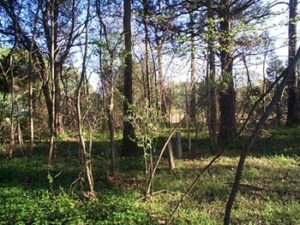
- Name and location of the property: The property known as the Cashion and Moore Family Cemetery is located northwest of the intersection of McAuley Rd. and Hwy. 73, near Davidson, N.C.
- Name, address and telephone number of the present owner of the property: The owner of the property is:
Hugh Allen White and Laura Anne White
PO Box 1431
Huntersville, NC 28070-1431
- Representative photographs of the property: This report contains representative photographs of the property.
- A map depicting the location of the property: This report contains maps which depict the location of the property. The U.T.M. coordinates of the property are 17 519842E 3922531N
- Current Deed Book Reference to the property: There is no individual deed recorded on the property. The property was willed to the White’s by their father. The Tax Parcel Number of the property is : 007-451-01.
- A brief historical sketch of the property: This report contains a brief historical sketch of the property.
- A brief physical description of the property: This report contains a brief physical description of the property.
- Documentation of why and in what ways the property meets criteria for designation set forth in N.C.G.S. 160A-400.5:
- Special significance in terms of its history, architecture, and /or cultural importance: The Commission judges that the property known as the Cashion and Moore Family Cemetery does possess special significance in terms of Charlotte-Mecklenburg. The Commission bases its judgment on the following considerations:
- The Cashion and Moore Family Cemetery is representative of burial practices of a certain strata of early white settlers in the region.
- The Cashion and Moore Family Cemetery is a rare survivor of a family burial ground in the Davidson vicinity.
- The Cashion and Moore Family Cemetery contains an instructive collection of early and mid-19th century funerary art.
- Integrity of design, setting, workmanship, materials, feeling, and/or association: The Commission contends that the physical description included in this report demonstrates that the Cashion and Moore Family Cemetery meets this criterion.
- Ad Valorem Tax Appraisal: The Commission is aware that designation would allow the owner to apply for an automatic deferral of 50% of the Ad Valorem taxes on all or any portion of the property which becomes a designated “historic landmark.” The total amount of acres in the tract of land on which the Cashion and Moore Family Cemetery is located is 69.81. The total appraised value of the Tax Parcel is $20,288. The property is zoned R3.
Date of Preparation of this Report: December 18, 2005.
Prepared by: Dr. Dan L. Morrill
Historical Overview
Summary Statement of Significance
Though not well kept or preserved over the years, the Cashion and Moore Family Cemetery, also known as the Rocky River Baptist Church Cemetery, is representative of burial practices of a certain strata of early white settlers in the region. At this writing there is reason to believe that the Cashion and Moore Family Cemetery is a rare survivor of what was essentially a family burial ground in the Davidson vicinity. The cemetery contains a small but instructive collection of early and mid-19th century funerary art. Until now the cemetery has survived largely because it has been hidden from public view. As development comes ever nearer, the site is worthy of protection as an important link to Mecklenburg County’s earliest white settlers.
Historical Context Statement
One can best understand the historical significance of the Cashion and Moore Family Cemetery by considering its place within the society and culture that emerged in Mecklenburg County with the arrival of white settlers. A fundamental transformation of the Yadkin-Catawba territory occurred in the 18th century when the era of Native American domination of the region came to a precipitous end. European civilization became predominant within a very few years. The initial white settlers drove their covered wagons into the Carolina Piedmont in the 1740s, mostly along ancient Indian trading paths. First in a trickle then a virtual flood, these immigrants, who were mostly from Pennsylvania, Maryland, and Delaware, came swarming down the Great Philadelphia Wagon Road to establish farms and homestead. Unlike the white traders who had preceded them, these families planned to stay.1
Most of the pioneers who moved into the Piedmont in the mid-1700s were Scots-Irish Presbyterians or German Lutherans. About 250,000 Scots-Irish immigrated to the New World in the first quarter of the 18th century, most entering through Philadelphia, Baltimore, or Lewes, Delaware. Learning that the land near the coast was already taken, the former residents of Ulster trekked inland and created farms until they reached the Alleghany Mountains. They then turned south and began filtering into Virginia and the Carolinas. Although both arrived in the Yadkin-Catawba region during the same years, the Germans and the Scots-Irish did not live side by side but settled in separate church-centered communities, the former along Buffalo Creek in what is now Cabarrus County and the latter in the southern reaches of the Catawba territory along the banks of Mallard Creek, Reedy Creek, Sugar Creek, Long Creek and the Catawba River. The population of Mecklenburg County reached 11,395 in 1790.
The great majority of the early settlers of Mecklenburg County scratched out a meager living in the fields they labored to keep free from unwanted trees. Almost all of their humble log dwellings have long succumbed to insects or the hands of man. These subsistence farmers grew what they ate and made what they wore. The staple crop they raised on the land they owned or rented was corn, either eaten directly or indirectly after it had been used as fodder for the animals, mainly pigs. Some farmers did raise livestock that they turned loose to graze on the open range of the Piedmont and herded periodically for drives to coastal markets. Some corn was distilled into whiskey and sold. But most settlers knew nothing about commercial agriculture. They were poor and malnourished. Infectious diseases like measles, influenza, whooping cough, and dysentery could easily take anyone away. The Cashion and Moore Family Cemetery most probably contains the grave of at least one child.2
The invention of the cotton gin in 1793 was a transforming event for Mecklenburg County and the entire South. Thereafter, farmers could ship about twelve times as much cotton to market than they could before, and the world price decreased by approximately one half. This meant that industrious individuals, even in the Piedmont, who owned substantial amounts of land and the requisite labor supply could increase their annual income by 600 percent. One such enterprising person was Thomas Cashion, a native of Chesterfield County, Virginia, who moved with his wife, children, and cousins to Mecklenburg County in 1800 or 1801.3
Most slave owners in Mecklenburg County, like their counterparts elsewhere in the South, owned relatively small numbers of bondsmen and bondswomen. “In rough terms,” states Peter Kolchin, “about one-quarter of Southern slaves lived on very small holdings of 1 to 9.” The percentage in such peripheral cotton growing areas as Mecklenburg County was even higher. The majority of Mecklenburg farmers simply did not have enough money to compete with the planter elite. Representative of this sizeable group was Thomas T. Sandifer , a physician, whose house still stands on Moore’s Chapel Road.
|
| This is the Thomas T. Sandifer House. The Cashion Plantation House might have resembled this structure since Sandifers and the Cashions came from the same social strata. |
In 1860, Sandifer’s “personal estate was worth $7,000.00, and he held three slaves,” writes historian Frances P. Alexander. “Sandifer’s slaves included two men, ages 33 and 20, and one woman age 31.” The relationship of Sandifer and his slaves would have been personal and intimate. “On farms with fewer than ten slaves,” says Kolchin, “masters could typically be found in the field, toiling alongside their slaves while bossing them and casually interacting with them.”
The Cashion and Moore Family Cemetery
Thomas Cashion (sometimes spelled Cashon) was born in 1758 and married Tabitha Traylor in 1780, by whom he had 8 children. Thomas was a member of the Virginia militia in the American Revolutionary War and fought at Portsmouth, Camden, and Gum Springs. It is reasonable to infer that Thomas Cashion became a slave owner of modest economic means. At the time of his death in December 1834 he willed to his son Thomas “the plantation on which I live,” “the negro Janet” to his son Joby, and $30 each to his grandchildren. Even the family burial ground, in which he and Tabitha Cashion are buried (she died in 1844) bears witness to the fact that Cashion did not belong to the planter elite. The grave markers, although distinctive, are much less ornate than those found in the John Dinkins Family Cemetery in southern Mecklenburg County, for example.4 Dinkins owned 34 slaves. There are seven graves in the Cashion and Moore Family Cemetery, four of which belong to the Cashions. In addition to the graves of Thomas and Tabitha, their daughter-in-law Sarah Cashion is interred there as well as their granddaughter Sarah L. Cashion.5 The other three belong to the Moores, most likely members of Rocky River Baptist Church.6 At least one of the graves is that of a young girl, based on name and age at time of death. According to Allen White, a direct descendent of Thomas and Sara Cashion, Thomas Cashion first became aware of the attractiveness of the land in this area because he traveled through Mecklenburg County during the American Revolutionary War. He purchased the farm on which the cemetery is now located in 1802. White conjectures that the cemetery was initially a family burial ground and later was used by Rocky River Baptist Church, which led to the Moores being buried in the cemetery.7
Physical Description


The property known as the Cashion and Moore Family Cemetery is located northwest of the intersection of McAuley Rd. and N. C. Highway. 73, near Davidson, in Mecklenburg County, North Carolina. It is hidden from the road by a grove of trees. At this writing, it is next to a white house that is a private residence on an adjacent parcel of land not owned by the owners of the cemetery.
 |
 |
| Intersection of McAuley Rd. and Highway 73 |
Grove of Trees surrounding Cashion Cemetery |
The cemetery is situated on a relatively flat parcel among a grove of trees, and there is no formal entrance. It is most accessible from the west. The Cashion and Moore Family Cemetery is laid out like most cemeteries of the period. The headstones face east (roughly) toward the rising sun. The graves are arranged in rows roughly running north/south with the burial plots parallel to one another. All the graves have headstones and footstones. They are meager in design and do not have elaborate carvings. The majority are simple rectangular slabs of stone with information about the deceased providing the only decoration. Two of the headstones have the decendent’s name carved out in the shape of an arch.
The simple design of the funerary art suggests that the Cashions were not among the planter elite of Mecklenburg County. Cultural folklorist Wade B. Fairey writes: “Besides the cost of carving, there was a hauling fee and other funeral costs. Therefore, for those few people who could erect a tombstone, it became a statement of economic and social superiority, and the examples … read like a guide to the area’s social circles.”8 There are trees that have grown over burial plots, and the roots have undermined some of the headstones. There is a thick covering of vines on the ground of the cemetery. These vines often obscure the footstones. The dates of death on the headstones range from 1834 to 1854, with Thomas Cashion being the first interred.
The Cashions who are buried on the plot are in the easternmost row of the cemetery. Thomas Cashion’s grave is located farthest south, then Tabitha Cashion’s, wife of Thomas Cashion, then Sarah L. Cashion’s, wife of Thomas Cashion Jr., and then Sarah Cashion’s, Thomas’s and Sarah’s granddaughter, moving northward. Thomas Cashion’s grave also has a marker at his footstone erected by the D.A.R. for his service in the Virginia Militia. It is unclear when this marker was placed at the grave, though it is less worn than any of the other gravestones. It was probably erected in the early 1900s. The graves of the Moore children are in their own row located to the west of the Cashion family row. These headstones are in much greater disrepair than those of the Cashion family and are mostly undermined by tree roots.
 |
 |
| Graves of the Cashions |
Graves of the Moores |
 |
 |
| Thomas Cashion’s Headstone. |
Tabitha Cashion’s Headstone |
.
 |
 |
| Thomas Cashion served in the Virginia militia during the American Revolutionary War. |
This marker was erected by the Daughters of the American Revolution, most likely in the early 1900s. |
- The information in this report is largely taken from Morrill Book/Index.htm Information is also taken from Kylene Edson, “Survey and Research Report on the Cashion and Moore Family Cemetery,” December 16, 2005.
- This conjecture also results from the fact that the Moore graves are smaller than the Cashion graves.
- The estimation of the date Thomas Cashion arrived in Mecklenburg County is based upon investigations on the internet, see http://archiver.rootsweb.com/th/read/NCMECKLE/1998-02/0888715965; http://archiver.rootsweb.com/th/read/NCMECKLE/1998-03/0889375694;and http://www.rootsweb.com/~ncomgs/cemetery1.htm Other cemeteries in northern Mecklenburg County include:
Bethel Presbyterian Church Cemetery
Bethesda Methodist Church Cemetery
Cook’s Memorial Presbyterian Church Cemetery
Davidson College Cemetery
Davidson Family Cemetery
Gilead A.R.P. Church Cemetery
Hopewell Presbyterian Church Cemetery
Robin S. McGee Cemetery
Ramah Presbyterian Church Cemetery
Trinity Methodist Church Cemetery
- The most noteworthy and talented early stone cutters in Mecklenburg County were the Bighams. Residents of the Steele Creek community of Mecklenburg County, the Bighams carved stones of intricate design, including elaborate coats of arms. One can find Bigham stones in places such as the Dinkins Family Cemetery and the cemeteries of Hopewell Presbyterian Church and Steele Creek Presbyterian Church.
- This information has been provided by descendant. He is Stephen Allan Patrick, PO Box 23118 Johnson City TN 37614.
6. At this writing the history of Rocky River Baptist Church remains undetermined. One could assume that the burial ground was originally intended for church members and later became more directly associated with the Cashion family. For details see http://cmstory.org/cemetery/details.asp?id=38. One of the Moore gravestones is for Juleann Moore. Another is for Mary R. Moore.
- Interview of Allen White by Dr. Dan L. Morrill (December 20, 2005).
- Wade B. Fairey, “The Changing York County, South Carolina, Tombstone Business, 1750-1850,” Journal of Early Southern Decorative Arts, Vol. XVI, No. 2, Nov. 1990.

This report was written on January 28, 1976
Click here to view Charlotte Observer Article on the John Price Carr House
1. Name and location of the property: The property known as the J. P. Carr House is located at 200-206 N. McDowell St., Charlotte, N.C. 28204.
2. Name, addresses, and telephone numbers of the present owners and occupants of the property:
The official records of Mecklenburg County indicate that the present owner of the property is:
Mr. and Mrs. Wiliam R. Lee, Sr.
R.F.D. 7 Box 837
Charlotte, N.C. 28213
Telephone: 596-8682
The present occupants of the property are:
Mr. Walter Smith, Resident Manager
204 N. McDowell St.
Charlotte, N.C. 28204
Telephone: 332-4525
Mr. Edward Morrison, Tenant
Mr. Jim Miller, Tenant
Mr. James Robertson, Tenant
Mr. Craig Brown, Tenant
Mr. Charles Harton, Tenant
3. Representative photographs of the property: Representative photographs of the property are included in this report.
4. A map depicting the location of the property: A map depicting the location of the property is included in this report.
5. Current Deed Book Reference of the property: The most recent reference to this property is found in Deed Book 3720, Page 27, as filed in the Mecklenburg County Registry. The Parcel number of the property is: 08009301 (Handwritten revision to 08009308)
6. A brief historical sketch of the property:
The house was erected in 1904 by John Price Carr. The son of Thomas Milton Carr ( a minister in the Methodist church ) and Rebecca Price Carr, he was born on November 25, 1854, near the present site of Trinity Methodist Church on the Beatties Ford Rd. Forced by the death of his father to leave school at an early age, Mr. Carr contributed to his family’s upkeep by hauling lumber in his native Hopewell Community. Through this and other enterprises he acquired a keen business sense which was to serve him well in adult life.

Mr. John Price Carr
On February 14, 1878, (Valentine’s Day) Mr. Carr married Anna Eliza Little, daughter of William Price and Hannah Sifford Little. Mr. Little, who had served in the Confederate Army, was a farmer and a former sheriff of Mecklenburg County. As newlyweds Mr. and Mrs. Carr rented the John McIntyre Log Cabin as their initial abode. For several years Mr. Carr and his older brother engaged in the raising and selling of cattle. Mr. Carr’s business activities, however, expanded into other pursuits. He secured an interest in H. M. Bassamon & Co., a firm which operated a cotton gin in Charlotte. Mr. Carr sold his interest in this enterprise on September 11, 1891. But the farm boy from Hopewell, now 36 years old, must have realized that the city was the place of greatest financial opportunity.

The John McIntyre Log Cabin, the first home of Mr. John Price Carr and his wife Anna Eliza Little Carr.
On November 17, 1891, Mr. Carr began to assemble what eventually became a large tract of land to the northeast of the intersection of N. McDowell St. and E. Fifth St. Shortly after purchasing the final portion of the tract on February 15, 1895, Mr. Carr established his residence at what was then 903 Myers St., soon to be re-named E. Fifth St. From here he also operated a moving company, the enterprise which was to become his vocation for the remainder of his life. Obviously, he had selected this property because of its suitability for his business activities. Barns and other outbuildings were constructed behind the dwelling to house the mules and the equipment necessary to sustain the enterprise.
The single-story frame structure which housed the Carr family was becoming increasingly crowded with the birth of additional children. The fifth and last child, Annie Price Carr, was born in 1898. In 1904 Mr. Carr moved the family “up the hill” to their “new spacious house” at 200 N. McDowell St, “on the outskirts of Charlotte.” Mr. Carr personally supervised the construction of the house. To this task he brought an impressive array of skills. Because his company had already moved several houses in the City, Mr. Carr had a firm grasp on the principles of sound construction. Having worked in the lumber trade as a boy, he appreciated the aesthetic qualities of wood. Understandably, most of the lumber used in the house was cut in Hopewell and brought to Charlotte in Mr. Carr’s wagons. His administrative and financial skills enabled him to got the most for his money. The workmen who erected the house were paid by the day.
Not surprisingly, Mr. Carr selected the Queen Anne Style for his home. This was the most fashionable style of domestic architecture in Charlotte during the late 1800’s and early 1900’s, and by selecting it Mr. Carr no doubt sought to demonstrate to the community that his family had secured substantial status.
In subsequent years Mr. Carr continued to demonstrate that he was a man of substance and character. His business thrived. Replacing mules and wagons with an impressive collection of specialized vehicles, Mr. Carr became the local expert on moving heavy equipment. He transferred the presses of the Charlotte Observer from the railroad depot to the newspaper’s headquarters. He moved buildings of all types, sizes, and shapes. He played a major part in transporting materials to the site of Camp Greene. More routine business operations also occupied a considerable portion of his time. He was the major deliverer of merchandise which arrived at the Seaboard and Southern railway stations in transit to local merchants.
Mr. Carr was more than a successful businessman. He contributed greatly to the improvement of the community in which he resided. From 1905 until 1907 he served as the representative of First Ward on the Charlotte Board of Aldermen. He was a member of the Executive Committee of the Democratic Party in Mecklenburg County. He was a trustee of the Carnegie Public Library, the forerunner of the Charlotte-Mecklenburg Public Library. For 42 years he participated in the activities of the Second Presbyterian Church, which later served an the nucleus of the Covenant Presbyterian Church of today. He was ordained a deacon, April 3, 1910, and an elders June 29, 1913. He served on building, finance, and other committees and was a leader in the Sunday School program.
Mr. Carr’s most lasting contribution, however centers around his efforts to rescue Presbyterian Hospital from oblivion. In July 1917, Presbyterian Hospital, then located at W. Trade and Mint Sts., stood on the brink of collapse. A fire had seriously damaged its facilities. Indeed, the patients were temporarily housed on the second floor of a downtown building. The Board of Directors of the Hospital, of which Mr. Carr was a member, held an option to purchase the vacated facilities of Elizabeth College for $225,000, A campaign to raise the funds, however, was $40,000 short, and the option was about to expire. Mr. Carr and four other men personally underwrote a loan for the necessary $40,000. With considerable justification one can claim that without John Price Carr there would be no Presbyterian Hospital today.
Pneumonia ended the life of John Price Carr. He died on April 7, 1927, in the hospital which he had done so much to save. The funeral services were conducted at the home by Dr. A. A, McGeachy, pastor of the Second Presbyterian Church. Mr. Carr is buried in Elmwood Cemetery.
Mrs. Carr remained at the homeplace until 1951, when she sold the house to Mr. and Mrs. William R. Lee, Sr., and moved with her youngest daughter and her son-in-law to 111 Hermitage Rd. She died in 1956. Mrs. Annie Price Carr Wurzburg, the only surviving child of Mr. and Mrs. John Price Carr, lives with her husband on Hermitage Rd. She remembers her father as a loving and kind man who displayed throughout his life the highest ethical standards.
Mr. and Mrs. Lee lived in the Carr House for several years. More recently, they have rented the house to male boarders. The house was moved slightly in the late 1960’s to make way for a modification in the route of E. Fifth St.
Although current rumor suggests that the City of Charlotte has purchased the house under the auspices of the Community Development Department, the official records of Mecklenburg County indicate that this transaction has not been consummated.
7. A brief architectural description of the property: An architectural description of the property is appended to this report.
8. Documentation of why and in what ways the property meets the criteria set forth in N. C. G. S. 160A-399.4:
a. Historical and cultural significance: The historical and cultural significance of the property known as the J. P. Carr Home rests upon two factors. First, the evidence suggests that Mr. Carr mas a man of substantial significance in the history of Charlotte. Second, the house is one of the finest examples of the Queen Anne Style of domestic architecture in this city. It is certainly the most significant Victorian structure in the entire First Ward.
b. Suitability for preservation and restoration: A brief investigation suggests that the house is structurally sound. The exterior is beginning to show evidence of some structural decay. However, the house can be restored. And it is worth noting that it is still serving as a viable dwelling.
c. Educational value: The structure is located in an area of high visibility. Consequently, it can serve as a valuable tool for making the local citizenry more aware of its architectural history. Moreover, the career of Mr. Carr could interest a number of people in the history of Charlotte at the turn of the century.
d. Cost of acquisition, restoration, maintenance, or repair: The Commission has no intention of purchasing this property. It does, however, believe that the property can be adapted to a use which will justify the cost of restoring and maintaining the structure.
e. Possibilities for adaptive or alternative use of the property: As suggested above, the Comission sees this structure as well suited for adaptive use. Located near the Governmental Plaza, the house has interior spaces which could be adapted to a wide variety of uses.
f. Appraised value: The 1975 appraised value of the structure itself is $6,230.00. The appraised value of the land is $22,440.00. The Commission is aware that designation of the property would allow the owner to apply for a special property tax classification.
g. The administrative and financial responsibility of any person or organization willing to underwrite all or a portion of such costs: As indicated earlier, the Commission has no intention of purchasing this property. Furthermore, the Commission assumes that all costs associated with the structure will be met by whatever party now owns or will subsequently own the property.
9. Documentation of why and in what ways the property meets the criteria established for inclusion on the National Register: The Commission believes that the property known as the J. P. Carr House does meet the criteria of the National Register of Historic Places because of its architectural merit and because of its association with an individual of outstanding local historical significance.
10. Documentation of why and in what ways the property is of historical importance to Charlotte and/or Mecklenburg County: The property known as the J. P. Carr House is significant to the history of Charlotte because of its architectural merit and because of the historical accomplishments of its builder, Mr. Carr, by saving Presbyterian Hospital from oblivion, made a momentous contribution to the life of this community.
Bibliography
An Inventory of Older Buildings In Mecklenburg County And Charlotte For The Historic Properties Commission.
Interview with Mrs. Annie Price Carr Wurzburg (December 18, 1975).
Records of the Mecklenburg County Register of Deeds Office.
Records of the Mecklenburg County Tax Office.
The Charlotte Observer (July 26, 1917).
The Charlotte Observer (April 8, 1927).
The Charlotte Observer (January 26, 1936).
Date of Preparation of this report: January 28, 1976
Prepared by: Dan L. Morrill, Director
Charlotte-Mecklenburg Historic Properties Commission
Telephone: 332-2726
Architectural Overview
At 200 North McDowell Street cornering on East Fifth Street is the turn of the century late Queen Anne style residence known as the “Carr House.” This house is highly visible to Charlotteans since it is located on the perimeter of the bustling governmental plaza area of the Queen City. The architecture of the house offers such variety and intriguing detail that most local residents, as well as chance visitors, are drawn to lingering study of the charm of the house as they drive by.
An important outgrowth from the Philadelphia Centennial Exhibition in 1876 was an interest in several half timber buildings erected at the exhibition by the British Government. These buildings embodied fresh new design freedom from the traditional classical of early Victorian, and were admired by The American Builder magazine as “wonderfully adaptive to this country, offering comfort and livability”, being plain enough and yet capable of the highest ornamental development, the style was enthusiastically endorsed. This was actually a reaction against high Victorian so much in vogue during the 70’s and 80’s, and showed a renewed interest in the picturesque qualities of a more rural manner. This new style was soon developed by architects and designers into a uniquely American architecture, characterized by irregular outlines, light frame construction, steep pitched roofs, open interior spaces, and verandas and porches.
In Charlotte this style was widely used in the growing residential neighborhoods of First Ward, Fourth Ward and along the affluent blocks of Tryon and Trade Streets. Only here and there are remaining vestiges of these lovely old Charlotte neighborhoods, and the Carr House is a fine example of this heritage.
The exterior illustrates the extraordinary plan irregularity with two story, gabled wings extending boldly from each axis. Across the front and curving down each side of the front bay, and sheltering the main entrance and a lesser side door is an expansive porch covered with a low tin roof. This porch is supported by delicate paired Doric wood columns set on solid panelled pedestals. While Queen Anne was the popular style of the late nineteenth century, and the Carr House an outstanding example of the style at the turn of the century designers were looking back with some nostalgia to colonial architecture. These porch columns show evidence of this nostalgic look backward and presage the coming colonial revival of the early twentieth century. Some interior work also reflects this influence.
The house rests on a solid red brick foundation wall interrupted at regular intervals by glazed, wood frame foundation vents. The entire exterior is covered with narrow horizontal beveled weatherboards. Starting above a molded drip cap over the foundation wall the siding rises to a wide molded frieze. At a moderately wide second floor roof overhang the cornice is defined with carefully molded cove and crown trim, and built-in concealed gutters blend into the overhang configuration. This molded roof overhang band is a strong design element which serves to unify the elaborate exterior massing – carrying as it does across the gable faces and segmenting the oval tower which accents the street corner facade. This turreted tower rises well above the main roof line and creates a lofty focal point. It is sheathed with narrow, tight green “fish scale” wood shingles through its full height. Queen Anne design popularly faced rounded turrets to street corners, and this house was precisely proper in this respect. It is worthy of note that of the several extant Queen Anne houses in Charlotte all have, or at one time had, street corner towers.
The four main roof gables are covered with similar wood shingles and each is pierced by a large bulls eye gable window with glazed fan lights and trimmed with wooden voussoirs at quarter points in the circle.
The front bay wing has angled corners with narrow high windows in the angles at each floor. The gable wall frames above this bay create angular canopies over the corner windows and are decorated with suspended beaded grill work and turned, drop pendants. Windows are all large double hung, weight balanced single units, each sash with one large undivided glass. Over the massive panelled entrance doors at the front and side the frames are topped with finely detailed stained glass leaded transom windows. The many surfaced roof is covered with square edge slate shingles interrupted at mid slope with several courses of rounded ‘fish scale’ units. At the crown of each gable rake and at the main, hipped center ridge the roof is topped with molded cresting.
On the Fifth Street side a recessed veranda adjoins the rear kitchen. This porch offered an outside summer dining or screened sitting area and provided a screened and sheltered service entrance. The veranda has been, at some past time, solidly enclosed and is no longer open. However, some of the original diagonal screen slats and other trim remain.
Once inside the front door the elegance of the fine original oak millwork is immediately apparent. From a large hall, panelled and trimmed with golden oak, one is led through wide pocket doors to a formal parlor at the front, to a large dining room toward the rear, or to a private hall leading to family sitting rooms and bed chambers adjoining the side entrance. Rising from the other side of the entrance hall three flights of stairs lead to the second floor. In all important first floor rooms there are delicately crafted oak mantels with beveled oval or rectangular mirrors in over-mantels. These mantels are all classical in design, Georgian as well as Adam, and feature small glazed Italian tile in remarkably good condition. All rooms on the first floor are uniformly finished with warm oak wainscoting, elaborate door and window millwork, and were unstintingly trimmed by highly skilled craftsmen. Built-in window-seats, glass door cupboards and small storage cabinets were inserted in numerous nooks and crannies.
On the second floor a carefully finished hall, again wainscoted with the same fine oak, meanders about as it leads to various bed chambers, all of which are richly decorated and above whose doors high transom windows flood the hall with natural light.
The house embodies an exciting array of the best of Queen Anne detailing. Without exception the exterior escapes any chance of monotony, and the interior includes a high degree of elaboration. The design could be called an essential treasure in Charlotte’s architectural heritage and the need for its preservation is absolutely undeniable.
The HPC will likely be a party to any plans for the building, and it is suggested that immediate contact with the local authority having jurisdiction be considered.
JOHN PRICE CARR HOUSE
The Carr House, 200-206 N. McDowell St., located across the street from Charlotte’s main post office, was erected in 1904 by Mr. John Price Carr, and was designated historic by City Council on July 28, 1980. The house is also listed in the National Register of Historic Places. The son of Thomas Milton Carr, a minister in the Methodist Church, and Rebecca Price Carr, John Price Carr was born on November 25, 1854, near the present site of Trinity Methodist Church on Beatties Ford Road. Forced by the death of his father to leave school at an early age, Mr. Carr contributed to his family’s upkeep by hauling lumber in his native Hopewell Community. Through this and other enterprises he acquired a keen business sense which was to serve him well in adult life.
On February 14, 1878, Mr. Carr married Anna Eliza Little, daughter of William Price and Hannah Sifford Little. Mr. Little, who had served in the Confederate Army, was a farmer and a former sheriff of Mecklenburg County. As newlyweds Mr. and Mrs. Carr rented the John McIntyre Log Cabin as their initial abode. For several years Mr. Carr and his older brother engaged in the raising and selling of cattle. Mr. Carr’s business activities, however, expanded into other pursuits. He secured an interest in H. M. Bassamon & Co., a firm which operated a cotton gin in Charlotte. Mr. Carr sold his interest in this enterprise on September 11, 1891. But the farmboy from Hopewell, now 36 years old, must have realized that the city was the place of greatest financial opportunity.
On November 17, 1891, Mr. Carr began to assemble what eventually became a large tract of land to the northeast of the intersection of N. McDowell St. and E. Fifth St. Shortly after purchasing the final portion of the tract on February 15, 1895, Mr. Carr established his residence at what was then 903 Meyers St., soon to be re-named E. Fifth St. From here he also operated a moving company, the enterprise, which was to be his vocation for the remainder of his life. Obviously, he had selected this property because of its suitability for his business activities. Barns and other outbuildings were constructed behind the dwelling to house the mules and the equipment necessary to sustain the enterprise.
The single-story frame structure which housed the Carr family was becoming increasingly crowded with the birth of additional children. The fifth and last child, Annie Price Carr, was born in 1898. In 1904, Mr. Carr moved the family “up the hill” to their “new spacious house” at 200 N. McDowell St. “on the outskirts of Charlotte.” Mr. Carr personally supervised the construction of the house. To this task he brought an impressive array of skills. Because his company had already moved several houses in the City, Mr. Carr had a firm grasp on the principles of sound construction. Having worked in the lumber trade as a boy, he appreciated the aesthetic qualities of wood. Understandably, most of the lumber used in the house was cut in Hopewell and brought to Charlotte in Mr. Carr’s wagons. His administrative and financial skills enabled him to get the most for his money. The workmen who erected the house were paid by the day.
Not surprisingly, Mr. Carr selected the Queen Anne Style for his home. This was the most fashionable style of domestic architecture in Charlotte during the late 1800’s and early 1900’s, and the style is anything but monotonous. With its magnificent streetcorner tower, four gables, shaped shingles, high hipped roof, stained glass windows, porch, and colunms, the Carr house is a visual treasure in an area now dominated by concrete and glass. Downstairs, the house featured a large entry hall, panelled and trimmed with golden oak, a formal parlor, a kitchen, a large dining room, several sitting rooms and bedrooms and three flights of stairs leading to the second floor. Nearly every room in the house featured a fine oak mantel with a beveled oval or rectangular mirror in an over-mantel. The mantels were all classical in design, Georgian as well as Adam, and featured small glazed Italian tile in remarkably good condition. Built-in window-seats, glass door cupboards, and small storage cabinets were inserted in numerous nooks and crannies in the house. oak wainscoting, and elaborate door and window millwork, were trimmed by highly skilled craftsmen. Transom windows were over the doors.
In subsequent years Mr . Carr continued to demonstrate that he was a man of substance and character. His business thrived. Replacing mules and wagons with an impressive collection of specialized vehicles, Mr. Carr became the local expert an moving heaving equipment. He transferred the presses of the Charlotte Observer from the railroad depot to the newspaper’s headquarters. He moved buildings of all types, sizes and shapes. He played a major part in transporting materials to the site of Camp Greene. More routine business operations also occupied a considerable portion of his time. He was the major deliverer of merchandise which arrived at the Seaboard and Southern railway stations in transit to local merchants. Mr. Carr was more than a successful businessman. He contributed greatly to the improvement of the community in which he resided. From 1905 until 1907 he served as the representative of First Ward on the Charlotte Board of Aldermen. He was a member of the Executive Committee of the Democratic Party in Mecklenburg County. He was a trustee of the Carnegie Public Library, the forerunner of the Charlotte-Mecklenburg Public Library. For 42 years he participated in the activities of the Second Presbyterian Church, which later served as the nucleus of the Covenant Presbyterian Church of today. He was ordained a deacon, April 3, 1910, and an elder, June 29, 1913. He served on building, finance and other committees and was a leader in the Sunday School program.
Mr. Carr’s most lasting contribution, however, centers around his efforts to rescue Presbyterian Hospital from oblivion. In July 1917, Presbyterian Hospital, then located at W. Trade and Mint Streets, stood on the brink of collapse. A fire had seriously damaged its facilities. Indeed, the patients were temporarily houses on the second floor of a downtown building. The Board of Directors of the Hospital, of which Mr. Carr was a member, held an option to purchase the vacated facilities of Elizabeth College for $225,000. A campaign to raise the funds, however, was $40,000 short, and the option was about to expire. Mr. Carr and four other men personally underwrote a loan for the necessary $40,000. With considerable justification one can claim that without John Price Carr there would be no Presbyterian Hospital today.
Pneumonia ended the life of John Price Carr. He died on April 7, 1927, in the hospital which he had done so much to save. The funeral services were conducted at the home by Dr. A. A. McGeachy, pastor of the Second Presbyterian Church. Mr. Carr is buried in Elmwood Cemetery.
Mrs. Carr remained at the homeplace until 1951, when she sold the house to Mr. and Mrs. William R. Lee, Sr., and moved with her youngest daughter, Mrs. Annie Price Carr Wurzburg, and her son-in-law to 111 Hermitage Road. The stalwart Mrs. Carr didn’t want to move and it is reported that the movers had to carry her, sitting in her rocking chair, from the home where she had lived for half a century. Mrs. Carr died in 1956. Mrs. Wurzburg described the house where she grew up as “always a happy place, very full of life. Papa and Mama did so much entertaining. It was quite a grand place … quite the biggest in the neighborhood. It really was a wonderful place to grow up.”
Mr. and Mrs. Lee lived in the Carr House for several years. The house, moved slightly in the late 1960’s to make way for a modification in the route of E. Fifth Street, was later rented out to male boarders. The house fell into disrepair in the 1970’s and was purchased by the Community Development Department of the City of Charlotte. The Charlotte-Mecklenburg Historic Landmarks Commission, and Dr. Dan L. Morrill, worked with Mr. T. Bragg McLeod, owner of Moss Trucking Company and McLeod Trucking and Rigging Company, to save the house. Renovation of the house took more than eighteen months to complete and cost over $400,000. Under the direction of architect Jim Johnson and with the aid of interior designer Nancy Thomas and the Andrew Roby Co., the house was painstakingly restored to its original grandeur. Mr. McLeod took a special interest in the property due to the fact that Mr. Carr had been in the heavy moving business as he is.
Mr. McLeod’s nationally known companies have handled nuclear generators, textile machinery, entire plants, and structural steel. The companies have gained wide recognition for hauling Tweetsie to Blowing Rock, a Sherman tank to Charlotte’s Freedom Park and the nation’s 60- foot Christmas tree from North Carolina to the White House lawn in 1972. On March 17, 1981, dedicatory ceremonies were held for the opening of the renovated John Price Carr House. The conversion of the house by Mr. McLeod into offices necessitated the construction of a parking lot on the northern side and to the rear of the house. Great care was taken to preserve the “feeling” of the front yard and those portions of the back yard which were not dedicated to parking. No major changes to the property have occurred since 1981. Today, the Carr House is a living reminder of Charlotte’s romantic Victorian heritage. It provides contemporary Charlotte an elegant link to its architectural past and the history of a major industry.
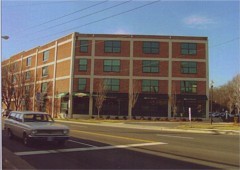
Carolina Transfer and Storage Building
- Name and location of the property. The property known as the Carolina Transfer and Storage Building is located at 1230 West Morehead Street in Charlotte, North Carolina. UTM Coordinates: 17 512562E 3898260N
- Name, address and telephone number of the present owner of the property.
The present owners of the property are:
suite # name
102 Edward Lee Harris
104 West End Development Associates LLC
106 Fergusson Nye LLC
108 Team Lighting LLC
110 Eubert Wesley McLeod Jr.
112 Eubert Wesley McLeod Jr.
114 Patricia A. Ganster
116 Robert Trevor Williams
202 Edith R. Saxton
204 Neighboring Concepts LLC
206 B & P Holdings LLC
208 Thomas Investments LLC
210 Neighboring Concepts LLC
212 Gary N. Wirth
214 DRG Properties LLC
302 Thomas Michael Todd
304 West End Development Associates LLC
306 Off Third Properties LLC
308 Bobby M. Morrison
312 West End Development Associates LLC
402 Keith Properties Inc.
404 Twelve Thirty W. Morehead LLC
406 Wilhelm Hedrich
The mailing address for each of the above owners is 1230 W. Morehead St., suite # ___, Charlotte, North Carolina, 28208.
- Representative photographs of the property. This report contains representative black and white photographs of the property. Color slides are available at the Charlotte-Mecklenburg Historic Landmarks Commission office.
- Maps depicting the location of the property. This report contains two maps depicting the location of the property.
- Current deed book reference to the property. The most recent deeds to this property are recorded in the Mecklenburg County Register of Deeds Office:
unit # tax parcel # Deed Book/Page
102 733-244-25 11244 / 767
104 733-244-26 11298 / 917
106 733-244-47 11148 / 353
108 733-244-27 11156 / 399
110 733-244-28 11175 / 968
112 733-244-29 11175 / 968
114 733-244-30 11305 / 440
116 733-244-31 11210 / 536
202 733-244-32 11220 / 401
204 733-244-33 11306 / 680
206 733-244-34 12126 / 328
208 733-244-35 11240 / 152
210 733-244-36 11306 / 697
212 733-244-37 11152 / 220
214 733-244-38 10983 / 176
302 733-244-39 12744 / 001
304 733-244-40 11298 / 917
306 733-244-41 10958 / 082
308 733-244-42 11494 / 822
312 733-244-43 11298 / 917
402 733-244-44 10972 / 382
404 733-244-45 10928 / 225
406 733-244-46 11163 / 157
- A brief historical sketch of the property. This report contains a brief historical sketch of the property.
- A brief architectural description of the property. This report contains a brief architectural description of the property.
- Documentation of why and in what ways the property meets criteria for designation set forth in N. C. G. S. 160A-400.5.
- Special significance in terms of its history, architecture, and/or cultural importance. The Commission judges that the property known as the Carolina Transfer and Storage Building does possess special significance in terms of Charlotte-Mecklenburg. The Commission bases its judgment on the following considerations:
1) The four-story fireproof warehouse was built in 1926 using the state-of-the-art “flat-slab” construction method. This technique uses concrete slab floors supported by distinctive mushroom columns. The configuration allowed for a more open floor plan without sacrificing strength–particularly desirable for a storage facility. The concrete and brick elements were left exposed, and thus the construction method is clearly reflected in the design of the building. The Carolina Transfer and Storage building is a good, intact example of a flat-slab warehouse building from the 1920s.
2) The Carolina Transfer and Storage building reflects the boom years of
the 1920s in Charlotte and the consequent need for businesses of every kind to meet the demands of the new economy. It was one of the first to be erected on West Morehead Street west of the Southern Railway tracks–an area that quickly developed into a commercial and light industrial corridor. Carolina Transfer and Storage was a family business that supported four generations of Wilkinson family members.
- Integrity of design, setting, workmanship, materials, feeling and/or association. The Commission contends that the physical and architectural description which is included in this report demonstrates that the Carolina Transfer and Storage Building meets this criterion.
- Ad Valorem tax appraisal. The Commission is aware that designation would allow the owner to apply for an automatic deferral of 50% of the Ad Valorem taxes on all or any portion of the property which becomes a designated “historic landmark.” The current appraised values are as follows:
unit # land building total value
102 $ 70,000 $ 134,800 $ 204,800
104 70,000 82,730 152,730
106 75,000 112,260 186,260
108 75,000 250,510 325,510
110 75,000 244,380 319,380
112 60,000 52,860 112,860
114 75,000 187,070 262,070
116 78,000 308,310 386,310
202 75,000 159,640 234,640
204 80,000 396,900 476,900
206 60,000 65,010 125,010
208 75,000 250,510 325,510
210 75,000 202,890 277,890
212 75,000 86,590 161,590
214 75,000 259,850 334,850
302 75,000 152,490 227,490
304 85,000 615,450 700,450
unit # land building total value
306 $ 75,000 $ 250,510 $ 325,510
308 75,000 203,570 278,570
312 75,000 83,890 158,890
402 75,000 152,490 227,490
404 85,000 373,220 458,220
406 80,000 378,280 458,280
The property is zoned URC.
Date of preparation of this report: January 7, 2002
Prepared by:
Mary Beth Gatza
428 N. Laurel Avenue, #7
Charlotte, NC 28204
(704) 331 9660
STATEMENT OF SIGNIFICANCE
The Carolina Transfer and Storage building is historically and architecturally significant to Charlotte. The four-story, all-masonry warehouse was built in 1927 using state-of-the-art warehouse design concepts. It was constructed using the “flat-slab” technique, which consists of continuous concrete slab floors supported by mushroom columns. This method was particularly well-suited for storage facilities because it allowed for a more open floor plan without sacrificing weight capacity. The construction method is evident in the design of the Carolina Transfer and Storage building. The concrete frame, slabs and columns were all left exposed, though the wall surfaces were infilled with brick (exterior) and terra cotta (interior). Having this new, modern, fireproof building enabled the company to expand its business.
Carolina Transfer and Storage was founded in 1922 by three brothers–Fabius A., John L. and W. D. Wilkinson. The company was wholly family-owned and operated, and over the years employed four generations of the Wilkinson family (as well as some non-related workers). The building was one of the first to be erected on West Morehead Street west of the Southern Railway tracks (beyond Mint Street), which quickly developed into a commercial and light industrial corridor. It reflected Charlotte’s growth in population and economic activity, and the consequent need for businesses of every variety to meet the demands of the new economy.
HISTORICAL SKETCH
Overall economic and demographic trends favored the business climate in Charlotte during the 1920s. The United States census counted 46,388 people living in Charlotte at the beginning of the decade, and 82,675 people in 1930–an increase of seventy-eight percent, or 36,287 people.1 According to data collected by Miller Press (publishers of the annual city directory), about 6,000 of the new residents arrived between 1926 and 1927 2–just as Carolina Transfer and Storage was expanding its facilities. Drawing on information from the Standard Statistics Company of New York, an April 1928 newspaper article declared that “the volume of business in Charlotte for the month was reported to be 80 percent above the average for 1920-1924.”3 Undeniably, an increase in people and businesses in the area provided a larger customer base for the transfer and storage industry in Charlotte. In 1920, there were seven such companies listed in the city directory under the heading “transfer.” By 1930, there were eighteen companies listed.4
The location on West Morehead Street was within the city limits in the mid-1920s, although it had not yet been fully developed. The nearby neighborhood of Wesley Heights, located just north of this area, had opened in 1921.5 When it was built in 1927, Carolina Transfer and Storage was the last (westernmost) building on West Morehead Street. The only neighbors were a small commercial structure across the street and a similar warehouse, the Union Storage and Warehouse Company, two blocks to the east. West Morehead Street developed steadily over the next few decades, filling in and pushing westward to its junction with Wilkinson Boulevard.6 The West Morehead Street location had the advantage of being close to the city and convenient to the newly-opened Wilkinson Boulevard,7 North Carolina’s first state highway. Additionally, the site was equipped with a Piedmont and Northern Interurban Railway spur line, so freight arriving by rail could be handled easily. The P & N, as it was informally referred to, was a light rail system between Charlotte and the textile mills of Gaston County to the west.
Carolina Transfer and Storage was a local company owned and operated by members of the Wilkinson family. W. H. Wilkinson (1847-1928) brought his wife, Marya Caldwell (1852-1928) and children to the Paw Creek section of Mecklenburg County from Catawba County around 1890.8 After reaching adulthood, all five of their sons relocated to Charlotte.9 In 1922, three sons, Fabius A. (1877-1945), William D. (1879-1946) and John L. (1886-1952) joined together to establish Carolina Transfer and Storage Company.10
The first president of the company was William D. Wilkinson. He was married to Ida Lenora Saine in Paw Creek on April 25, 1906, and they moved to Charlotte shortly thereafter. In 1908 he was working as manager and treasurer for the Carolina Realty Company. By 1916, he was serving as president of that company and had also branched out into the insurance business, forming the firm of Wilkinson and Lee with a partner, B. P. Lee. That was a short-lived business, but by 1922, he and his brothers had established Carolina Transfer and Storage Company. William D. Wilkinson served as president from 1922 through the early 1930s, when he moved to Columbia, South Carolina. He died there in 1946, survived by his wife, Lenora and son, William D. Wilkinson, Jr.11
John L. Wilkinson first appeared in the Charlotte city directory in 1907 (the same year his brother W. D was first listed). A year later, in 1908, he married Louise M. Bradley (1889-1951). He worked for a time with J. W. W. Sons Company, but became secretary of the Cochran and Ross livery stable by 1918. In addition to stabling horses, Cochran and Ross provided transfer, moving, packing and storage services around this time. Perhaps his exposure to the business convinced John that profits could be made, though motor trucks were fast replacing horse-drawn wagons. John served as vice-president of Carolina Transfer and Storage from its founding in 1922 until his brother stepped down in 1934. At that time, John assumed the role of president, a post which he held until 1950 when his health failed. John was undeniably active in business and civic affairs. His obituary lists his many activities, including memberships in the Charlotte Traffic and Transportation Club, the Charlotte Executives Club and the American Trucking Association (board of directors). He served as Charlotte City Councilman (1935-1941) and Mayor Pro Tem and was chairman of the Charlotte Chamber of Commerce transportation committee. Additionally, he was president of the National Furniture Warehouse Association, Allied Van Lines, and North Carolina Motor Carriers Association. John died in 1952, survived by a two daughters and a son, John L. Wilkinson, Jr. His son and two sons-in-law all had long careers at Carolina Transfer and Storage.12
Fabius A. Wilkinson joined his younger brothers in forming the Carolina Transfer and Storage Company in 1922. Apparently he did not move to Charlotte that early, but probably remained a county resident through the late 1920s. He was a vice-president in the family business through 1934, after which time he served as treasurer. He died in 1945. His two sons, Clyde L. and William E., both worked for Carolina Transfer and Storage.13
The second generation of Wilkinsons to run the family business included children of four of the five original brothers.14 Brothers Augustus M. “Gus” (1872-1957) and Mack R. (1896-1918) did not work for the company, but their sons did. In all, the second generation included: Ray S. and Adrian M. (sons of Gus), Clyde L. “Dick” and W. E. (sons of Fabius), John L. Jr. (son of John L.), E. R. Brietz and F. H. McNeely (sons-in-law of John L.), and Mack R. and Charles R. (sons of Mack R.).15 Some had brief tenures and entry-level jobs, while others had long careers and high positions.
The third generation of Wilkinsons to work in the company included two family members.16 Robert W. was Adrian’s son (and Gus’s grandson), while and W. E., Jr. was W. E.’s son (and Fabius’s grandson).17 Robert W.’s son, Robert L., also worked for the company briefly in the mid-1950s, thus representing the fourth generation of Wilkinsons at Carolina Transfer and Storage.18
Carolina Transfer and Storage was a success from the start. They were located downtown initially, and apparently recognized the need for a new modern warehouse building a mere four years after establishing the business. The Charlotte News announced in 1926 that “what is believed to be the largest single contract for moving ever executed in Charlotte was signed Friday afternoon by John L. Wilkinson, of the Carolina Transfer and Storage Company, and…Southern Railway Lines” for relocating the Southern Railway offices. The lot on West Morehead Street was purchased in September 1926, and just two weeks later, they applied for a building permit. The plan was drawn by an engineer, G. T. Barnes. The building was constructed quickly, and was open for business by early February 1927.19 The “flat-slab” construction method was state-of-the-art for warehouses during the early-twentieth century, and the new facilities allowed the company to offer expanded services. In 1924, their city directory entry said simply, “hauling, moving and packing.” But in 1927, after the new building opened, they boasted “transfer, hauling, moving, packing and bonded warehouse.” Thus, the building enabled storage to become a significant component of the business. The all-masonry building was hailed as being fireproof–a feature that would constitute a competitive advantage in the storage business. In fact, they touted the fact that the place was both bonded (insured) and fireproof directly on the building. The West Morehead Street facade was originally a blank wall which was painted with a full-sized advertisement for the company. Along with the telephone number (#609), it read:
“CAROLINA TRANSFER & STORAGE CO.
MOVING–PACKING–STORING
Bonded FIRE-PROOF Warehouse”20
In time, the advertisement would change, and a 1948 photograph shows that the size of the advertisement had grown to accommodate a picture if a delivery truck, but still included the words “BONDED FIREPROOF WAREHOUSE.”21 By that time, Carolina transfer and Storage had become affiliated with Allied Van Lines, a national company.22
Over the decades, the principals of the Carolina Transfer and Storage Company aged and died off. The business dwindled and finally closed sometime during the 1970s. The property was renovated and converted to office suites with individual ownership (office condos) in 1999. The Carolina Transfer and Storage building was listed on the National Register of Historic Places in 1999.
ARCHITECTURAL DESCRIPTION
Setting
The Carolina Transfer and Storage Building is located on the north side of West Morehead Street, in the 1200 block, about a mile from the center of Charlotte. This section of West Morehead Street contains primarily commercial and light industrial structures dating from the middle decades of the twentieth century. Morehead Street, which runs generally northwest to southeast, curves to the west in this section. It intersects the side streets here at an angle, and thus the Carolina Transfer and Storage Building lot is an irregular polygon shape. The Morehead Street side of the otherwise rectangular lot slants at an angle of about fifty degrees. The building occupies the front half (approximately) of the lot, and the rear (north) portion of the lot is paved and used for parking. The main facade (south elevation) abuts West Morehead Street, the west elevation stands along Calvert Street, the north elevation opens up to the parking lot, and the east elevation is next to the driveway and parking lot. Beyond the lot lines, commercial and light industrial buildings line West Morehead and Calvert Streets, and the I-77 off-ramp borders the property on the east side.
Description
The Carolina Transfer and Storage Building is a four-story all-masonry warehouse building constructed in 1926 (photo #1). The building’s footprint conforms to the shape of the lot and is therefore an irregular polygon–that is, a rectangle with one side deeply slanted at an angle of about a fifty-degrees. The building materials are reinforced concrete, brick and terra cotta tiles. Thus, the building was constructed to be fireproof, which was an important quality for safeguarding the contents stored inside.
The construction method used in the Carolina Transfer and Storage Building is called the “flat-slab” technique. The framing is made entirely of poured, reinforced concrete. The floors are continuous thin slabs of concrete resting on round columns. The columns are flared at the top, thus enlarging the surface area which supports the weight above it (photo #8). This distinctive shape is called a “mushroom” column and is particular to this method of construction. For further stabilization, a square concrete pad, called a “drop panel” lies between the column and the slab. With this method, only the slab itself separates the floors–the floor of one level is the ceiling of the level below.
The flat-slab construction method was developed simultaneously by Swiss and American engineers in the first decade of the twentieth century. Robert Maillart (1872-1940), is credited for inventing the method around 1900, although his first flat-slab building (the Beschellschaft Company warehouse in Zurich, Switzerland) wasn’t built until 1910.23 Meanwhile, in America, Claude A. P. Turner filed a patent for the technique in 1908.24 The primary benefit of the system is that it eliminates the need for beams and girders to support the floors, thereby saving space and materials. Also, compared to earlier methods, it supports a greater amount of weight while allowing for a more open interior.25 This is an obvious advantage for a warehouse building.
The flat-slab construction method is reflected in the design of the Carolina Transfer and Storage Building. The horizontal and vertical components (slabs and columns) of the concrete frame are visible on the exterior of the building. The spaces between them are filled in with terra cotta tiles (on the interior) and brick (on the exterior), and pierced by industrial steel sash windows. The concrete pilasters on three sides (north, west and south) have simple molded capitals (photo #5). The shortest side of the building is the east elevation–it has only four bays (photo #1). The main facade (the south, or Morehead Street side) has a shallow stepped parapet concealing the building’s flat roof (photo #6). There is a double-door entrance in the center of this seven-bay facade. A similar door is located on the north elevation, which also has seven bays (photo #2, #3). On the north elevation, six of the bays are fenestrated, with original industrial steel sash windows. The seventh (westernmost) bay is solid, and in fact protrudes higher than the rest of the building. It holds the elevator shaft and stairwell.
Alterations
Originally, only the north and south sides of the building were fenestrated. There were no windows on the east and west sides, probably reflecting that the need for wall space on the interior was greater than the need for illumination. The south side directly abutted a spur line of the Piedmont and Northern Railway. This elevation was solid above the first story, and had three recessed truck bays on the ground floor. While fine for a warehouse, this arrangement was not as suitable for modern uses. When the building was converted to office space in 1999, the ground floor was filled in with large, multi-paned windows, and the upper stories were pierced with windows that closely resemble the original windows. Likewise, the west elevation was fitted with new windows. Except for the window openings, no other original material has been removed. The integrity of the structure is good.
On the interior, as befitting a warehouse, the building was originally one large open space. New walls and doors were added in the process of subdividing the building for office space. The old freight elevator was replaced by a bank of two modern elevators for safety and convenience. A hallway now runs off of the elevator lobby, through the center of the building, angling off to the left and branching off to the right, accessing the various office suites. There are presently twenty-three office suites ranging from 775 to over 6,000 square feet in size. All of the original wall surfaces and mushroom columns were left exposed and unchanged. Mechanical systems (HVAC and electrical) were run along the ceiling and are also exposed–hiding them would have required that a drop ceiling be added, which would have concealed the concrete slab construction.
- LeGette Blythe and Charles R. Brockmann, Hornet’s Nest: The Story of Charlotte and Mecklenburg County (Charlotte: McNally of Charlotte, 1961), p. 449; Thomas W. Hanchett, Sorting Out the New South City: Race, Class and Urban Development in Charlotte, 1875-1975 (Chapel Hill: University of North Carolina Press, 1998), p. 2.
- The Charlotte News, 16 April 1927, p. 11.
- The Charlotte Observer, 21 April 1928, p. 11.
- Charlotte City Directories, 1920 and 1930.
- Gatza, Mary Beth, “Wesley Heights Historic District,” Nomination to the National Register of Historic Places (1995), p. 7-2.
- Charlotte City Directories, various years after 1927;Sanborn Map Company, “Insurance Maps of Charlotte, North Carolina,” 1929 and 1951.
- Wilkinson Boulevard was named after W. C. Wilkinson, who was not a member of this family.
- The Charlotte Observer, 20 April 1928, p. 1;Moore’s Chapel Methodist Church, cemetery roster (electronic record found at www.cmstory.org);United States Census, North Carolina, Catawba County, 1880 (soundex).
- Charlotte City Directories, various years after 1902;The sons are: Augustus M. Wilkinson (1872-1957), Fabius A. Wilkinson (1877-1945), William D. Wilkinson (1879-1946), John L. Wilkinson (1886-1952) and Mack R. Wilkinson (1896-1918).
- Charlotte City Directories, various years after 1922.
- Mecklenburg County Marriage License, 23 April 1906; Charlotte City Directories, various years after 1907; United States Census, North Carolina, Mecklenburg County, 1900 and 1910; The Charlotte Observer, 7 April 1946, p. B-2;
- Mecklenburg County Marriage License, 15 August 1908; Charlotte City Directories, various years after 1907; United States Census, North Carolina, Mecklenburg County, 1910 and 1920; Blythe and Brockmann, Hornet’s Nest, p. 452; The Charlotte Observer, 25 June 1952, p. 16-B.
- Mecklenburg County Marriage License, 6 November 1901; Charlotte City Directories, various years after 1921; United States Census, North Carolina, Mecklenburg County, 1900; The Charlotte Observer, 14 January 1945, sec. 2, p. 4.
- Charlotte City Directories, various years after 1921.
- Ray (1920-1996) was a driver in the mid-1940s; Adrian was a driver in the mid-1950s; Dick (1904-1960) was assistant manager around 1930 and secretary from the mid-1930s through the mid-1950s; W. E. (1904-1990) retired after forty-five years with the company, first as warehouse manager and later as president; John was vice-president in the mid-1940s through the mid-1960s and was president in the early 1970s; E. R. Brietz was treasurer from the mid-1940s through the early 1970s; F. H. McNeely was secretary from the mid-1940s through the early 1970s; Mack retired after forty-one years, rising from clerk to warehouse manager; Charles worked there from the mid-1940s through the mid-1950s.
- Charlotte City Directories, various years after 1921.
- Robert W. was and was employed as a driver and warehouseman from around 1930 through the mid-1960s; W. E. Jr. was vice-president in the 1960s.
- Charlotte City Directories, various years after 1921; The Charlotte Observer, 2 July 1976, p. 21-A.
- Charlotte City Directories, various years after 1921; The Charlotte News, 9 October 1926, p. 12, 6 February 1927, p. 7-C; Charlotte Building Standards Department, Building Permit #7193, 5 October 1926.
- The Charlotte News, 6 February 1927, p. 7-C.
- Charlotte Chamber of Commerce, “Charlotte, North Carolina: Focal Point of the Carolinas,” booklet, c. 1948. On file in the Carolina room at the Public Library of Charlotte and Mecklenburg County.
- Charlotte City Directories, various years after 1927.
- Carl W. Condit, American Building: Materials and Techniques From the Beginning of the Colonial Settlements to the Present. (Chicago: The University of Chicago Press, 1982), p. 243; Aly Ahmed Raafat, Reinforced Concrete in Architecture. (New York: Reinhold, 1958.), pp. 75-76; John Fleming, Hugh Honour and Nickolaus Pevsner, A Dictionary of Architecture. (New York: Penguin Books, 1977), pp. 183-84.
- Condit, American Building, p. 243; Mattson, Alexander and Associates, Inc. “(Former) Carolina Transfer and Storage Building.” Nomination to the National Register of Historic Places (1998), p. 8-2.
- Condit, American Building, p. 243; Charles Merrick Gay, John W. MacGuire and Harry Parker, Materials and Methods of Architectural Construction, 3rd ed. (New York: John Wiley & Sons, 1958), pp. 598-601.

The Carolina Theater as it is now

Carolina Theater in 1946

Carolina Theater, interior, 1946
Click here to view Charlotte Observer Article on the Old Carolina Theatre
This report was written on Sept. 1, 1982. An addendum written on April 1, 2000 follows.
1. Name and location of the property: The property known as the Old Carolina Theater Building is located at 224-232 N. Tryon St. in Charlotte, N.C.
2. Name, address and telephone number of the present owner and occupant of the property:
The present owner of the property is:
John H. Cutter, et. al.
204 Latta Arcade
Charlotte, N.C., 28202
Telephone: 704/332-4975
(Bryant W. Cutter Real Estate)
The only present occupant of the property is: Ace Shoe Repair
230 N. Tryon St.
Charlotte, N.C.
Telephone: 704/333-3648
3. Representative photographs of the property: This report contains representative photographs of the property.
4. A map depicting the location of the property: This report contains a map which depicts the location of the property.
5. Current Deed Book Reference to the property: The most recent deed to this property is recorded in Mecklenburg County Deed Book 3514 at Page 215. The Tax Parcel Number of the property is 080-011-01.
6. A brief historical sketch of the property:
The Carolina Theater opened on March 7, 1927, when Warren Ervin, who managed the Carolina for the Publix Theaters Corporation, welcomed the large audience that came to see “A Kiss In A Taxi,” starring the “ever popular” Bebe Daniels. 1 The Carolina also presented Miss Fae Wilcox at the Wurtlitzer Organ, accompanying a program of novelty slides. 2 “The beautiful organ loft gives the appearance of one of the castles of old times,” the Charlotte Observer proclaimed. 3 Features ran for only three days, and on Thursdays, Fridays, and Saturdays, the B. F. Keith Vaudeville Troupe performed on the stage. 4
During the 1920’s, lavish cinema palaces were constructed throughout the United States. 5 “We sell tickets to theaters, not movies,” said Marcus Loew, head of the Loew’s chain. 6 Architects for these movie houses were free to borrow from various historical motifs and to employ ostentatious ornamentation, because their mandate was to provide an opera house for the masses. “No kings or emperors have ever wandered through more luxurious surroundings. In a sense, those theaters are a social safety valve in that the public can partake of the same luxuries as the rich, and use them to the same full extent, ” one designer explained. 7 The architects of the Carolina Theater were New Yorker R. E. Hall and C. C. Hook of Charlotte. 8
A native of Wheeling, W. Va., and graduate of Washington University, Charles Christian Hook (1870-1938) had moved to Charlotte in 1891 to teach in the Charlotte Public Schools and had established his architectural practice a year later, when Edward Dilworth Latta, president of the Charlotte Consolidated Construction Company, had hired him to design houses in Dilworth, Charlotte’s first streetcar suburb. 9 From these modest beginnings, Hook went on to establish a distinguished professional reputation as a leading architect of the two Carolinas. Among the imposing edifices in Charlotte that Hook designed was the Academy of Music Building on S. Tryon St., a turn-of-the-century opera house. 10 Consequently, it was logical that Publix Theaters, which also managed the Imperial and the Alhambra Theaters in Charlotte, would call upon Hook’s expertise when planning the Carolina. 11 The J. A. Jones Construction Company began building the lavish movie palace in March 1926.12
Publix Theaters selected architectural styles that it deemed appropriate for the different regions of the country. Accordingly, the Carolina, a Southern theater, emphasized Mediterranean motifs. “All the best in art and architecture from the various countries bordering on this sea of famed blue are combined in a harmonious assemble,” the Charlotte Observer explained. 13 Wrought-iron chandeliers, exterior balconies, and ticket booth suggested the Spanish Renaissance, as did the decorative tile on the roof and on the floor of the lobby. The overall decor of the lobby reminded one of a Venetian palace. 14 Draperies were imported from France. 15 “For sheer splendor and luxury it is a creation that will provoke admiration throughout the theatrical world,” a reporter predicted when writing about the impact of the completion of the Carolina. 16
The Piedmont Realty and Development Company, headed by John Hastings Cutter (1878-1958), owned the Carolina Theater. A native of Barnesville, Ga., Cutter had come to Charlotte in 1905 and had entered the textile and cotton exchange business. Subsequently, he became active in commercial real estate, including the Citizens Hotel Company, which erected the Hotel Charlotte on W. Trade. 17 Cutter also made major contributions to charitable and religious institutions. He was a founder of the Charlotte Community Chest, a member of the board at Old St. Peter’s Hospital, and a devoted communicant at St. Peter’s Episcopal Church. 18 The Carolina Theater underwent a major renovation in 1961, when it became the Carolinas home of Cinerama. Indeed, the original ornamentation inside the building was sacrificed to a “modern, suburban” look; and the projection booth was moved to the main floor. 19 The last hurrah for the Carolina came in the mid 1960s. “The Sound of Music” played to 398,201 people during its run there from March 31, 1965, until October 4, 1966. 20 On November 17, 1965, Joseph M. Sugar, vice president of 20th Century Fox, presented a certificate to theater manager Kermit High, celebrating that the Carolina was the first theater to show “The Sound of Music” to more people than lived in the community in which the theater was located. 21 To say the least, the once-proud Carolina Theater has fallen on hard times in recent years. It outlasted all other uptown movie houses, but even the Carolina could not overcome the changing lifestyle of middle class Charlotteans. It closed on November 27, 1978, after showing “The Fist,” starring Bruce Lee. 22 Fire struck the rear of the building on November 13, 1980. 23 The offices on the second floor, which once housed physicians and dentists, are now vacant; and only one store remains at street level. The future of this grand old movie palace is uncertain at best. 24
Notes
1 Charlotte Observer, “Carolina Theater Section” (March 6, 1927), pp. 1,2, & 11.
2 Charlotte Observer (March 5, 1927), p. 14.
3 Charlotte Observer, “Carolina Theater Section” (March 6, 1927), p. 2.
4 Ibid., p. 10.
5 For a comprehensive overview of movie theater architecture, see Ben M. Hall, The Best Remaining Seats: The Story Of The Golden Age Of The Movie Palace (Clarkson N. Potter, Inc., New York, 1961), and David Naylor, American Picture Palaces: The Architecture Of Fantasy (Van Nostrand Reinhold, New York, Cincinnati, Toronto, London, Melbourne, 1981).
6 Naylor, p. 11.
7 Ibid., p. 31.
8 Charlotte News (March 22, 1926), p. 5A. Building Permit #6752 (Charlotte Building Inspection Department).
9 Charlotte News (May 20, 1891), p. 1. Charlotte News (September 17, 1938), p. 12.
10 Charlotte Observer (September 8, 1902), p. 5. The architectural firm of Hook and Sawyer designed the Charlotte Academy of Music Building.
11 Charlotte Observer (March 5, 1927), p. 14.
12 Building Permit #6752 (Charlotte Building Inspection Department).
13 Charlotte Observer “Carolina Theater Section” (March 6, 1927), p. 10.
14 Ibid.
15 Ibid., p. 6.
16 Ibid., p. 10.
17 John Hastings Cutter’s Certificate of Death (Mecklenburg County Public Health Department). Charlotte News (July 11, 1958), Sec. 2, p. 1.
18 Charlotte Observer (July 11, 1958), Sec. B., p. 1. This article contains a photograph of John Hastings Cutter.
19 “Carolina Theater” (A Folder in the Vertical Files of the Carolina Room of the Charlotte-Mecklenburg Public Library.
20 Ibid.
21 Ibid.
22 Ibid.
23 Charlotte Observer (November 14, 1980), p. 1-A.
24 Miller’s Official Charlotte, N.C. City Directory (Miller Press, Asheville, N.C., Vol. XXX, 1930), p. 1232.
7. A brief statement of the architectural significance of the property: This report contains a brief statement of the architectural significance of the property prepared by Thomas Hanchett, architectural historian.
8. Documentation of why and in what ways the property meets the criteria set forth in N.C.G.S. 160A-399.4:
a. Special significance in terms of its history, architecture, and/or cultural importance: The Commission judges that the property known as the Old Carolina Theater Building does possess special historic significance in terms of Charlotte-Mecklenburg. The Commission bases its judgment on the following considerations: 1) it is the only extant building in Charlotte-Mecklenburg which once served as a lavish movie palace; 2) it was designed by the architectural firm of Hook and Sawyer, and C. C. Hook was an architect of enormous importance in this community; 3) J. H. Cutter, the owner of the property, was an important figure in business and civic affairs in Charlotte-Mecklenburg.
b. Integrity of design, setting, workmanship, materials, feeling and/or association: The Commission judges that the exterior of the Old Carolina Theater Building does retain its integrity; also, the Commission judges that the property continues to make an important contribution to the N. Tryon St. streetscape.
9. Ad Valorem Tax Appraisal: The Commission is aware that designation would allow the owner to apply for an automatic deferral of 50% of the Ad Valorem taxes on all or any portion of the property which becomes “historic property.” The current Ad Valorem tax appraisal of the .416 acres of land is $181,350. The current Ad Valorem tax appraisal of the building is $30,880. The total Ad Valorem tax appraisal is $212,230. The property is zoned B3.
Bibliography
Charlotte News.
Charlotte Observer.
Ben M. Hall, The Best Remaining Seats: The Story Of The Golden Age Of The Movie Palace (Clarkson N. Potter, Inc., New York, 1961).
Miller’s Official Charlotte, N.C. City Directory (Miller Press, Asheville, N.C., Vol. XXX, 1930).
David Naylor, American Picture Palaces: The Architecture Of Fantasy (Van Nostrand Reinhold, New York, Cincinnati, Toronto, London, Melbourne, 1981).
Records of the Charlotte, N.C., Building Inspection Department.
Records of the Mecklenburg County Public Health Department.
Records of the Mecklenburg County Register of Deeds Office.
Records of the Mecklenburg County Tax Office.
Vertical Files in the Carolinas Room of the Charlotte-Mecklenburg Public Library.
Date of the Preparation of this Report: September 1, 1982
Prepared by: Dr. Dan L. Morrill, Director
Charlotte-Mecklenburg Historic Properties Commission
3500 Shamrock Dr.
Charlotte, N.C. 28215
Telephone: 704/563-2307
Architectural Description
by Thomas W. Hanchett
The 1927 Carolina Theater is a good example of an early twentieth century “movie palace”, the last surviving theater in downtown Charlotte, North Carolina. The building’s plan combines a restrained Classical Revival decorated theater with rental retail and office space along the two street fronts. The exterior makes use of four separate architectural styles, applied like stage sets to create the illusion that the structure is four separate buildings.
The Carolina Theater is located on North Tryon Street, the city’s main street, at the corner of Sixth Street. The building consists of two-story block containing three major components. On Tryon Street is a two-story block containing the theater lobby and large retail spaces on the ground floor, with office space above. Behind it is a taller brick mass containing the theater seating, with three tiny storefronts nestled into the Sixth Street side. At the back is the tallest unit, the stage house which holds the stage and its paraphernalia.
The block fronting on Tryon Street has the most architecturally elaborate exterior. It is divided into three distinct units, each with its own architectural theme. At the street corner is the first “building with a stuccoed exterior of Spanish origin, a style chosen by architects R. E. Hall and C.C. Hook because it supposedly reflected the theater’s Southern location. Its curved-top corner parapets, tile false roof with sculpted eaves of stucco, pilasters, and arched windows with one remaining false balcony of iron are all hallmarks of the Spanish Colonial style.
The second “building” of the front is the smallest, but the most opulently decorated because it is the theater entrance. It is faced with carved stone and has a glass and steel cantilevered marquee. The architectural style is hard to pin down, for it borrows the Spanish tile roof of the first “building” and also incorporates a Classically inspired modillion cornice and oversized swag molding. The primary architectural influence, however, can be identified as Art Nouveau, because of the curved cornice and lintels, the curving wooden tracery in the transoms above the second floor windows, and the generally playful feeling of the oversized stone ornament. Art Nouveau was just emerging as the new style for storefronts at the end of the 1920s when the Carolina Theater was constructed, but never reached widespread popularity due to the Depression’s curtailment of building activity.
The third “building” is faced with stone and brick in what architectural historian Marcus Whiffen has termed the Jacobethan style. It combines motifs from the Jacobean and Elizabethan eras in England, probably chosen by Hall and Hook for its association with Shakespeare. Particularly distinctive are the flat arched windows framed by alternating bands of brick and stone. The first floor shopfront has been altered over the years: in fact, none of the original Tryon Street shopfronts survive today.
On the Sixth Street side of the theater the exteriors of the seating block and the stage house have been treated as a single architectural unit, the fourth “building”. Its red brick massing conveys a robust functionalism, with hints of Classical decoration. At either end of this facade two story office/exit units pop out of the main mass of the building, joined by a one-story row of small stores. Above these, a steel stairway from the theater balcony cascades down the side of the building. Second floor windows in the office units have blind brick arches with Classically inspired keystones, springers, and sills of concrete, and there is a concrete medallion over each storefront. The simple wooden shopfronts survive much as they were when the theater was built.
One entered the theater itself from Tryon Street through the long, narrow lobby, which was decorated in the Venetian style according to contemporary newspaper accounts. The body of the theater, with its large balcony, had Classical Revival pilasters and moldings of plaster. This may be the mark of architect C.C. Hook, a local champion of the Classical and Colonial Revivals. Old photos indicate the theater was quite grand, though considerably more dignified than the gaudy opulence of some of the era’s best known “movie palaces”, like the Fox Theater in Atlanta.
There has been little change in the spatial configuration of the lobby and theater over the years, but a significant amount of ornament was destroyed in a 1960s remodeling. The proscenium arch remains but the pilasters that visually supported it were sacrificed to a wider movie screen. According to Bruce Keith, of David Furman Architects, who has been inside recently, the low relief plasterwork remains largely intact, and there are enough remnants of the larger pieces to accurately recreate them if desired.
Addendum to the Survey and Research Report on the Carolina Theater
1. Name and location of the property: The property known as the Carolina Theater is located at 222 North Tryon Street in Charlotte, North Carolina.
2. Name and address of the present owner of the property:
City of Charlotte
600 East Fourth Street
Charlotte, NC 28202
3. Representative photographs of the property: This addendum contains representative photographs of the property.
4. Maps depicting the location of the property: This addendum contains a map depicting the location of the property.
� 5. Current deed book reference: The most recent deed to the property is recorded in Mecklenburg County Deed Book 6303, page 619. The tax parcel number for the property is 080-011-10.
6. A brief architectural description of the property: This addendum contains an architectural description of the building’s interior.
7. Ad Valorem Tax Appraisal: The current total Ad Valorem tax appraisal of the .416 acres of land and the building is $2,358,510.00.
8. Date of Preparation of this Addendum: April 1, 2000
9. Prepared by:Emily Ramsey
745 Georgia Trail
Lincolnton, NC 28092
Historical Overview
The Carolina Theater, completed in 1927, is the last remaining “movie palace” in center city Charlotte. The theater, which opened as a Publix Theater franchise for vaudeville entertainment and silent movies, was designed by R. E. Hall and Charlotte architect C. C. Hook as an “atmospheric theater.” Hall and Hook, under direction of Publix Theaters, used a variety of Mediterranean and Spanish motifs to reflect the theater’s Southern location. In its heyday, the Carolina Theater was host to prestigious stars such as Elvis Presley, Bob Hope, Guy Lombardo and Ethel Barrymore; “Gone With the Wind” premiered in the Carolinas at the Carolina Theater, and in the mid-1960s, over 398, 201 people (more than the entire population of Charlotte) flocked to the Carolina to see “The Sound of Music” on the only Cinerama screen in the Carolinas. The theater, which showed its last movie ( “The Fist”, starring Bruce Lee) on November 27, 1978, is now owned by the City of Charlotte. The Carolina Theater Preservation Society, a non-profit corporation formed in 1997, is currently leading efforts to restore the theater, which is presently unoccupied.
Architectural Description
Original Condition of the Theater
The interior of the theater is, despite its deterioration, representative of the extravagance of cinemas constructed during the 1920s across the United States. Originally, moviegoers entered from North Tryon Street into a long, narrow lobby, which, according to 1927 newspaper accounts, was designed to “suggest a Venetian palace.”� The lobby has since been demolished, physically separating the remaining facade from the theater itself. Otherwise, the spatial configuration of the theater has remained unchanged. From a promenade beyond the entrance lobby doors, one can walk down to the orchestra level or take one of two staircases leading up to a second lobby on the mezzanine level. Stairs continue upward to access the mezzanine and balcony, which originally accommodated 550 seats. The main level of the theater, the orchestra level, slopes down towards the imposing stage, which rises three stories and dominates the space.
The original design for the interior of the theater was lavish and intricately detailed, intended to give the overall effect of a Mediterranean palace and formal garden. The orchestra level of the theater formed the principal seating area, with 900 seats stretching from the promenade to the stage. The balcony, visually supported by gargolyed brackets, swept over the back of the orchestra level, creating a low ceiling lined with small, twinkling “star” lights. An orchestra pit fronted the stage. The backstage area included several upstairs and downstairs dressing rooms.
The mezzanine lobby was the most elaborate of the theater’s three lobbies.� The lobby featured low, exposed ceiling beams with geometric patterns and Art Deco style stenciling in shades of gold, green, and pink. Textured stucco walls provided a background for green and red tiled baseboards and intricate plaster rosettes and moldings. Each door in the lobby was also crowned with plaster detailing. The focal point of the mezzanine lobby was a decorative recessed arch framing a marble statue and pedestal, which sat on a stepped tiled base. A tiled cigar room for men and a women’s rest room opened off of the mezzanine lobby.�
The mezzanine and balcony levels, located directly above the mezzanine lobby, afforded the best view of the main theater space itself. The stage, framed by a proscenium arch and pilasters decorated in a colorful Spanish motif, formed the center of the space, and was flanked by two equally impressive organ chambers, which housed the pipes of the theater’s 8-rank Wurlitzer organ. The organ chambers were designed to resemble romantic window balconies ñ both were topped with an elaborately decorated arch supported by spiraling columns and framed at the bottom by a balustrade. Curtains completed the illusion and hid the bulky pipes from the audience’s view. Beyond the organ chambers, flanking the mezzanine, were intricately painted murals depicting a Mediterranean garden of dark painted cypress trees and flowering plants. When illuminated with blue lighting projected from the ceiling, these murals transformed the Carolina Theater into an outdoor pavilion. Each mural was bordered by projecting ionic pilasters; stuffed pigeons and peacocks perched from the balustrades that framed the murals closest to the stage. “Garlands of flowers, clambering vines, and masses of tropical foliages” at the base of each mural completed the outdoor illusion.�
Alterations and Current Condition of the Theater
The earliest alterations of the original interior came only a few years after the Carolina Theater opened. During its first years, the Carolina Theater was used mainly for vaudeville acts and silent movies. In the 1930s, the theater began showing movies with sound. To improve the acoustics, the walls of the theater were covered with soundboard. New murals with a slightly different design were painted on top of the soundboard that covered the original murals. Otherwise, the theater remained relatively unchanged until 1961, when a $250,000 “modernization” of the theater, including the installation of a Cinerama screen, began.� While this made the Carolina Theater the only Cinerama theater in North Carolina or South Carolina, it also damaged much of the original interior. To accommodate the new movie screen, which was much wider than the stage itself, the pilasters around the stage were removed.� The projecting capitals of the ionic pilasters flanking the theater’s murals were removed so that heavy curtains could be hung to cover the walls completely. A large portion of the mezzanine was carved out to make room for the three projectors necessary for showing Cinerama productions. The theater’s original projector room, suspended above the rear of the balcony, still remains. In the luxurious mezzanine lobby, the original stucco wall treatment was covered by a smooth white plaster. The stairs leading down to the promenade were widened, and sections of the wrought iron railing were replaced with new railing with a modern, geometric shape. The wrought iron chandeliers above the balcony were replaced with sleek, modern light fixtures. Much of the original high relief plaster detailing that had covered the theater was removed.
After the Carolina Theater closed in 1978, neglect and vandalism caused further deterioration of the original elements of the theater’s interior. A fire in 1982 badly damaged most of the stage, which was later rebuilt four feet higher than the original when developers considered incorporating the theater into City Fair. The effort to extinguish the fire dumped copious amounts of water into the theater ñ its effects can be seen most clearly on the soundboard murals.
Much of the originally opulent interior of the Carolina Theater is now gone. The floors, once covered with intricate tiled designs and plush carpets, are now bare concrete. None of the theater’s seats remain. The detailed scenes in plaster above the organ chamber and the gargoyled brackets under the balcony are gone, and crude columns have been placed beneath the balcony to provide structural support. However, important details remain, and remnants of what used to be abound. The stage’s proscenium arch, the organ chambers and balustrades, the soundboard murals (still impressive even with water-damage), and the original projection booth are all still intact. Parts of the textured stucco walls, stenciled ceiling beams, and tiled baseboards in the mezzanine lobby have been uncovered, and may possibly be restored completely. The outlines of the plaster rosettes, door crownings, and the recessed arch centerpiece of the mezzanine lobby are clearly visible, and could be recreated. The ionic pilasters framing the murals are still intact, though their capitals were damaged in the 1961 remodeling. The ceiling of the theater remains largely as it was in 1927, suffering mainly surface damage. Well-preserved plaster detailing remains on the front of the mezzanine and balcony, and much of the low relief plaster molding remains, particularly on the ceiling.
Notes
1 The Charlotte Observer. “Carolina Theater Places Charlotte in High Class As Amusement House Center” (March 6, 1927) p.10.
2� A small lobby and men’s restroom was located in the theater’s basement.
3� The Charlotte Observer, “Carolina Theater Places Charlotte in High Class. . .” p. 10.
4� Ibid.
5� The Charlotte Observer. “Cinerama Coming To Carolina Theater: Carolina’s First Due Dec. 1” (November 3, 1961). The Cinerama projected movies onto a screen with an arc of 146 degrees, created almost a complete semicircle. This type of movie screen was supposed to make the viewer feel more involved in what was on the screen.
6� Ibid.