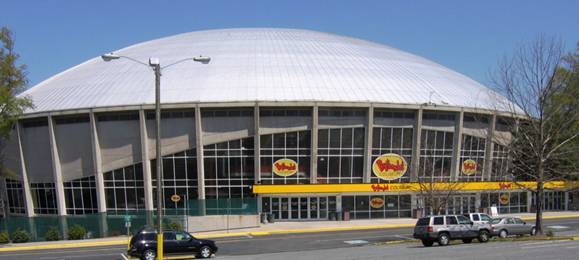
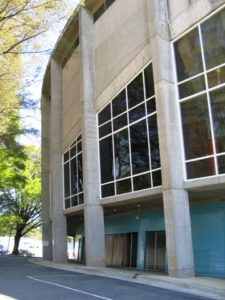
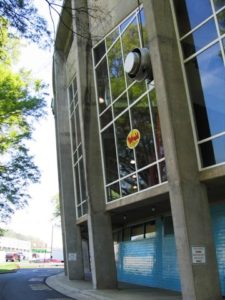
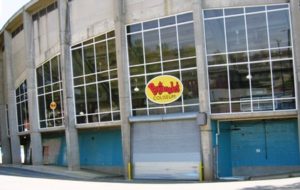
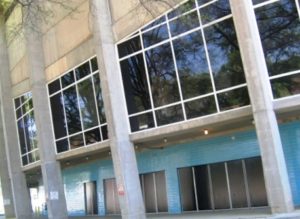
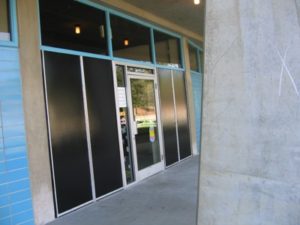
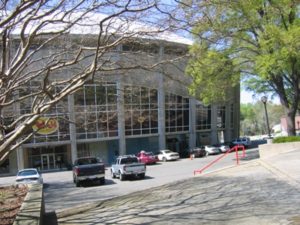
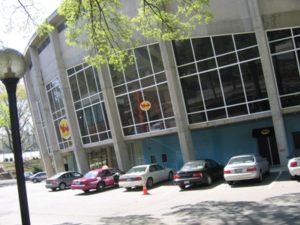
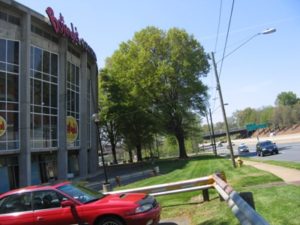
Charlotte Coliseum, photo taken in April of 2009..
- Name and location of the property. The property known as the Charlotte Coliseum is located at 2700 East Independence Boulevard in the Echo Hills neighborhood of Charlotte, North Carolina.
- Name and address of the present owner of property: The City of Charlotte, 600 E. 4th Street, Charlotte, NC 28202
- Representative photographs of the property. This report contains representative photographs of the property.
- A map depicting the location of the property. This report contains maps which depict the location of the property.
| Portion of Property Recommended for Designation |
- Current Deed Book Reference to the Property. The most recent deed to this property is listed in Mecklenburg County Deed Book 1469 at page 62. The Tax Parcel Number of the property is 159-028-01.
- A brief historical sketch of the Property. This report contains a brief historical sketch of the property prepared by Ms. Paula M. Stathakis.
- A brief architectural description of the property. This report contains a brief architectural description of the property prepared by Mr. Davis H. Liles.
- Documentation of why and in what ways the property meets the criteria for designation set forth In N.C.G.S. 160A-400.5.
- special significance In terms of its history, architecture, and cultural importance. The Commission judges that the property known as the Charlotte Coliseum does possess special significance in terms of Charlotte-Mecklenburg. The Commission bases its judgment on the following consideration: 1) the construction of the Charlotte Coliseum was completed in 1955 to provide the first single-purpose sports facility in the area; 2) the construction of the Charlotte Coliseum was the culmination of an intense fifteen year promotional effort by civic and political leaders; 3) the Charlotte Coliseum, designed by Odell & Associates, was the largest free-span dome in the world at the time it was built; 4) the Charlotte Coliseum was important for its pioneering architectural design; 5) the Charlotte Coliseum fostered major economic growth for the city at large and Independence Boulevard in particular; and 6) the Charlotte Coliseum housed a large variety of events that entertained and enriched the citizens of the City of Charlotte, Mecklenburg County and the region.
- integrity of design, setting, workmanship. materials, feeling and or association. The Commission contends that the architectural description by Mr. Davis H. Liles which is included in this report demonstrates that the Charlotte Coliseum meet this criterion.
- Ad Valorem Tax Appraisal. The Commission is aware that designation would allow the owner to apply for an automatic deferral of 50 % of the Ad Valorem taxes on all or any portion of the property which becomes a designated “historic landmark.” The current appraised value (as of April 2009) of the improvements is $14,557,300. The current appraised value of the 18.83 acres is $5,741,600. Approximately 6 acres of the property is being recommended for landmark designation. The property is zoned B-2.
- This report finds that the exterior, and land associated with the Charlotte Coliseum should be included in landmark designation of the property.
Historical Essay prepared by: Paula M. Stathakis
Date of Preparation of this Report: 30 July 1990
Updated in 2001, Lara Ramsey
Updated in April 2009, Mary Dominick
Historical Essay
by Paula M. Stathakis
Charlotte did not have a coliseum until 1955, although the need for such a facility was apparently recognized in the early 1930’s. Charlottean and civic booster Clarence Kuester was a vocal early advocate for a coliseum, but World War II prevented consideration of any such plan.1 The idea of a city coliseum and auditorium was revived in the late 1940s and was well received. Two mayors, Herbert Baxter and his successor Victor Shaw, devoted much of their energies and influence to these civic improvements.
 |
| Herbert Baxter |
In 1947, while Baxter was Mayor, a proposal to build a coliseum was introduced to the City Council. A bond referendum was scheduled for October 28. The request was for $2.5 million, but there was no plan or even a specific site. Mayor Baxter wrote a series of six articles for the Charlotte Observer in which he presented six different arguments to the effect that the project was essential for the city’s growth. Maintaining that prompt action was essential for the city’s future, he urged a positive vote. This, he promised, would be followed by quick action to create a commission to assess such questions as location, design, costs, and method of financing. The Mayor also recommended that the existing armory-auditorium (the present Grady Cole Center) be converted into a coliseum at a cost of $250,000, thus saving the city the expense of two major new buildings. Baxter insisted that two separate structures were necessary because sports events and cultural programs had very different needs. A single multi-purpose building would not suffice; a basketball game in an adjacent room would ruin the evening for theatergoers.2
The special election of October 28, 1947 presented voters with a proposal to build a municipal auditorium and civic center at a cost not to exceed $2.5 million. Mayor Baxter, who could not share with the voters any details about the buildings because there were none to share, did promise that bonds would not be issued nor would construction begin until there were favorable circumstances in the construction market and on the bond markets.3
The eligible electors totaled 4831. According to the vote-against registration law, the votes of those who were eligible but did not cast their ballots were counted as votes against the measure. The bond issue was defeated by the slim margin of 83 votes. Some supporters blamed their defeat on rainy Election Day weather, while other observers blamed the vote-against law itself.4
Perhaps the voters had failed to support the bond issue because there were too many unanswered questions about the proposal. Mayor Baxter was never able to tell Charlotteans what the $2,500,000 would buy or even the approximate location of the new facilities. His third article acknowledged that site selection was critical; easy access and ample parking were essential. It was, however, impossible to select a location before the election because there were no funds to acquire options on potential sites. The Mayor was not unduly concerned about this, arguing that there would be “plenty of time to determine the proper location after the vote is recorded.”5 On the issue of the lack of plans, Baxter maintained that it would be “illegal for the city government to spend one cent on the project until the people approve.” Since architects could not be hired, the buildings would have to remain mysteries until after the bonds were approved.6
In fact, the only thing that many Charlotte voters were sure about on October 28 was that they had to decide whether or not to spend $2.5 million. Given the many uncertainties, it is surprising that the proposal lost by only 83 votes. The next mayor, Victor Shaw, argued that the failure of the bond election was not due to “public indifference,” but was because the people would not “buy a pig in a poke.”7
Prior to the construction of the coliseum, the only comparable facility was the Armory-Auditorium on Cecil Street (now on Kings Drive). This structure was generally considered barely adequate at best. Charlotte was not able to attract high-quality entertainment because the hall was so inferior. During the next bond campaign, a newspaper article flatly stated that such celebrities as Sonja Henie, Jimmy Durante, Ray Bolger, and Danny Kay refused to book Charlotte because they would not work in the Armory-Auditorium.8
In 1949 Mayor Shaw received an unsolicited letter from self-described showman, Ned Alvord of Chicago, who had recently passed through Charlotte. Alvord told Mayor Shaw that the Armory Auditorium needed to be replaced, but that great care was essential in the design of auditoriums and theaters. Not just any architect would do, he warned. When Charlotte was ready to build, Alvord urged the city to study the “excellent municipal houses planned by those who knew their trade” in Charleston, W. Va., Louisville, Fort Worth, and San Antonio. The ending of his letter pungently describes the status of a city without an adequate public auditorium: “….For a horrible example, you only have to look at your Armory-Auditorium or recall the one uptown that preceded it.
Certainly I have an axe to grind. For some 45 years I have been a showman frequently exposed to the necessity of playing attractions in houses shunned by the solvent public because of inadequate facilities. If you have a suitable theater, it means just that more favorable reception of traveling attractions.”9
 |
| Mayor Victor Shaw |
Shaw campaigned for mayor as the man who would bring progress and development to Charlotte. His interests ranged from traffic problems and rent control to what he considered essential improvements, a civic center and a municipal auditorium. Shortly after his election in April 1949, Mayor Shaw began behind-the-scenes negotiations to secure an auditorium. The Mayor’s extensive correspondence with A. J. Gocking indicates that a group of local businessmen and the Mayor were interested in adding a city auditorium to the Oasis Temple of the Shrine on South Tryon Street. A letter from Gocking to Shaw, dated June 18, 1949 contains cryptic references to this plan, in which Frank Sherrill (co-owner of the S & W Cafeteria), Caspar Chandler, George Ivey (of Ivey’s Department Store) Norman Pease (architect), and Lee Folger were also involved. Gocking, the intermediary between this group and the Mayor, sent regular reports to Shaw from his summer home in Highlands, NC, where most of these early meetings took place. In mid-June the group unanimously agreed to locate the city auditorium at the rear of the Shrine building. The Potentate of the Shrine, however, had not yet been approached. This task was delegated to Frank Sherrill, who developed second thoughts and had to be pushed back into line by the Mayor.10
Gocking reported to the Mayor that the Potentate favored the idea, and Gocking was certain that the public would receive the plan well. “I am positive that the citizens will vote for it, if presented in the proper manner with all the cards face up.”11 By July Gocking was so confident of the plan that he wrote to Caspar Chandler that he hoped that it could be brought out in the open “for discussion by all.” Blueprints for the proposed layout were already drawn.12
Even though plans were not yet made public, the movers and shakers of Charlotte were aware that something was up. Mayor Shaw complained to Gocking that he was besieged daily by people wanting information and a chance to become involved. Murray Atkins made a special visit to the Mayor’s office to discuss the sale of revenue bonds. 13
The plan to build next to the Oasis Shrine Temple was fraught with problems, although these difficulties are perhaps more apparent with the advantage of hindsight than they were to contemporaries. Gocking feared that it might be difficult to sell the plan to the general membership of the Shriners.14 A portion of the proposed site behind the Temple was owned by the Bruns family, which did not wish to sell; Gocking admitted that getting an option on this lot would be a “master stroke.”15 Furthermore, when Gocking talked personally with the Potentate, it was apparent that the Shrine leader was not as enthusiastic as Gocking had been led to believe.
The most important obstacle was that the auditorium and also the Charlotte Shrine headquarters would occupy the same building, with the top two floors committed to the Shrine.16 In September, the newspaper broke the story, describing a five story structure with a 3500 seat auditorium and the two top stories allocated to the Shriners. The City would provide elevators, heat, water, and janitorial service for the whole building. If the City abandoned the property at any time or failed to provide facilities for the Oasis Temple, the title would revert to the Temple. 17
Mayor Shaw responded to this publicity by stating that the final decision on a site would by made by the people. He publicly bristled at allegations that he had “engineered” agreements that would bind the city to the Shrine plan. Shaw announced that he and City Manager Henry Yancey would sample public opinion, perhaps by mailing questionnaires. The Observer countered by urging the City to consider a site on the Thompson Orphanage property or an area on East 4th Street.18
The plan to combine the Auditorium with the Shrine building met an unfavorable response from the public and from the members of the Shrine Club. At a meeting in Asheville, Shriners voted against the proposal. Mayor Shaw then decided to ask the City Council to name a citizens committee to select a site. “It is important,” he stated, “that we go ahead with this venture and build Charlotte the kind of auditorium we need so urgently.” Residents were asked to suggest possible sites. The key issue was whether to locate the new facility downtown, or in a more remote place with better parking. 19
Mayor Shaw, estimating construction costs of about $1.5 million, presented two financial options. A referendum could be held to authorize a bond issue and low-interest long-term loans, or the city could use a new law authorizing local governments to issue revenue bonds that would not be a debt against the city, but would be repaid from operational revenues of the Auditorium. 20
 |
| David Ovens |
On October 27 a planning committee was created under the leadership of David Ovens, Vice-President and General Manager of J. B. Ivey and President of the Charlotte Community Concert Association. The Mayor described Ovens as “the most public-spirited citizen that Charlotte ever had.” 21 Ovens’s appointment had been in the wings since mid-summer. The other members were Henry Allison, President of Allison-Erwin; Claude S. Cochran, Attorney; Frank 0. Dowd, President of Charlotte Pipe and Foundry; James P. McMillan, President of Southern Radio Corp.; Ivey W. Stewart, President of Commercial National Bank; and Frank 0. Sherrill, President of S & W Cafeteria. The Committee’s tasks were to determine the size and type of building, its general location, the method of finance, and the selection of an architect.22
In addition to its local work, the committee traveled to other cities to learn from their experiences. Few cities had been able to build new auditoriums in the post-war years, but the committee profited from its visits to Chicago, Cincinnati, and Milwaukee. The Chicago Coliseum, which seated over 20,000, was the most impressive, and the members became even more convinced of the value of a quality facility to a city. James McMillan captured this feeling well, lamenting that “When I saw the Sonja Henie Show in the Chicago Coliseum, I realized all over again just what Charlotte is missing by not having a coliseum completed and in operation ” 23
The Ovens Committee selected architects A. G. Odell and Associates to design two structures, a coliseum and an auditorium. The Odell firm, after working informally with the committee for months, was formally appointed by the City Council in May, 1950. The contract retained A. G. Odell and Associates to design and supervise the construction of the buildings, if and when work was authorized. Initial projections were for a 10,000 seat coliseum. 24
The City Council delayed approval of the contract for a week. At the insistence of Councilman Basil M. Boyd the contract was amended to include a clause providing that no fees be paid to the architects in the event that the necessary bonds were not approved by the voters. 25
Although selection of an architect was an important step, the City still had not found a site nor developed a plan to finance construction. The site problem was especially difficult. The Ovens Committee could not find a large enough tract of land to accommodate the buildings and adequate parking, and was unable to decide between a downtown or more suburban location. The Thompson Orphanage site and a four-block area between East Fourth Street and Independence Boulevard remained under consideration, but neither seemed ideal. 26 By May, Ovens thought that he might have to settle for two separate sites, as it seemed impossible to assemble a 12 acre tract adequate for both buildings.
In order to give impetus to a project which had been limping along since October, in late May the Council planned to rush a $3 million bond election for water, sewer, and street improvements and to reserve $2.5 million of the allowable debt limit for the coliseum. Mayor Shaw hoped for a late summer or early fall vote. 28
A bond issue of at least $3 million to build on a site on Independence Boulevard was recommended to the Council on August 16. The breakthrough on the site came with the committee’s announcement that it had obtained a 90 day option on land 1/4 mile south of the Chantilly School. The property, owned by Dwight Phillips, had 1000 feet of road frontage and was 1000 feet deep. It was large enough for a 10,000 seat coliseum with adequate parking, and was far enough out of town to prevent traffic congestion.29
The Council, relieved by the discovery of this apparently ideal site, set the bond referendum for October 14. The Council also approved the Ovens Committee’s recommendation that a separate Coliseum authority be created to manage the facility. 30
 |
| A. G. Odell, Jr. |
Although Odell and Associates had not begun to prepare detailed blueprints, the firm provided drawings of the proposed buildings to help generate public enthusiasm. One architect recalled that he and others worked extra hours at night to complete this work. These preliminary drawings were for a rectangular coliseum which bore no resemblance to the circular plan that was actually adopted. The auditorium did look like the structure which was later built. 31
Voters were bombarded with literature extolling the advantages of the bond. The Charlotte Chamber of Commerce issued a brochure to urge Charlotteans to support the $3 million bond issue on the 14th of October. The brochure gave citizens a much more detailed explanation of what they were voting on than they had in 1947. With a population of 200,000 in the metropolitan area and approximately 1 million within a fifty mile radius, it was inexcusable, the Chamber argued, that Charlotte did not already have a modern auditorium and coliseum. Rejection of the bond issue would stunt the city’s growth and keep major entertainers away. “The impresarios of the amusement world are giving us the cold shoulder. We are shunned, ignored, and even scorned…. Nobody likes to sit in our Armory-Auditorium warehouse, let alone try to put on a show there.”32
The brochure explained the purpose of each building and why the city needed both, why they could not be located downtown, and land and construction costs. An architect’s drawing showed the rectangular coliseum, described above, on the left side of the plot and the auditorium on the right, the reverse of what was actually done. 33
The local papers were not able to resist this opportunity to engage in some civic boosterism. For several days prior to the election, the Charlotte Observer ran a series of articles promoting the Auditorium bonds. One article reminded the electorate: “There are few who will not admit the inadequacy of the Armory-Auditorium, jerry-built in the ’20s in 90 days to take care of a reunion of Confederate war veterans.” 34
The full-scale promotional onslaught worked on this second attempt to obtain a coliseum. The dominant front page headline on October 15, 1950 screamed “City Auditorium Bond Voted.” Out of forty-one precincts, thirty-nine approved the bond. Of the 7000 eligible voters, 5915 cast their vote: 3763 in favor, 2152 against. With the bond secured, the next step was to create a coliseum authority to supervise the affairs of the building. 35
Odell and Associates then began to work in earnest. In order to keep costs down and to reduce the number of undesirable seats, they decided on a circular design for the coliseum. Such a circular structure was reminiscent of classical designs. A major feature of the Charlotte building, in contrast to ancient Roman designs, was that the actual arena surface was rectangular rather than round. By placing a rectangle inside a circle, rather than a circle within a circle or a rectangle within a rectangle, Odell created an excellent seating arrangement. This design also allowed the use of a bold but economical dome roof. The use of pre-cast straight seats rather than curved seats cast in place also helped to minimize costs.


The Council authorized the purchase of the Phillips tract for $2500 an acre, as stipulated in the option agreement. Mayor Shaw confidently planned to break the ground for the long-awaited project before his term expired in May, 1951.36 By early November a topographical survey of the site had been completed and transmitted to the architect.37 Planning construction of the coliseum was more difficult than for the auditorium. A major issue was whether to use steel or reinforced concrete for the roof beams. The New York based structural engineering firm of Severud-Elstad-Kruger had been hired to assist Odell.38 Together, the two firms were able to design and build what was at the time the largest free‑span dome in the world An important innovation provided by Severud-Elstad-Kruger was the use of a computer to carry out the complex mathematical calculations necessary for this difficult structural problem.39 The building is supported by concrete columns which lean inward, not outward.40 To compensate for this, a tension ring carries the thrust of the roof. The dome spans 332 feet, 4 inches. 41
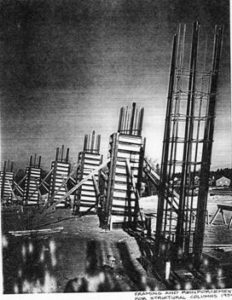
Preliminary plans for the entire project were presented to the public in October, 1951. The Charlotte News published photographs of the models, which gave the first indication that the coliseum would seat more than 10,000 people. Capacity was 12,500 for basketball and could reach 14,000 for boxing. The coliseum was big enough to fit the old Armory-Auditorium on the arena floor.42 In addition to this large, flexible seating capacity; there was also a mechanism to make ice on the floor for skating shows or hockey.43
Unfortunately, construction was substantially delayed, as federal government controls on steel consumption and a general rise in construction costs soon brought the project to a halt. Of the $3 million approved for the project, $225,000 had already been spent on site preparation, architects’ fees and other costs by October, 1951. A. G. Odell Jr. was already concerned about cost increases. A federal ban on the construction of amusement buildings was enacted in response to the nation-wide steel shortage caused by the Korean War and the effects of the steelworkers strike of 1949, and the Charlotte facility fell into the category of “amusement buildings.” 44
These problems delayed construction until 1953. By that time, the City discovered that it was $500,000 short for the new estimates. Bids were received on March 13, 1953, and even the lowest exceeded the funds voted.45 The Council was forced to propose an additional $1 million bond issue to the voters. Supporters took out a full page advertisement in the Observer on June 5, explaining that material shortages had prevented construction in 1951 and 1952, and that costs had risen in the meantime. 46 The bond issue passed. Construction was scheduled to begin on July 1 and to be completed in 1955. Contracts were awarded to the following firms: Thompson and Street, construction; P. G. Godfrey, plumbing; Hopkins, Hicks, Ingle, heating; F. E. Robinson, electrical; and Amreco of New York, the ice rink.47
A strike by sheetmetal workers interrupted construction in November, 1954. The strike, which involved 200 workers in Charlotte, combined with winter winds and low temperatures to delay completion from May, 1955 to late summer.48
In May, 1955, however, the Coliseum was opened to public view. On the first weekend of the month about 12,000 people toured the complex. The open house was sponsored by the Chamber of Commerce, and members of the United States Marines acted as tour guides. 9 The official opening of both buildings was held as scheduled on September 11, despite some last minute delays.50
The dedication ceremonies of Sunday, September 11 attracted 13,000 people to the coliseum. Activities began at 2:30. Highlights of the program included music by the 101st Airborne Band, remarks by A. Grant Whitney, Mayor Philip L. Van Every, James P. McMillan, architect A. G. Odell, Jr., and Governor Luther H. Hodges. Billy Graham, whose crusades would fill the building in later years, gave the dedication address. After the formal part of the service, the audience was treated to an entertainment program with selections from fine arts as well as from popular culture. Presentations were given by the Charlotte Opera Association, the Ballet Society, the Symphony Society, the Little Theater, the Myers Park and Second Ward High School Bands, the Arthur Murray Dancers, a YMCA trampoline duo, and Arthur Smith and the Crackerjacks. Charlotteans were not only entertained, but they were given an important demonstration of the many possible uses of the building. The fitting finale for the afternoon was “Bless This House.”51
In its first year of operation the Coliseum hosted events such as the Ice Capades and the DeSoto Dealers Dinner. 52 During its first full year, the 1956-57 season, the Coliseum was booked from September through April. A partial list of events presented to Charlotteans that year includes the NC Motor Carriers Association Truck Rodeo, the Ice Capades, the Italian Carabinieri (Police Marching Band), the Dixie Fashion Show, thirty ice hockey games, the Esther Williams Water Show (with Esther Williams in person), college basketball, professional basketball (the Fort Wayne Zollners versus the Saint Louis Hawks), and the Carolina Lumber Dealers Annual Show. The manager, Paul Buck, seemed to have something for every taste. 53
The newspapers regularly advised its readers that the Coliseum was operating in the black. On June 30, 1965, at the end of the first decade of operations, the Coliseum Authority reported that it had experienced only one losing year. Manager Paul Buck attributed the Coliseum’s success to big attractions like the Ice Capades, basketball, and country and western concerts.54 In 1982 the Coliseum Authority had a record‑breaking year with a profit $595,880. The biggest single money maker was $21,356 on a Kenny Rogers concert. Total profit on concessions was $30,000. Rock concerts and Amway conventions were also significant sources of revenue that year. 55
The Coliseum building has historical significance for Charlotte on several different levels. It is important for its pioneering architectural design; it has had both direct and indirect influence on the city’s growth, and the huge variety of activities that took place in the facility were, in one way or another, important events in the lives of the people of the city and region.
From the moment that Odell & Associates unveiled the first model, the Coliseum was featured in professional architecture journals and trade publications. The buildings legendary claim to fame is that it was the largest free-span dome in the world at the time it was built.56 Another unique design feature was that the building could be completely evacuated in four minutes.57 Architecture and Building featured the Coliseum as an example of a welded radial structure, and it received international notice in an article in a Madrid journal.58 Look published a three-quarter page color photograph of the “world’s biggest dome.”59
The Baltimore American carried a full page story entitled “Charlotte, N.C. How City Built a Civic Center.” The Baltimore paper picked up the story because their local hockey team, the Baltimore Clippers, had been burned out of their arena in 1956, and, having no other facility in the Baltimore area, decided to play the rest of their “home” games at the new Charlotte Coliseum. The article lauded the city for its foresight in building the Coliseum-Auditorium complex. The paper praised the warm welcome given the Clippers, the Coliseum dome, its flexible seating arrangements, the “perfect” acoustics of the Ovens auditorium, and the parking lot for 2000 cars which “can be emptied in 15 minutes.”60
The Coliseum’s aluminum dome also attracted much notice and the building was liberally used in Alcoa’s advertisements. In 1956 it was featured on the Alcoa Hour, a TV program aired on NBC TV on July 8, but not shown in Charlotte until July 15. The promotional pamphlet for the program proclaimed: “See what Charlotte has done with aluminum on the Alcoa Hour. Presenting views of the new modern aluminum domed civic center.”61 Alcoa also featured the dome in its 1955 and 1956 newsletters, describing the Coliseum as “futuristic,” “graceful,” and “spectacular.”62 The Bethlehem Steel Company used a photograph of the steel ribs of the building, taken during an early phase of construction. According to this advertisement, 1000 tons of steel were used in the building.63 The Coliseum also appeared in Popular Mechanics and on the covers of Construction and The National Insurance Buyer. 64 All of these notices brought Charlotte to the attention of a wider audience, and it seems clear that the Coliseum helped to put Charlotte on the map.
The growth of the city, especially business growth along Independence Boulevard, also owes something to the Coliseum and the activity it created. In 1966, ten years after the Coliseum had become fully operational, growth in its vicinity was estimated to be worth 20 million dollars. When the complex opened in 1955, the only neighboring businesses were the Coliseum Motor Courts, a service station, a hamburger stand, and a Howard Johnson’s restaurant. These structures were built in anticipation of the Coliseum and Auditorium crowds. By 1966, commercial development was even more impressive. Three new shopping centers were built, each of Charlotte’s four major banks had branches in the area; North Carolina Savings and Loan had constructed a seven story headquarters building nearby; and car dealerships and several restaurants stretched the business strip along Independence Boulevard half way to Matthews. The Charlotte Merchandise Mart, a major national marketplace for men’s and women’s clothes, was built across a side street from the Coliseum. 65
The Charlotte Coliseum has been a significant part of the lives of at least two generations of Charlotteans. The building was the site of the circus, the Ice Capades, and music events from Elvis and Kenny Rogers to Lawrence Welk. In September 1965 12,300 fans went to see the Welk show at the Coliseum. A highlight of the evening was the Lennon Sisters dressed in “form fitting sleeveless black tops, bright figured skirts, and new upsweep hairdos.”66
The Coliseum was the focus for regional sports. Basketball, the most popular sport in the Carolinas, was a staple of the featured athletic fare. Professional wrestling also flourished. The 1956 season gave Charlotte its first taste of the alien sport of ice hockey when the Baltimore Clippers temporarily adopted the Coliseum for its home ice. The Clippers played five games in Charlotte to finish their year; they attracted 41,200 fans for an average of 8400 per game. Two games were sellouts. A team represented Charlotte in the Eastern Hockey League the next year. 67 The Coliseum Authority purchased its own hockey team in 1960. Charlotteans were also introduced to ice skating in the Coliseum, because the building was open for public skating from 1956. Skate rental in 1960 was 50 cents. 68
More solemn events also took place at the Coliseum. Many Charlotte residents sat through their high school or college graduation ceremonies there, or attended one of several Billy Graham crusades.
The Coliseum may be unique because, more than any other building in the region, it has played some part in the life of nearly every Charlotte area resident. Even in the shadow of its larger successor, the old Charlotte Coliseum might still prove useful as a place to play college basketball, house a new hockey team, or accommodate concerts whose audiences would be swallowed up in the new 24,000 seat structure.
- This example of Kuester’s civic activity was noted in a typescript in the Herbert Baxter Papers, with no author and no date indicated. Herbert H. Baxter Papers, Special Collections, UNCC, series 4, folder 4.
- Baxter’s articles appeared in the Charlotte Observer, October 5-October 10, 1947.
- Charlotte Observer, Oct. 28, 1947 “Voters Settle Auditorium Bond Issue Today,” by Hal Tribble, p. 1B.
- Charlotte Observer, October 29, 1947, “Auditorium Bond Issue Beaten by 83 Votes,” p. 1A.
- Charlotte Observer, October 7 1947, by H. H. Baxter. Clipping file, reel 5, UNCC Library, no pagination.
- Charlotte Observer, October 9, 1947, by H. H. Baxter, ibid.
- Victor Shaw, radio campaign speech, April 19, 1949, Victor Shaw Papers, Special collections, UNCC, Box 3, Series 2: Speeches, Folder 1.
- Charlotte Observer, June 5, 1953, “Large Turnout is Called for in Bond Vote,” p. 1B.
- Ned Alvord to Victor Shaw, August 6, 1949,Victor Shaw Papers, Box 1, Series 1: Correspondence, 1949, Folder 3.
- A.J. Gocking to Victor Shaw, June 18, 1949, Shaw Parers, Box 1, Series 1: Correspondence, Folder 2. According to Shaw, Sherrill had to be prodded to approach Oasis Potentate J. Y. Jordan with the proposition. Shaw to Gocking, July 5, 1949, Ibid.
- Gocking to Shaw, July 7, 1949, Ibid.
- Gocking to Chandler, July 7, 1949, Shaw Papers, Box 1, Series 1: Correspondence, Folder 2.
- Shaw to Gocking, July 12, 1949, ibid.
- Gocking to Shaw, July 7, 1949, ibid.
- Shaw to Gocking, July 22, 1949, ibid ; Gocking to Shaw July 24, 1949, ibid.
- Ibid.
- Charlotte Observer, September 26, 1949, “Oasis Potentate J. Y. Jordan, Mayor Shaw, Discuss Proposition in Letters,” by Hal Tribble, Clipping file, UNCC Library, no page; Charlotte Observer, October 19, 1949, “Oppose Shrine Site for City Auditorium,” by Hazel M. Trotter, p. 1B.
- Charlotte Observer, October 29, 1949, “Shaw Explains Shrine Deal,” p. 1B.
- Charlotte Observer, October 28 1949, “New Auditorium Plans are Shaped,” by Hal Tribble, p. 1B.
- Ibid.
- Shaw to Gocking, July 9, 1949, Shaw Papers, ibid.
- Charlotte Observer, October 27, 1949, “City Council Takes Steps for New Auditorium,” by Hal Tribble, Clipping file, UNCC Library, reel 5, no page; Ibid, November 3, 1949, “Ovens Selects Aides in Study,” by Hal Tribble, p. IB.
- Charlotte Observer, January 10, 1950, “Group Studying Coliseum Plans in Other Cities,” Hazel M. Trotter, Clipping file, no p. 6.
- Charlotte Observer, May 12, 1950, “Contract will be Submitted to Governing Heads Today,” by Hal Tribble, Clipping file, no p.
- Charlotte Observer, May 18,1950, “Approval of Architect’s Contract is Held Up for One Week by City Council,” Clipping file, no p.
- Charlotte Observer, December 18, 1949, photo diagram, p. 1B.
- Charlotte Observer, May 20, 1950, “Two Sites Proposed for Auditorium, Coliseum,” by Hazel Trotter, Clipping file, no p.
28 Charlotte Observer, May 25, l95O, “City to Rush $3 Million Bond Election Plans,” by Hal Tribble, p. 1B.
- Charlotte News, August 16, 1950, “Committee Urges Site on Cities East Edge for Facility,” by Tom Fesperman, Clipping file, no p.
- Charlotte Observer, August 17, 1950, “Committee recommends Special Election to Finance Project,” Clipping file, no p.
- Interview with Scott Ferebee, Jr., project architect for Odell during the planning phases of the coliseum-auditorium project, July 25, 1990.
- Chamber of Commerce Brochure, 1950, Property of A. G. Odell and Associates. Access generously provided by Mr. Davis H. Liles.
- Ibid.
- Charlotte Observer, October 10, 1950, “A Building For Every Purpose, ” p. 1B.
- Charlotte Observer, October 15, 1950, “City Auditorium Bond Voted,” p. 1A.
36 Charlotte Observer, October 16, 1950, “Speedy Action Seen on Auditorium Site,” Clipping file, no p.
- Charlotte Observer, November 8, 1950, “First Step Completed on Auditorium Project,” p. 1B.
- Charlotte Observer, February 23, 1951, “Few details Unsettled on Auditorium Project,” Clipping file, no p.
- Ferebee interview, July 25, 1990.
- Odell remarked that he preferred this design “…to keep the Coliseum from looking like a gasoline storage tank.” The Chattanooga Times, November 20, 1955, “New Auditorium, Coliseum Give Charlotte Sharp Focus On Entertainment,” p. 17.
- Ferebee interview, July 25, 1990; Architectural Record, “Structural Forms Keynote Civic Center,” December, 1952, p. 122.
- Charlotte News, October 11, 1951, “Planning on Auditorium-Coliseum Gets Go Ahead from City Council,” by Tom Fesperman, p. 1B.
43 Ferebee interview, July 25, 1990
- Charlotte Observer, October 12, 1951, “Coliseum Still Facing Major Hurdles,” by Hal Tribble, p. 1B; ibid., October 27, 1951, “NPA Ban Won’t Halt Auditorium Planning,” Clipping file, no p.; ibid., October 22, 1951, “Coal Crisis Causes Rail Restriction,” p. 1A.
- Charlotte Observer, March 13, 1953, “Coliseum-Auditorium Bids Will be Received Today,” Clipping file, no p.
- Charlotte Observer, June 5, 1953, “Vote Yes. We’ve Waited Long Enough,” p. l0A.
- Charlotte Observer, June 9, 1953, “Auditorium‑Coliseum to be Ready in 1955,” p. 1B.
- Charlotte Observer, November 4, 1954, “Coliseum Job Halted by Strike,” Ibid , December 18, 1953, “Coliseum-Auditorium Project Progressing Despite Cold,” both Clipping files, reel 5, no p.
- Charlotte Observer, May 2, 1955, “12,000 Persons Tour Auditorium-Coliseum,” Clipping file, no p.
- Charlotte Observer, June 4, 1955, “Coliseum Opening May be Postponed,” Clipping file, no p.
- Program, Charlotte Coliseum-Ovens Auditorium Dedication Service, Sunday, September 11, 1955. Property of A. G. Odell Jr. and Associates; access kindly provided by Davis H. Liles.
- William H. Sumner Photographic Collection, Special Collections, UNCC.
- Charlotte Observer, August 15, 1956, “Buck Gives Schedule,” by Dick Banks, Charlotte Public Library Clipping Folder, Charlotte Public Buildings, Charlotte Coliseum, Folder 1.
- Charlotte News, September 15, 1965, “Coliseum, Ovens Auditorium End Tenth Year With $38,751 Profit,” by Emery Wister, p. 1B.
- Charlotte News, September 3, 1982, “Coliseum Shows Record Profit,” by John Wildman, p. 1B.
- Architectural Forum, “World’s Largest Dome,” November, 1954, p. 159.
- Progressive Architecture, September 1956, p. 120. The ribs of the Coliseum Dome were featured on the cover.
- Architecture and Building, “Exhibition Hall,” October 1956, pp. 388-392; Revista Informes de la Construccion, “El palacio de los deportes y auditorio de Charlotte,” November 1955, no. 75, pp. 72-75.
- Look, “World’s Biggest Dome,” January 20. 1956, p. 37
- Baltimore American, April 6, 1956, “Charlotte, N.C. How a City Built a Civic Center,” by James C. Mullikin, no p. Copy in possession of Odell and Associates, generously provided by Davis H. Liles.
- Pamphlet for the Alcoa Hour, 1956. Property of A. G. Odell and Associates, generously provided by Davis H. Liles.
- The Alcoa News, February 14, 1955, p. 3; Alcoa Aluminum News Letter, February 1956, pp.3‑4. A stylized color drawing of the Coliseum is on p.1 of the latter issue.
- Architectural Record, “On the News Front With Structural Steel,” April 1955, p. 108.
- Popular Mechanics, “Two Acre Dome,” February 1957, p. 71; Construction in North Carolina Virginia. and West Virginian , June 7 1954; and The National Insurance Buyer, Vol. 11, no.3, May 1964.
- Charlotte News, September 7, 1966, “On Independence Boulevard a $4.7 Million Magnet for City,” by Emery Wister, Charlotte Public Library, Clipping Folder, Charlotte Public Buildings, Charlotte Coliseum, Folder 1.
- Charlotte News, September 27, 1965, “12,300 Hear Lawrence Welk,” p. 6A.
- Newsletter from Robert P. Elmer, Jr., Director of Public Relations, Charlotte Clippers, September 1956. Copy in the possession of A. G. Odell and Associates.
- Charlotte Observer, July 23, 1960, “City Youths Can Skate for Less,” Charlotte Public Library, Clipping Folder, no p.
Architectural Description
by Davis H. Liles, AIA
The original Charlotte Coliseum is located on a 17.67-acre site between Independence Boulevard East and Coliseum Drive. The 208,400 square-foot arena shares the site with the 68,452 square-foot Ovens Auditorium. The two separate buildings were both constructed in 1954‑55. The Coliseum’s location, three miles from the center of town, was considered on the outskirts of the city of 135,000 residents at that time. The building was designed by A.G. Odell, Jr. and Associates, and received international publicity during and after its construction. The original design of the Coliseum was modified in 1970 with the construction of a new entrance on the north side leading to the parking lots, closing off the existing east side lobby for coliseum offices and erection of a building on the west side to enclose air conditioning and mechanical equipment which were added at the time. The circular drive around the building was closed and the new entrance entered at the upper concourse level of the building.
Ovens Auditorium under construction, photograph taken on July 22, 1954
At the time of its construction, the building was noted by Look Magazine (January 24, 1956) as the “world’s largest dome”. St. Sophia’s great Byzantine dome is 107 feet in diameter and the dome at St. Peter’s in Rome is just under 138 feet. Charlotte Coliseum’s circular dome spans 332 feet and is 112 feet above the floor at its peak. Throughout history significant religious and civic buildings have been a source for major advances in architecture and engineering. The combined requirements for economy of construction and maintenance, safety, flexibility, ease of circulation and need for an exciting but simple shape determined a circular domed design. Architecturally, this type of dome is a space frame‑-no piece of steel in it is more than 18 inches deep.
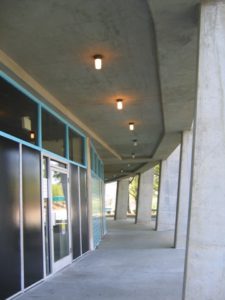
Using a design technique invented in 1863 for considerably smaller domes by German steel expert J.W. Schwedler, the weight of the domed structure was reduced such that it could be held by 48 cast‑in‑place columns sloped outwards 7 feet from bottom to top to keep rain off the exterior windows and add visual interest. The aluminum sheathed dome covers a two acre area. It consists of a lightweight aluminum roof laid on a precast concrete and wood fiber deck resting on a metal-ribbed, convex latticework. A 172 ton tension ring, sitting atop the 48 columns, resists the outward thrust of the dome’s 970 tons of steel. Severud-Elstad-Krueger of New York were the consulting structural engineers and the steel erector was Southern Engineering of Charlotte.
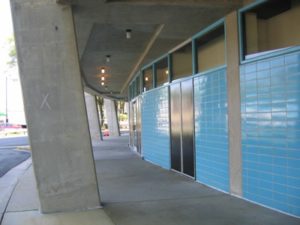
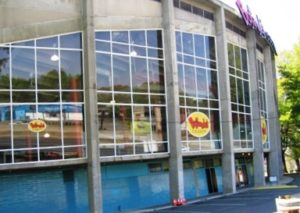
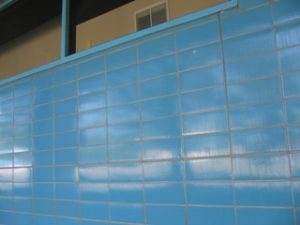
Precast concrete bleachers serve as a base on all four sides for 10,000 permanent seats. While the building is circular, the straight seating on the four sides of the 99 foot x 212 foot arena floor eliminate any undesirable corner seating and maximize seating on the side. Aisles and exits were designed to empty the building in four minutes. The upper level concourse completely circles the building and large glass openings on the exterior bring in natural light to the circulation areas and provide a strong visual connection with the outside plaza. The glass expanses also reinforce the drama and spectacle associated with large assembly buildings of this type. On the exterior undulating precast concrete panels appear to float on top of the glass and provide a strong contrast to the shining aluminum panels on the roof. On the lower level the exterior is finished with blue glazed ceramic tile underneath a continuous overhang.
Space underneath the seating areas is used for support functions including offices, ticket offices, locker rooms, dressing rooms, concessions, vending areas and service areas. All of the glass areas are below the line of seating levels. Most of the exposed surfaces are structural concrete, steel, and terra cotta block partitions. Intense primary colors are used as accents to brighten the interior. On each side a large open area with a 35 foot high wall of glass provides an open intermission area. The floor of the arena was designed with ice-making capacity for local hockey events and touring ice shows. Public restrooms are provided on both levels. Storage areas are provided for temporary seating, portable staging and a portable basketball floor. A central scoreboard provided game information and a catwalk system hung from the roof provided access to the lighting and sound systems, also hung from the dome. Press boxes and special spotlighting are located between the top of the seating and the dome’s perimeter.
Up to 3,500 temporary seats can be added to the special arena events, depending on the type the years events have been featured such as circuses, rodeos, horse shows, trade shows, rock and country music concerts and conventions. The facility’s bold design, engineering feats and overall impact served as a significant milestone in Charlotte’s growth as a regional center both in economic terms and as a symbol of the City’s vision for the future. With the opening of the new 23,000 seat Charlotte Coliseum in 1988, its operation was halted. Recent interest has been expressed in its renovation to serve smaller scale events and to continue to provide economic support for Independence Boulevard business. The basic building remains sound and continues to serve as an engineering, design marvel that was a precursor of the enormous stadia/arenas that are being built today and also stand as visible symbols of civic pride. The magic of an unsupported 332 foot dome remains a powerful visual image today for all those who attended Coliseum events.
Addendum (2001)
by Lara Ramsey
The Charlotte Coliseum (now known as Independence Arena) was hailed as an “architectural marvel” by architects, public officials, and Charlotteans when they first opened to a crowd of thousands in 1955. North Carolina Governor Luther Hodges proclaimed the Coliseum “a perfect building,” and a Charlotte resident attending the grand opening declared, “We’ve been waiting twenty-five years for Charlotte to do something like this.”1 Designed by A.G. Odell & Associates, the modern complex drew national attention for its “fresh, futuristic design” and was featured in several publications.2
The former Coliseum, with its aluminum-covered dome measuring 332 feet in diameter, received the lion’s share of the publicity. In 1956, Look magazine printed a three-quarter page color photograph of the building, calling it the “world’s biggest dome.”3 The building’s large seating capacity was ideal for sporting events and big-name acts like Elvis Presley and the Rolling Stones. Between 1955 and 1988, over 20 million people attended events at the former Coliseum and Ovens Auditorium.4 As the years passed, however, it became apparent that the city was outgrowing its first Coliseum. With the building of the new Charlotte Coliseum on Tyvola Road, there were concerns that leaving the former Coliseum open would provide competition for the new 24,000-seat arena. When the new Coliseum opened in 1988, the old Coliseum closed its doors.5
With the city’s rapid growth, many people began to rethink the idea of using the smaller venue to compliment the new Coliseum. In 1991, the city granted a 35-year lease on the Coliseum to the Independence Arena Management Group, owned jointly by D.L. Phillips Co. (owners of Merchandise Mart) and Arena Associates, Inc. The Group began raising funds for a renovation of the Coliseum, which was renamed Independence Arena.6 The project would eventually cost over $4 million to complete – approximately the same amount of money that had been spent to build the Coliseum and Ovens Auditorium in the 1950’s.7
Most of the renovation involved updating existing parts of the Coliseum. The sound system and lighting system were updated, as were the restrooms, locker rooms, dressing rooms, concession stands, and the box office. A new scoreboard and two new message boards were installed. The building was also made more accessible to the handicapped. An elevator was installed to transport visitors to the upper concourse, where ramps led to six areas that could accommodate up to six wheelchairs each.8
Special care was also taken to preserve the original features of the building. The original oak floor was refinished, and the ice floor (consisting of 12 miles of pipe) was inspected and found to be in working order. The original maple folding seats were also refinished. Richard Cherry, who was hired by the city to inspect the building prior to the renovation, noted that “after 37 years, there was less than 1% breakage in the seats . . .they are very sturdy, they look great, and we didn’t have to spend $400,000 for new plastic seats. 9
The former Coliseum re-opened as Independence Arena on September 18, 2001. The building that had once been the world’s largest free-span dome was now billed as a “sidekick” to the recently built 25,000-seat Charlotte Coliseum. The new Coliseum would house Hornets games and big-name entertainment, while Independence Arena would provide a venue for smaller events like UNCC basketball games and Charlotte Checkers matches. 10
Other changes were made to the former Coliseum in the years following its re-opening. In 1995, color television monitors were installed in the concourses, and a restaurant-lounge called the Locker Room opened in the building to serve Charlotte Checkers fans with season tickets.11 The former Charlotte Coliseum will soon undergo yet another change – the wireless phone company Cricket has agreed to pay $100,00 to change the name of Independence Arena to Cricket Arena.12
Although Ovens Auditorium did not undergo the full-scale renovation that the old Coliseum received, the building (which remained open when the Coliseum was forced to close in 1988) has been updated over the past decade. In August of 1990, new, dark teal seats replaced the original orange and turquoise seating. 103 extra seats were added to the auditorium, increasing its seating capacity to 26,603.13 The original concession counter in the upstairs lounge was replaced in the mid-1990’s with a counter of dark wood that blends with the surrounding bead board. New furniture was added to the lounge, and new carpeting was installed throughout the building. Around this time, a two-story addition was built onto the left side of the center section of the auditorium, facing the old Coliseum. This new addition houses passenger and service elevators and restrooms on the ground floor; a hospitality area occupies the second level.14
The former Charlotte Coliseum and Ovens Auditorium, although no longer the main venues in the city, remain as architectural icons to many Charlotteans. The modern design of the Coliseum/Auditorium complex drew national attention to Charlotte, and the presence of the buildings helped the city to expand culturally and economically.
-
-
Charlotte Coliseum Photo Gallery
-
-
-
-
-
-
-
-
-
-
-
-
-
-
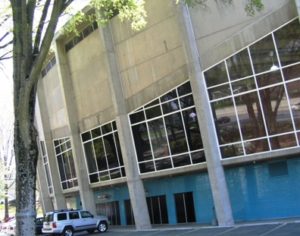
-
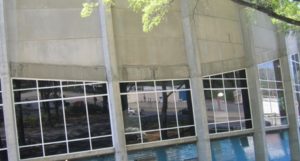
-
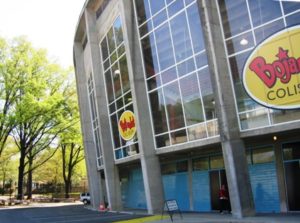
-
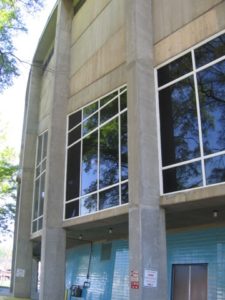
-
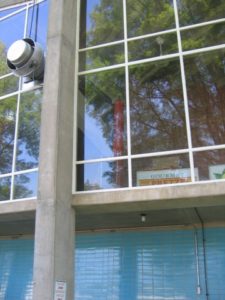
-
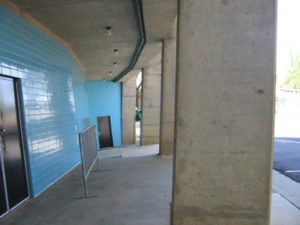
-
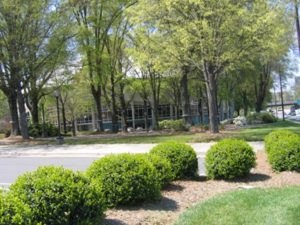
-
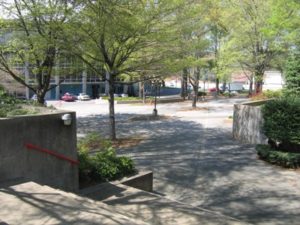
-
-
- “Renovated Facility Flaunts Fifties Flair.” Charlotte Observer, September 15, 1993, special advertising section.
- Ibid.
- “Revamped arena ready for its coming out.” Charlotte Observer, August 27, 1993, 1A.
- “The NEW old coliseum.” Charlotte Observer, January 20, 1996. (taken from the vertical file “Public Buildings – Coliseum (Old) in the Robinson-Spangler Carolina Room).
- “The Old Dome.” Charlotte Magazine, p. 52.
- “Just sit down and listen up: new seats at Ovens Auditorium are no smaller, officials say – and that’s the bottom line.” Charlotte Observer, October 23, 1990, 1-B.
- Interview with George Hite, February 17, 2001.
- “The Old Dome.” Charlotte Magazine, p. 54 (month unknown – article provided by the Coliseum and Convention Center Authority).
- Ibid.
- American Institute of Architects, Charlotte Chapter. “Survey and Research Report on the Charlotte Coliseum.” July 30, 1990, p. 25 (copy of Look magazine article).
- “The Old Dome”, p. 54.
- Ibid.
- Fans will walk into 1950’s in renovated arena.” Charlotte Observer, October 20, 1991 (page number unknown – taken from the vertical file “Public Buildings – Coliseum (Old) in the Robinson-Spangler Carolina Room).
- “Charlotte Landmark Gets New Lease On Life.” Charlotte Observer, September 15, 1993, special advertising section (taken from the vertical file “Public Buildings – Coliseum (Old) in the Robinson Spangler Carolina Room).

Cedar Grove House

Hugh Torance House and Store

Mill Ruin
This report was written on 22 April 1993
1. Name and location of the properties: The properties known as Cedar Grove and the Hugh Torrance House and Store are located on Gilead Road, Huntersville, in Mecklenburg County , North Carolina.
2. Name, address, and telephone number of the present owner of the properties: The owners of the properties are:
Mr. and Mrs. Richard Torrance Banks
PO Box 122
8229 Gilead Rd.
Huntersville, North Carolina 28078
Telephone: 704 /875-0774
3. Representative photographs of the properties: This report contains representative photographs of the properties.
4. Maps depicting the locations of the properties: This report contains maps which depict the locations of the properties.
5. Current deed book references to the properties: Cedar Grove Tax Parcel Number 009-061-01 is not listed in the Mecklenburg County deed books. The most recent reference to the second Cedar Grove property, Tax Parcel Number 015-091-04, is listed in Mecklenburg County Will Book W23 at page 77. The most recent reference to Cedar Grove Tax Parcel Number 009-061-07 is listed in Mecklenburg County Will Book W23 at page 77. The most recent reference to the Hugh Torrance House and Store, Tax Parcel Number 009-061-09, is listed in Mecklenburg County Will Book W23 at page 77.
6. A brief historical sketch of the properties: This report contains a brief historical sketch of the properties prepared by Ms. Paula N. Stathakis.
7. A brief architectural description of the properties: This report contains a brief architectural description of the properties prepared by Ms. Frances Alexander.
8. Documentation of why and in what ways the properties meet criteria for designation set forth in NCGS 160A-400.5:
a. Special significance in terms of history, architecture, and cultural importance: The Commission judges that the properties known as Cedar Grove and the Hugh Torrance House and Store do possess special significance in terms of Charlotte and Mecklenburg County. The Commission bases its judgment on the following Considerations: 1) the Hugh Torrance House and Store was built between 1780 and the early 1800s, and Cedar Grove was constructed between 1831 and 1833; 2) the Hugh Torrance House and Store is one of the few houses to survive from the eighteenth century settlement period of the county; 3) Cedar Grove is one of the premier Greek Revival houses remaining in the county and the Piedmont; 4) because of their physical and historical associations, these two properties offer a unique picture of agricultural life in Mecklenburg County from the settlement period through the antebellum era; 5) the two houses, and their various construction campaigns, illustrate clearly the evolution of residential architecture in the county during early periods, for which little remains; 6) both houses are remarkably intact, retaining important characteristic interior and exterior features, including original floor plans, decorative elements, hardware, and woodwork.
b. Integrity of design, setting, workmanship, materials, feeling, and association: The Commission contends that the architectural descriptions by Ms. Frances P. Alexander included in this report demonstrate that Cedar Grove and the Hugh Torrance House and Store meet this criterion.
9. Ad Valorem Tax Appraisal: The commission is aware that designation would allow the owner to apply for an automatic deferral of 50% of the Ad Valorem taxes on all or any portion of the properties which become designated historic landmarks. The current appraised value of the improvements to Cedar Grove is $144,600. The current appraised value of the improvements to the Hugh Torrance House and Store is $6,880. The current appraised value of Cedar Grove Tax Parcel 015-091-04 is $54,750. The current appraised value of Cedar Grove Tax Parcel 009-061-01 is $193,160. The current appraised value of Cedar Grove Tax Parcel 009-061-07 is $86,880. The total appraised value of the three parcels of the Cedar Grove property is $479,390. The current appraised value of the Hugh Torrance House and Store, Tax Parcel 009-061-09, is $15,000. The total appraised value of the Hugh Torrance House and Store property is $21,880. Tax Parcel Numbers 009-061-01 and 00906109 are zoned RU. Tax Parcel Number 009-061-07 and Tax Parcel Number 015-091-04 are zoned R3.
Date of preparation of this report: 22 April 1993
Prepared by: Dr. Dan L. Morrill
in conjunction with
Ms. Frances P. Alexander
and Ms. Paula M. Stathakis
Charlotte-Mecklenburg Historic Landmarks Commission
P.O. Box 35434
Charlotte, North Carolina
Telephone: 704 /376-9115
Historical Overview
Cedar Grove and the Hugh Torrance House and Store were one part of a large financial concern owned and managed by the Torrance family. The first member of this family in Mecklenburg County was Hugh Torance, who came to the area in the late eighteenth century. Hugh and his son James accumulated a substantial tract of land and by 1840 owned over one hundred slaves; a concentration of wealth that was not common for this area. Although some plantations thrived in Mecklenburg in the nineteenth century, the more common enterprise for the region was small, and usually subsistence farming. Planters commonly defined as those who owned twenty or more slaves were more prevalent in Eastern North Carolina, in Virginia, in the South Carolina low country, and in the black belt regions of Georgia, Alabama, and Mississippi.
Hugh Torance (1743-1816) emigrated to the American colonies from Ireland c. 1763. 1 A letter written by his minister in Five Mile Town in the Parish of Clogher and County Tyrone vouched that “Hugh Torance is an unmarried person and descended from honest and reputable parents and from infancy lived in ye bounds of the Protestant Dissenting Congregation of this place and always behaved himself orderly and supported a very fair church is certified by Thomas Boyle (?) D.D.” 2 It is not known what ship brought Hugh Torance to America, or where he first landed. It is known that he and his brother Albert came together, and the family believes that they came as indentured servants. Hugh lived in Pennsylvania for several years. Shortly after the outbreak of the American Revolution, Hugh took an oath of allegiance to the General Assembly of Pennsylvania. 3
Hugh joined the revolutionary forces and fought in North Carolina in a light cavalry company, the “Partisan Chargers” led by Captain Galbraith Falls who was killed on June 20, 1780 at the Battle of Ramsour’s Mill. 4 Records show that Hugh was a disbursing agent for Falls’ militia and probably stayed in the army until 1781. 5
After the war, Hugh married Captain Falls’ widow, Isabella Kerr Falls (1783-1816). He and Isabella and her eight children lived briefly in Rowan County where Hugh had a store. They had one child together, James Galbraith Torrence (1784-1847).
According to land records, Hugh Torance was active in Mecklenburg County by 1779. He purchased 667 acres in that year, and by the 1790s, was in a position to purchase over 500 acres during the course of the decade. By the time of his death he had accumulated over 1400 acres. 6 In Rowan County, Hugh was a merchant, but he became a planter in Mecklenburg. The building currently designated as the Torrance House and Store is the first of two structures Hugh built to accommodate his family.
The inventory of Hugh Torance’s estate shows that he owned a substantial amount of livestock: sixty cows, twelve horses, forty-six sheep, and 150 hogs, as well as their offspring . In terms of real and personal property, Hugh Torance owned 1400 acres, thirty-three slaves. The estate had $1500.00 cash on hand. 7
Hugh’s youngest son James acquired all of the property in Mecklenburg County and focused most of his financial interests in a dry goods store that he opened in 1805. James purchased most of his initial inventory from merchants in Philadelphia. According to the recipts from his first buying trip in May and June, 1805, James spent nearly $4000.00 to purchase ribbons, cloths, buttons, dishes, jugs, tools, kettles, shovels, curry combs, rat traps and hardware. 8
Torrence suplied articles to his North Mecklenburg customers that they could not manufacture themselves, which suggests that the majority of his patrons concentrated in agricultural production. James Torrence extended credit for his customers for periods ranging from one day to one month. 9 His customers frequently paid him in cotton or sometimes in land. Cash was usually used as a method of partial payment. Sometimes customers traded in other commodities such as lard or powder in exchange for merchandise. 10 During this time cash would have been scarce for most of Torrence’s middling neighbors. Economic relations based on barter and exchange indicate that the area was not connected with a market economy during the period that Torrence owned his store, and probably was not for a significant period afterward. 11
Torrence sold the store in 1825 to Samuel McCombs of Charlotte; according to family legend, his daughters convniced him that it was beneath a man of his stature to engage in trade. Besides his store, James also ran a large plantation with a saw mill on site. During James’ life, the Torrence plantation expanded to approximately 3000 acres. 12 James grew primarily cotton and corn, but also grew the provisions and livestock necessary to maintain a large plantation.
Plantations were rare in Mecklenburg and seem to have been concentrated in the northwestern section of the county. Other substantial landowners in the vicinity were the Lattas, the McDowells, the Davidsons, and the Alexanders. Slave holding was common in Mecklenburg County, but the Torrences and their landed peers frequently owned thirty or more slaves, which was an exceptional number for this area. 13
Unfortunately, very little information about the Torrence family slaves survives in the family papers. A notebook titled “Ages of Negroes” is the only surviving inventory of the slave population on the Torrence Plantation. According to this notebook, James Torrence owned 125 slaves, excluding two who were marked as dead and three who were struck from the lists. 14 The Torrence slaves sometimes shopped at local merchants using Torrence’s account for dry goods. Invoices from Andrew Springs show that slaves had purchased calico, buttons, shoes, bonnets, suspenders, tin cups, coffee, sugar and turpentine. 15
The Torrence family seldom mentioned their slaves in their correspondence. In the surviving records, James Torrence makes no personal notes regarding his slaves; he only mentions them in the 1840 inventory, and in his will, as some slaves were given to his children. His son Hugh alluded to a problem slave in a letter to his father in 1838: “I have a negro in the woods he may attempt to go back though I cannot tell. It is Dick. I undertook to whip him a few days ago and when I called him up – he took to the woods. He is a great rascal. If I ever get him, I will sell him — for I believe he will spoil every negro we have if I keep him.” 16 James’ twelve year old daughter Jane Elizabeth writing from Salem Female Academy in 1835 closed her letter by asking her father to “Tell the black people howdy for me.” 17 During the Civil War, James Torrances’ widow Margaret wrote to her son Richard that her “darkeys are doing very well. Some of the negroes in this quarter have left their masters to try the Yankees.” 18
There is no complete record of overseers, and no record of there being one before 1849. It appears that from 1849-1851 a new overseer was hired every year. 19 This kind of turnover was not unusual. Planters dismissed overseers for a range of different reasons: leniency or cruelty to slaves, drunkenness, and failure to make a good crop. 20 In 1862, Margaret Torrance, James Torrance’s widow, hired James Brown to oversee the plantation. Brown stayed with the family until 1865. The contract between James Brown and Margaret Torrance illustrates the usual responsibilities of overseers. Brown agreed to enforce eighteen provisions in exchange for $210.00, and the use of a milk cow and a horse.
Brown’s primary responsibilities involved monitoring the slaves’ work and protecting the Torrance’s property. Slaves were to begin their day early enough to feed the stock and prepare their own breakfast. Brown was to follow the slaves to their work to make sure that they went on task. Slaves stayed at work until sundown. In the summer, field hands received a two hour break at midday, and one hour in the fall and spring. The slave cabins were inspected at least once a week at night “to keep the negroes from running about”, and no one was allowed out of their cabin without permission. On Saturday evenings, women were allowed to spend two hours to wash their laundry and all hands were expected to appear on Monday mornings with “comb head and clean clothes unless prevented by circumstances.” Brown was also responsible for the maintenance and health of livestock. He supervised gearing horses and had to account for the condition of gear, wagons and tools. 21
The primary role of slaves on the Torrance Plantation was to produce cotton. There are no complete records of cotton production, but some indication of the plantations cotton output exists in the receipts of cotton sales from 1816-1846. In 1816, cotton gins could press between 285-325 pounds of cotton. A receipt form a Charleston broker indicates that, in June 1816, cotton sold between 30 cents per pound to 22 cents per pound for an inferior grade. Thus in one exchange on June 22, 1816, James Torrance made $94.69 from three bales (after paying hauling and storage charges to the broker). The price of cotton declined steadily during the 1820s and 1830s. In order to continue to make a profit, Torrance had to focus on growing more cotton and had to take more cotton to market at a time to make the trip worth his while. Torrance usually traded with cotton brokers in Charleston, Fayetteville, and Columbia. By 1843, Torrance’s receipts show that the price of cotton had plunged to five and a quarter cents per pound. In May 1843, Torrance sold 150 bales weighing 54,055 pounds an average of 360 pounds per bale at five and a quarter cents per pound to make $2325.40. In 1827 when Torrance was paid nine cents per pound, he could make $2000.00 from 69 bales. Towards the end of his life, cotton prices rose slightly, but the latest receipt in his files, from 1846 shows that he did not make more than nine and three eights cents per pound. 22
In addition to cotton, James Torrance also raised sheep for wool. Other major crops included corn and wheat. He built a water-powered saw mill and grist mill in 1824. He sawed lumber for himself and his neighbors. 23
The Torrance Plantation supported a large number of people. James Torrance had a big family as well as over one hundred slaves. Torrance was married three times. He married his first wife, Nancy Davidson, in 1809. Nancy was the daughter of Ephraim and Jane Brevard Davidson of Mount Mourne (a plantation that was formerly in Mecklenburg County, but is now in Iredell County). James and Nancy had five children: Jane Adeline (1811-1820), Catherine Camilla (b. 1814), Isabella Malvina (1818-1893), Hugh Jr., and James Franklin (1816-1869). Nancy Davidson Torrence died of “typhus” in 1818 at the age of 26. 24
James Torrance remarried in 1821 to Mary Latta, daughter of James and Jane Latta of Hopewell. 25 James had two children with Mary Latta: William Latta (1822-1852) and Jane Elizabeth (1823-1844). Mary Latta Torrence died in 1824.
In 1827, James Torrence married for the third and final time. Margaret Allison was the daughter of Richard and Letitia Neil Allison of Statesville. Margaret and James had six children: Letitia (b. 1828), Mary (b. 1829), Delia (b. 1831). Richard (1833-1927), Sarah Jane (b. 1826), and John (1839-1904). Margaret Torrance died in 1880, surviving her husband by thirty-three years.
Cedar Grove, the extant plantation house currently occupied by Richard Allison Torrance’s grandson, Richard Banks, was built by James Torrance in 1831 for Margaret Torrance. Cedar Grove was built on the same site as a brick house built by Hugh Torance in 1784. Much of the lumber for Cedar Grove was processed on site by James Torrance’s saw mill. The bricks for the house were also made on site. Brick making was directed by master mason V. Rivafavoli. According to James Torrance’s account book kept during the construction of Cedar Grove, Rivafavoli and a crew of slaves made 12,000 bricks between October 3, 1830 and May 5, 1831. In total, Rivafavoli made over 20,000 bricks. 26
The master builders and carpenters for the house were David Hampton and Jacob Shuman. The staircase is said to show the influence of the Stirewalt style. Stirewalt was a master builder in Rowan County, and Hampton and Shuman may have apprenticed with him. The stairs are made of walnut and are the only part of the house that was not built from material that was gathered and processed on site. Most of the hardware in the house came from Philadelphia as did most of the original furniture. 27
By the time Cedar Grove was completed, most of the children from James Torrance’s first marriage had moved away. James Franklin, Hugh Jr., and Isabella and her husband Frank Smith moved to plantations in Mississippi by 1837. The other surviving child from his first marriage, Catherine Camilla, married William A. Latta of York County, SC.
Several letters survive from Hugh Jr., James Franklin, and Isabella that describe their lives in the Mississippi wilderness. By the 1830s, many planters moved westward in search of more fertile farmland. Torrance’s children established cotton plantations in Coffeeville, Mississippi. It was the steady westward expansion of plantation agriculture based on slave labor that ultimately ignited the political debate over free and slave territories that set the nation on the course toward the Civil War.
Coffeeville, Mississippi was a world away from Cedar Grove. The Torrance children exchanged an established plantation lifestyle for log cabins arid rough society. Isabella wrote to her sister Camilla that her new home was a cabin with so many cracks in the walls that the wind blew through them constantly. James Franklin commented that Mississippi was relatively uncivilized: “the people here are particularly fond of using the Bowye knife and fire arms- not less than four or five cases have occurred in this county since we got here in most of which sum man has lost his life.” 28
Although the soil in Mississippi was better-suited for cotton agriculture than in Mecklenburg County, James Torrance’s eldest sons had a difficult time establishing themselves on their new plantations. In the spring of 1838, Hugh Jr. wrote to his father that in the previous year he had raised thirty one (480 pound) bales of cotton and 4000 bushels of corn. At that time, prospects for the Torrances looked good as Hugh Jr. wrote to his father that Mississippi land would entice him away from Cedar Grove, “I think that you would be tempted to leave your clay hills – I am convinced that your negroes would make you more here in one year after the first than you can make there in three. Our land will produce 1000-1500 pounds of cotton to the acre a hand can work eight acres and will bring about 1200 pounds if well worked.” 29
In spite of these advantages, Mississippi was a hard place to make a living. James Franklin and Hugh Jr. managed to make large cotton crops, but they found that it was frequently difficult to get the cotton to market. They depended largely on river transport to take the crop to market, but, the river was often too low for them to move the cotton out or to take it very far. 30 It was preferable to get the crop to New Orleans for the best price. Unfortunately, there were no railroad lines in Mississippi until 1850, and none that ran near Coffeeville until 1860. Cotton had to be hauled by wagon to market, an expensive and difficult undertaking. The Torrences frequently had to sell their cotton in Mississippi which meant they were paid in Mississippi currency. Mississippi money was worthless out of the state, and James Franklin estimated that it was worth 10%-20% less than North Carolina currency. The death of the National Bank in 1833 and the absence of bank regulation contributed to the financial troubles the Torrences encountered.
The Torrence boys’ financial problems were compounded by the fact that they owed debts in Mecklenburg County and were unable to pay them with Mississippi currency. They were forced to ask their father to carry these debts for them, which James Torrance did, in addition to his own debts. Although James and Hugh’s cotton crop was enormous, especially compared to what their father was able to produce, the enthusiasm of their early letters quickly waned and changed to laments that they were unable to make a profit. Isabella wrote in 1840 that “Times are very hard here indeed.” Cotton sold for four cents a pound, and many of their neighbors had lost their plantations. 31
Isabella Torrence Smith probably suffered the most in Mississippi. Her husband, Frank Smith, died shortly after they moved there, leaving Isabella, their infant daughter, and a few slaves to manage a new plantation alone. At the time of Frank Smiths death, Isabella’s brother Hugh Jr. wrote to his father that she was nearly four thousand dollars in debt. At first, it seems that Isabella was determined to stay in Mississippi with her brothers, and at least make enough to satisfy her creditors. However, most of her letters home indicate that she preferred to return to Cedar Grove. She encountered the same financial difficulties as her brothers, and could not afford to return. Hugh Jr. urged his father to come for Isabella because she was lonely in Mississippi. 32 Isabella returned to Mecklenburg County in 1840. She married Rufus Reid, a neighboring planter and family friend, and they had six children. 33
Nothing in Isabella’s upbringing prepared her for life in the Mississippi wilderness. She described a camp meeting to her father as a disorderly, loud and unrefined affair, like everything else in the state. 34 She and her sister Camilla were raised in the relatively refined society of northern Mecklenburg County. They were sent to Salem Female Academy in Salem, N. Carolina, and Camilla also studied at Lucretia Sarazen’s School in Philadelphia. From girlhood, they were trained to think and behave according to the standards of their social station. Camilla moved within the same circles in Yorkville, South Carolina. Isabella’s log cabin on her Coffeeville plantation, in an unsettled area that relied on camp meetings as it had no established church proved to be territory for which Isabella was uniquely ill-suited.
Salem Academy was established in 1802 by the Moravian community and was the first boarding school for girls in North Carolina. 35 At Salem Female Academy, Torrances’ daughters were instructed in the curriculum approved for young ladies: grammar, geography, history, drawing, embroidery, sewing, and music. Competency in these subjects prepared the daughters of the elite for their roles as plantation mistresses for whom basic knowledge was as important as the fine arts.
Letters from James Torrance’s daughter Jane suggest that music was her favorite subject. In all of her surviving letters from school, she never fails to mention which pieces she has learned for recitals. Like all students away from home she also never failed to ask for more pocket money. The effects of the school on her social maturation and refinement are evident in her letters to her father over the course of three years. At eleven she wrote about the teeth she had to have pulled, and in the next paragraph requested that her parents send her a box of cakes, locks of their hair, and money. Within a few years, her letters assumed the tone of a young lady of privilege asking her father to “Give my love to all my dear acquaintances and friends when you see them. I remain your affectionate and dutiful daughter until death.” 36
Before the Torrance children were sent away to school, they were tutored at home. The community would sometimes hire a tutor and give him lodging and a school house as part of his salary to instruct the young boys of the area. Young girls were usually tutored in their homes. 37 William Latta Torrence was the first of James Torrance’s sons to have access to college. He was one of the first students at Davidson College and later attended the University of Pennsylvania Medical School. James Torrance was one of the initial subscribers to Davidson College. 38
Richard Allison Torrance, a son from James Torrance’s third marriage, was tutored as a child by Peter Stuart Ney. Ney is alleged by some to have been Napoleon’s field marshal Michel Ney. Although there is no evidence to support this claim, this romantic belief in Ney’s origins has been sustained. Ney taught at a school in Mineral Springs. A notebook belonging to Richard Torrance while he was a student of Ney’s in 1844 survives in the family papers. This notebook, kept when Richard was eleven years old, is primarily an exercise book for spelling and writing. Richard Torrance copied lines written by Ney such as ” Practice writing Richard Torrance; Rich men should be kind to poor men; Command your hand and pen Richard; Take more Pains or you will have no gains; Fear of God is the beginning of wisdom.” Ney’s elaborate and beautiful penmanship is followed by the scrawled lines of the young boy’s effort. 39
Richard Torrance completed his studies at the University of North Carolina. Little is known of his academic life there, but Richard spent considerable time trying to impress young women. On two occasions, Richard hired George Moses Horton to compose flattering acrostics to the current girl of his dreams. Horton was a slave who had taught himself to read and write, and had a talent for poetry. He earned extra money by composing love poems on demand for Chapel Hill students and eventually published three books of verse. Horton charged twenty-five to fifty cents to students to compose acrostics for their sweethearts. Hortons popularity quickly grew to the point that he was able to parley his talent into a cottage industry. In his biography, he wrote that “I have composed love pieces in verse for courtiers from all parts of the state and acrostics on the names of the tip-top belles of Virginia, South Carolina, and Georgia.” Richard Torrance commissioned two acrostics from Horton. “Inimitable Beauty” was composed for Sophia Alexander, daughter of a wealthy Mecklenburg County planter who was not swayed by this token and married John Sample of Tennessee instead. Another acrostic was sent to a Mary McClean in an unsuccessful attempt to win her affection. 40
Little is known about Margaret Allison Torrance, even though she became mother to all of James Torrance’s children and lived until 1880. Considerable historical inquiry has been made regarding the role of the plantation mistress, but Margaret Torrance did not leave journals or records behind except a few letters that give any insight into her life. 41 Current scholarship shows that plantation women assumed several different roles. As ladies, they were expected to be beautiful, refined, genteel, and versed in poetry and music. As managers of the plantation household, they had to clothe and manage the slaves, nurse the sick, supervise butchering and personally prepare and cure meat, and run the plantation in the absence of their husbands. After the death of James G. Torrance in 1847, Margaret Torrance managed Cedar Grove until her death (after the Civil War, her son John assisted her).
Richard Torrance married Bettie E. Reid, daughter of Rufus and Betsy Latta Davidson Reid, on November 26, 1856. He moved to Texas where he purchased land on the Brazos River in Fort Bend County, and Bettie stayed behind at Cedar Grove. Richard Torrance’s 1860 property assessment shows that he owned 640 acres, nineteen slaves and livestock valued at $27,000.00. 42
The separation was difficult for Bettie Torrance. In a letter to her son, Margaret Torrance reminded him that Bettie was very lonely at Cedar Grove, but she did not believe that Bettie would be happy in Texas. 43 Bettie eventually moved to Texas to join her husband, and shortly after she arrived, contracted a fever and died in September 1861, leaving him with two young daughters.
Both Richard and John Torrance served in the Confederate forces during the Civil War. At first, many Southerners hailed the War with great enthusiasm. Margaret Torrance was no exception when she wrote to Richard in 1861 that as of July, there were no close Torrance relations in service, but, “…nearly all of our most respectable neighbors have friends in the fields batteling for our rights. We may say that the flowre of our land are in the army. All the lower class are hanging back, nothing short of a draft will bring them into service.” 44 In October, 1861, John Torrance wrote to his brother “I have joined that army expect to leave home in a few days, probably never to return. I hope and trust I may, if I fall you must come and take care of those left behind.” 45 Richard Torrance joined the service shortly afterward with Terry’s Eighth Texas Rangers, a cavalry company that fought under Nathan Bedford Forrest.
Any enthusiasm the Torrance family had for the war definitely waned within the year. Margaret Torrance, faced with the harsh reality of having two sons in the army wrote to Richard in 1862, “Oh how often I think of you and John, when I get down to eat, particularly. I can have my tabal groaning and plenty to spare and think of my dear boyes, faring so scantily. It brings the tears to my cheek while writing. And now I do not know if you are in the land of the living or not.” She continued that she had recently read about the engagement of the Texas Rangers at Murfreesboro and the heavy Confederate losses there, “I can not help feeling like it was uncertain, whether I am writing to the living or the dead.” She could not know at the time she wrote this letter that Richard had been wounded at Murfreesboro, and lost a leg as a consequence. She reported in the letter that John had been wounded in Richmond, but was recovering. Unlike her inference a year before that all of the right sort had volunteered to fight for Southern rights, she indicated that she was actively looking for substitutes for both Richard and John, “I would give a negro a piece to get a substitute for you and John.” Her troubles were further complicated by the fact that her overseer, James Brown, had been drafted; she could not afford to lose him either. 46
Richard and John returned from the war, but the Torrance family did not escape from the ordeal unscathed. James Rufus Reid, son of Rufus and Isabella Torrence Smith was killed at Manassas, Virginia on November 1, 1861 at age sixteen. All of their slaves were freed and ceased to be personal property, and the value of their land decreased. There is only one recorded incident of a former slave contracting to work at Cedar Grove. 47
John Torrance returned to Cedar Grove where he lived until his death in 1904 Richard Torrance remarried in 1865 to Patience Eliza Gaston of Chester, SC. Eliza lived in Texas for a short time in 1867, but she returned to live alternately with her mother in Chester and with her mother-in-law at Cedar Grove, only periodically visiting Texas as long as Richard was there. Richard hoped to sell his farm in order to settle in North or South Carolina with is new wife and family. He was unable to leave Texas permanently until 1868. His primary problem was that his debts had exceeded that value of the property. He also had tremendous difficulty finding labor for his farm.
Immediately after the war, freed slaves preferred to work for themselves rather than for planters. Many former slaves did not remain in the areas near their plantations, and those who did did not work on the same schedule that they were forced to observe as slaves. Emancipation made agricultural labor very expensive, and planters’ primary concern from 1865-1870 was finding enough labor that would work efficiently and cheaply. The planters lament during this period was that black labor, was “indifferent, inefficient, and simply unreliable.” 48 Many historians beheve that during this period, the ex-slaves attempted to assert their independence and work according to the same schedule and routine as white farmers. The deviation in the work patterns expected of blacks caused whites to accuse them of laziness. The economic insecurity of the freedmen ultimately forced them to accept contracts as tenant farmers or sharecroppers. 49
In 1867, a series of letters to Eliza demonstrates the scope of the labor shortage for people like Richard. There was no one in his region to hire, which forced Richard Torrance to travel to contract labor for his plantation. Eliza received letters from Texas, Alabama, Georgia, and Virginia between January 13, 1867 and February 9, 1867, each letter reporting that it was necessary for Richard to move farther east, then north in search of tenant farmers or sharecroppers. His letter from Hampton, Virginia begins “I reckon you will think I have gone stark mad, sure enough, and maybe I have, but I am still trying to get hands.” 50
Eliza returned to Chester in 1868 with the children, and Richard faithfully wrote to her and she to him regarding his progress on the farm and how much he missed his family. He wrote that he wished they could live together, but “poverty prevents”, and that he expected to only make a “few” bales of cotton, and 2000 or 3000 bushels of corn, “barely enough to pay for making the crop.” 51
Richard had serious financial problems. As he explained in a letter to Eliza, the postwar value of his property had plummeted, “…when this war began my property was worth $75,000.00, now I aint worth a $1000.00-debts all paid I aint worth a dollar.” 52 The invasion of the “cotton worm” destroyed most of Richard’s cotton crop for 1868; he anticipated that he would only make two bales that year. 53
In spite of their difficult situation, Richard and Eliza had reason to celebrate. Their second child was born in 1868. Richard wrote to Eliza in September, “Nineteen days have passed since your last of August 27 was written and I suppose that dreaded time is passed also with you. I do hope and trust safely for you both.” 54 Circumstances continued to improve for Richard and Eliza Torrance.
In October, he wrote to inform her that he would be home by December. He planned to bring Bettie’s remains with him because he could not bear to leave them in Texas. Richard intended to rent Eliza’s mothers farm as he did not believe that Cedar Grove could support his mother, brother, and his family of six. His happiness at the prospect of reuniting with his family was marred by the realization that the future was uncertain and that the postwar world promised to be radically different from the familiar routine of his youth. 55
Richard Torrance ultimately returned to Mecklenburg County. He worked as a tax collector and continued to farm at Cedar Grove. He lost an arm in a cotton gin, and would have been dragged into the machine if a former slave working with him, Sam Alexander, had not ripped off the belt that had caught Torrance’s arm. Eliza Torrance died in 1917, and Richard died in 1927.
John Torrance returned to Cedar Grove after serving with the “Mecklenburg Wide Awakes”, the Thirty-seventh Regiment of the North Carolina Infantry. 56 He managed the farm after his mother’s death and continued to operate the saw mill. His account book of 1866 shows a list of “workmen” who were hired to work for one-third wages and two-thirds share of crops. This accounting kept track of work days lost as well as the dry goods John Torrance procured for these laborers. 57
Most of John Torrance’s friends and family were concerned about his drinking. A portion of his personal papers contain advertisements for cures for drunkenness. Several of his friends advised him to take the Keeley cure at a Keeley Institute conveniently located in Greensboro. His nephew Frank Witherspoon was cured at a Keeley Institute and worked for the Keeley Institute of Dallas, Texas. He gently offered to discuss the cure with his uncle in the future. 58
After the deaths of John and Richard Torrance, Cedar Grove and its surrounding property were divided into eleven parcels and distributed among Richard Torrence’s children. 59 The heirs drew lots to determine who would receive each parcel. Delia Torrance Banks (b. 1871) drew the lot which included Cedar Grove. 60
Delia Torrance worked as a stenographer with the firm of Clarkson and Duls before she married Howard A. Banks. Howard Banks, a religious journalist, began his career with the Charlotte Observer, then moved to Philadelphia to write for the Sunday School Times. Banks eventually published his own magazine, Christ’s Life or the Word of the Cross. Howard Banks died in 1932, and his family returned to Charlotte to live with Kate Torrance Sanders (Delia’s sister) in their home on Church Street. 61
The current residents of Cedar Grove are Richard and Belle Banks. Richard, the son of Delia and Howard Banks, moved his family into the house in 1944, after installing central heating, electricity, and plumbing. Mr. Banks wrote for the Charlotte Observer. He and his wife have been instrumental in the preservation of both the plantation seat and the earlier house and the store.
NOTES
1 The family name changes spelling from Torance to Torrence to Torrance. The changes were made by Hugh and later by his son James. Hugh changed the spelling to distinguish himself from his brother Albert’s son Hugh Torrence of Salisbury. James Torrance spelled his name Torrence until his marriage to his third wife, after which he spelled it Torrance to differentiate himself from the Iredell County Torrences. When referring to the property, Torrance will be used. Otherwise, various historic spellings will be used.
2 Photocopy of original letter of Thomas Boyle (?) dated August 20, 1763. Torrance-Banks Family Papers, Part I, Box 1, Folder 1. University of North Carolina at Charlotte Special Collections, hereafter UNCC.
3 Torrance-Banks Family Papers, Part II, Folder 87, Series 1.8, UNCC.
4 The Battle of Ramsor’s Mill was fought on June 20, 1780. A Whig force of 300-400 led by Col. Francis Leake and Major Joseph McDowell defeated the Tory forces of 1100 led by Lt. Col. John Moore. Hugh Lefler and Albert Newsome. North Carolina, The History of a Southern State, (Chapel Hill, 1973). p. 245.
5 Index and genealogical history prepared for Part I of the Torrance-Banks Family Papers, UNCC.
6 Torrance-Banks Family Papers, Part 1, Box 1, Folder 2A, UNCC.
7 Photocopy of Inventory of the Estate of Hugh Torrence, May 24, 1816 Torrance-Banks Family Papers, Part I, Box 1, Folder 1, UNCC.
8 Torrance-Banks Family Papers, Part I. Box 1, Folder 15 B. UNCC.
9 Torrance-Banks Family Papers, Part I, Box 1, Folder 16. UNCC.
10 Torrance-Banks Family Papers,UNCC. James Torrance, Account Book 1.
11 Most of the work that examines the regional transition from a barter to a market economy in the early nineteenth century has been done on regions of the northeast, however substantial work exists on the issue from the southern perspective. The transition begins in the north by 1820, and some areas in the south begin to show a strong market orientation by 1850. See Christopher Clark, “The Household Economy, Market Exchange, and the Rise of Capitalism in the Connecticut Valley, 1800-1860”, Journal of Social History 13 Winter 1979: 169-90; Ford, Lacy K. “Rednecks and Merchants: Economic Developinent and Social Tensions in the South Carolina Upcountry, 1865-1900”, Journal of American History 71 (September 1984): 294-318; James Henretta, “Families and Farms: ‘Mentality’ in Pre-Industrial America”, William and Mary Quarterly, 3rd Series, 35 (January 1978): 333; Winifred Rothenberg, “The Market and Massachusetts Farmers, 1750-1855”, Journal of Economic History 41 (June 1981): 283-314; Lewis Athertori, The Southern Country Store, 1800-1860, (1949); A Masters Thesis relative to this topic and more broadly concerned with the plantation economy of north Mecklenburg is being written by UNCC Master of Arts candidate David Blick.
12 Deeds recording the activity of Hugh Torance and James Torrence may be found in the Torrance-Banks Family Papers, Part I, Box 1, Folder 2A. UNCC.
13 Mecklenburg was one of three Piedmont counties that could count 50% of its inhabitants as slaves. Lefler and Newsome, p. 424.
14 Torrence-Banks Family Papers, Box 1, Folder 12, UNCC. The slaves are listed in what appear to be family groups. The most recent scholarship on slavery argues that in spite of the limitations of slavery, slaves maintained families that were often centered around a male head of household, and that they were able to build a world of their own. See: John Blassingame, The Slave Community, Eugene Genovese, Roll, Jordan, Roll, Herbert Gutmann, The Black Family in Slavery and Freedom, and Kennth Stampp, The Peculiar Institution.
15 Torrance-Banks Family Papers, Box 1, Folder 12. UNCC. Bill “for Negroes” from Andrew Springs to James Torrence, August 28, 1837.
16 Torrance-Banks Family Papers, Box 1, Folder 23 A. UNCC. Letter to James Torrance from Hugh Torrence, Coffeeville, Mississippi, February 7, 1838.
17 Torrance-Banks Family Papers. Box 1, Folder 24 A. UNCC. Letter to James Torrance from Jane Elizabeth Torrance, Salem, North Carolina, July 2, 1835.
18 Torrance-Banks Family Papers. Part II, Box 3, Folder 44 B. UNCC. Letter to Richard Allison Torrance from Margaret Allison Torrance, Cedar Grove, August 3, 1862.
19 Torrance-Banks Family Papers, Part I, Box 2, Folder 43 D, Account Book 10, 1848-1870. UNCC.
20 Genovese, Roll, Jordan, Roll, 14; Stampp, The Peculiar Institution, 39-40.
21 Torrance-Banks Family Papers, Part I, Box 1, Folder 12. UNCC. Agreement between Margaret Allison Torrance and James Brown, 1862.
22 Torrance-Banks Family Papers, Part 1, Box 1, Folder 8. UNCC.
23 Torrance-Banks Family Papers. Part 1, Box 1. Folder 16, UNCC. Mill Book, 1831-1832; Census of Agriculture Manuscript, 1860, Mecklenburg County.
24 Torrance-Banks Family Papers. Part I, Box 1, Folder 14. Photocopy of p. 499 of Abstracts of Vital Records From Raleigh, N. C. Newspapers, 1799-1819, by Lois S. Near. Entry 4673. Typhus was sometimes used to describe a variety of fevers besides the specific disease.
25 James and Jane Latta had three daughters, Nancy, Betsy, and Mary. Nancy (1801-1833) and Betsy (1797-1838) were the first and second wives of Major Rufus Reid who married Isabella M. Torrence as his third wife. All three of the Latta sisters were dead by 1838. Their mother, Jane Knox Latta, survived until 1864.
26 Torrance-Banks Family Papers, Part 1, Box 2, Folder 43 B, Account Book 4, Folders 19-20, and also included in this box is a typescript by Mr. Richard Banks concerning the construction of Cedar Grove.
27 Ibid.
28 Torrance-Banks Family Papers. Part I, Box 1, Folder 23 A, UNCC. Letter from Isabella Torrence Smith, Coffeeville, Mississippi, to Camilla Torrence Latta, Feb. 27, 1837; letter from James Franklin Torrence. Lusiscuna Valley, Miss., to James C. Torrance, June 17, 1837.
29 Torrance-Banks Family Papers, Part I, Box 1, Folder 23 A. UNCC. Letter from Hugh Torrence, Coffeeville, Mississippi, to James G. Torrance, February 7, 1838.
30 Torrance-Banks Family Papers, Part 1, Box 1, Folder 23 A, UNCC. Letter from James Franklin Torrence, Lusiscuna Valley, Mississippi, to James G. Torrance, January 5, 1840.
31 Torrance-Banks Family Papers, Part I, Box 1, Folder 23 B. UNCC. Letter from Isabella Torrence Smith, Lusiscuna Valley, to James G. Torrance, April 7, 1840.
32 Torrance-Banks Family Papers. Part I, Box 1. Folder 23 A. UNCC Letter front Hugh Torrence, Coffeeville, Mississippi, to James G. Torrance, February 7, 1838. It is apparent how lonely Isabella is in her letter to James G. Torrance Apr. 7, 1840.
33 Torrance-Banks Family Papers, UNCC. Part I, Box 1, Folder 23 B. Letter from James Franklin Torrence, Lusiscuna Valley, Mississippi, to James G. Torrance, September 3, 1840; Folder 26. Photocopy of Chalmers Davidson, “Two Daughters of Mount Mourne”, Briarpatch (March 1980): 8-15.
34 Torrance-Banks Family Papers. Part I. Box 1. Folder 23 A. UNCC. Letter from Isabella Torrence Smith, Coffeeville, Mississippi, to James G. Torrance. Oct. 8, 1838.
35 Lefler and Newsome, North Carolina, p. 409. Salem Academy later became Salem College.
36 Torrance-Banks Family Papers, Part I, Box 1, Folder 24 A. UNCC. Letters from Jane Torrence, Salem Female Academy, to James Torrance, July 2, 1835, July 7, 1836, December 15, 1837. Jane attended Salem Female Academy from the ages of ten to fourteen. Isabella attended Salem from ages seven to nine, Camilla from eleven to fifteen, and from ages sixteen to seventeen attended Lucretia Sarazen’s Boarding School in Philadelphia.
37 Torrance-Banks Family Papers, Part I, Box 1, Folder 24 A, UNCC. Robert A. Sadler was hired by the community to teach orthography, reading, writing, arithmetic, English, grammar, geography and surveying in 1827. He was paid two dollars a student, as well as boarding, washing, firewood, and school house. Two of Sadler’s students were James Franklin and Hugh Torrence.
38 Torrance-Banks Family Papers, Part I, Box 2, Folder 37, UNCC. Davidson College Receipts. James Torrance initially subscribed $500.00 towards the establishment of the college and from 1844-1845 made contributions to endow a professorship. William’s fees were approximately $35.00 per session (four sessions to the calendar year).
39 Torrance-Banks Family Papers, Part I, Box 1, UNCC. In the front of the notebook, Ney inscribed the following to Richard Torrance:
Time, lot, and chance may take away
Our wealth, but knowledge gained from Ney
Remains in fortunes darkest night
Resplendent as meridian light
Exalted minds will science gain,
Nor suffer life to pass in vain
Commanding time, they in the end
Endeavor to make God their friend.
40 Torrance-Banks Family Papers, Part I, Box 2, Folder 41 B, UNCC. Information concerning George Moses Horton and Richard Allison Torrance from a photocopy of Robin Brabham, “To the Tip Top Belles of Mecklenburg County: Two Acrostics by George Moses Horton”, CLA Journal 30 (June 1987): 454-460.
41 Cathleen Clinton, The Plantation Mistress, Elizabeth Fox-Genovese, Within the Plantation Household, Sally McMillen, Motherhood in the Old South: Pregnancy, Childbirth, and Infant Rearing.
42 Torrance-Banks Family Papers, Part I, Box 2, Folder 42.
43 Torrance-Banks Family Papers, Part II, Series 1, Box 3, Folder 44 A, UNCC. Letter from Bettie Torrance, Cedar Grove to Richard Allison Torrance, February 15, 1858; Letter from Margaret Torrance, Cedar Grove to Richard Allison Torrance, April 6, 1858.
44 Torrance-Banks Family Papers, Part II, Series 1, Box 3, Folder 44 B, UNCC. Letter from Margaret Torrance, Cedar Grove, to Richard Torrance, July 10, 1861.
45 Torrance-Banks Family Papers, Part II, Series 1, Box 3, Folder 44 B, UNCC Letter from John Torrance, Cedar Grove, to Richard Torrance, October 13, 1861.
46 Torrance-Banks Family Papers, Part II, Series 1, Box 3, Folder 44 B, UNCC. Letter from Margaret Torrance, Cedar Grove, to Richard Torrance, August 3, 1862. Another letter to Richard Torrance from a friend, R. H. Leigh, complained, “Oh! This war. This war!! When will it end we are so tired of it but the south can’t stop until we gain our independence and our rights…” April 5, 186?.
47 Torrance-Banks Family Papers, Part I, Box 1, Folder 12, UNCC. On January 21, 1867 a woman named Vina bound herself and her four children to work for Margaret Torrance for two years. Other such agreements may have been executed, but do not exist in the record.
48 James Roark, Masters Without Slaves, p. 164.
49 See Roark, Masters Without Slaves, Eric Foner, Reconstruction: America’s Unfinished Revoltuion, Roger Ransom and Richard Sutch, One Kind of Freedom.
50 Torrance-Banks Family Papers, Part II, Series 2, Box 5. Folder 117, UNCC. See letters from Richard Torrance to Eliza Torrance, January 13, 1867; January 22, 1867; January 25, 1867; January 29, 1867; February 3, 1667; February 9, 1867.
51 Torrance-Banks Family Papers. Part II, Series 2, Box 5, Folder 118. UNCC. Letter from Richard Torrance, Richmond, Texas, to Eliza Torrance, June 29, 1868.
52 Torrance-Banks Family Papers, Part II, Series 2, Box 5, Folder 118, UNCC. Letter from Richard Torrance, Fort Bend, Texas, to Eliza Torrance, July 26, 1868.
53 Torrance-Banks Family Papers, Part II, Series 2, Box 5, Folder 119, UNCC. Letter from Richard Torrance to Eliza Torrance, September 2, 1868.
54 Torrance-Banks Family Papers, Part II, Series 2, Box 5, Folder 119, UNCC. Letter from Richard Torrance to Eliza Torrance, September 15, 1868. Richard and Eliza Torrance had nine children together, plus two from Richard’s first marriage, making a total of eleven children.
55 Torrance-Banks Family Papers, Part II, Series 2, Box 5, Folder 119, UNCC. Letter from Richard Torrance to Eliza Torrance, October 20, 1868. He wearily noted in his letter, “…if Grant is elected president and I have no doubt he will be perhaps it would be better not to undertake to make a crop with free negroes, who can tell, I can’t.”
56 Torrance-Banks Family Papers, Part II, Series 3, Box 7, Folder 178, UNCC. Copies of John Andrew Torrance’s muster rolls.
57 Torrance-Banks Family Papers, Part II, Series 3, Box 7, Folder 181 A, UNCC.
58 Torrance-Banks Family Papers, Part II, Series 3, Box 6, Folder, 156, UNCC. Letter from Framk Witherspoon, Dallas, Texas to John Torrance, January 6, 1903. The appearance of national centers designed to reform drunkenness was doubtless part of the general reforming spirit of the early twentieth century.
59 Deed 731-295, October 6, 1928. Mecklenburg County Court House.
60 Interview with Mr. Richard Banks, March 1993.
61 Ibid.
Architectural Descriptions
Location and Site Description
Cedar Grove and the Hugh Torance House and Store are located on Gilead Road, west of I-77 and the town of Huntersville. The Cedar Grove property consists of three tax parcels: a 92.4 acre tract on the north side of Gilead Road; a 9.05 acre tract, also on the north side of Gilead Road; and a 25 acre parcel on the south side of the road. The 92.4 acre, northern tract contains the 1831-1833 plantation seat and four outbuildings. A brick outbuilding, containing the well house and laundry, is situated just to the rear of the house, and the granary, ice house, and horse shed (all wooden frame structures) are located between the plantation house and McDowell Creek, the western boundary of the property. The 9.05 arce site is vacant and abuts the 92.4 are parcel to the east. The earlier Hugh Torance House and Store rests on a 2.174 acre tract surrounded by the 92.4 acre Cedar Grove parcel. There are no outbuildings remaining with this property. Davidson College is currently conducting an archaeological investigation, approximately 30 to 40 feet northwest of the house.
The 117.4 acres of land associated with two of the three Cedar Grove tax parcels, the Cedar Grove plantation house, and the Cedar Grove well house and laundry have already been designated as local landmarks. The granary and ice house are in deteriorated condition, and the horse shed is inaccessible and only partially visible. These three outbuildings should be excluded from the designation, but the 9.05 are parcel, adjacent to the east, should be added to the Cedar Grove designation because this contiguous acreage is part of the historic Torrance estate. The proposed designation for the Hugh Torance House and Store includes the interior and exterior of the one building and the 2.174 are tract of land.
Cedar Grove
Exterior
The Cedar Grove property, is bounded by McDowell Creek on the west side and Torrence Creek to the south. The plantation seat and extant outbuildings are all situated on a knoll, located east of McDowell Creek, on the north side of Gilead Road. The knoll slopes northward and westward to encompass creek bottomland. The well house is directly to the rear of the plantation house, and the three other outbuildings are sited west of the house, just as the land begins sloping toward the creek. A detached kitchen originally stood northeast of the house, but this building is no longer extant. Gilead load originally ran farther to the south, but now traverses the property, north of the junction of the two boundary reeks. Woods now surround the house on the north and west sides, making the three deteriorated outbuildings largely inaccessible. To the east, an open field separates the Greek Revival plantation house from the earlier Hugh Torance House and Store.
Built between 1831 and 1833, the Cedar Grove plantation house is one of the finest examples of Greek Revival residential architecture in the state. 1 The house is a monumental, two and one half story, with raised basement, brick structure with a side gable roof and hipped roofed porches on the facade south elevation and rear elevation. The house measures 60 x 40 feet, with a five bay width and double pile depth, and central entrances in the front and rear elevations.
The exterior is distinguished by stepped, brick parapets, with corbeled caps, which terminate the gable ends of the roof. Double, brick, end chimneys are incorporated within the parapets, and corbeled, brick cornices with full returns delineate the gable roof and create pediments below the parapet line. The roof was originally covered in wooden shingles, but this covering has been replaced with standing seam tin. The brick exterior walls are laid in Flemish bond, and the walls meet a simple, flat, wooden cornice on the front and rear elevations. It is suggested that this cornice may be a replacement with the corbeled cornice of the end gables ontinuing around to the long elevations. 2 Gutter boxes along the overhanging eaves of the facade are marked ” 1831 “.
The porches extend across the center three bays of both the front and rear elevations. The south porch rests on a tall brick base laid in common bond. The base has heavy corner piers between which are structural arches of alternating soldiers and rowlocks. Wide granite steps lead to this porch. The shallow hip roof is supported by four stuccoed brick columns with Doric capitals, and the wide frieze is ornamented with scroll brackets and flat panels, which appear to be later Italianate additions. The frieze may have originally incorporated triglyphs or some other characteristic Greek Revival element. 3 The rear porch is supported by four stuccoed, brick columns, but these supports rest on a shallow”, brick pier and stone slab base. Above the Doric columns is a flat-panelled frieze. Parts of the brick foundation appear to be a fairly recent replacement. The double transverse, wooden stairs are also replacements. The basement is reached through a door located in the east bay of the rear elevation.
The tall, main entrance contains recessed double doors, each composed of five flat panels, paneled soffit and reveals, and heavy molded surrounds. The entrance is capped by, a transom light with tracery, but there are no sidelights. Double wooden screened doors over the entrance. The rear entrance is shorter, approximately six feet in height. A single, six paneled door is found at this entrance, and the upper panels contain fixed lights. The windows all have brick flat arches and granite sills. The first and second story windows are nine-over-nine light, double hung, wooden sash, while the short basement windows are six-over-six light. Under each gable end, there is a single six-over-six light, double hung, wooden sash window. The basement windows have paneled shutters hung on iron strap hinges, and the upper stories have louvered shutters.
Interior
Cedar Grove has a double pile, central hall floor plan. The monumental scale of the house creates an airy interior, with ceiling heights on the first floor reaching approximately 13 feet. The four first floor rooms open from the center hall, which terminates with a spiral staircase in the northeast corner. This elegant, cantilevered staircase rises in a open stairwell to the attic floor. The railing is formed of simple square balusters with a molded railing ending at a scrolled newel, and the stair risers are accented with tulip brackets. The hall has plaster walls; molded chair railing; paneled wainscoting; a wide, round-molded cornice, which forms a decorative band on the ceiling; and tongue and groove, pine floors. The pairs of rooms, flanking the hall, are connected by tall openings, which an be closed with flat-paneled, folding doors. The two front rooms are larger that those to the rear.
Each of the first floor rooms is reached by a tall, six-paneled door with flat-paneled reveals and soffits. Each room has plaster walls and ceilings; wide, tongue and groove, pine flooring; and a fireplace. The ceilings are delineated by heavy molded plaster cornices. The door and window surrounds are fluted with bull’s eye modillion corner blocks. In addition, the windows have paneled soffits and reveals, which are splayed for enhancing the lighting.
In the two west rooms, there is no wainscoting or chair railing. The front west room is used as a dining room, while the rear room is a kitchen. The kitchen appliances and fixtures are largely removable so as to cause little alteration to the historic fabric. The mantels on the west side have Ionic columns supporting a simple frieze and molded shelf. The mantels in the east rooms are similar but have Doric columnettes.
Access to the basement, second, and third floors was denied, but the plan of the second floor is identical to the first. The only alteration on this floor has been the partitioning of the northwest room to form a bathroom and closet. The owners report, however, that they had the bathroom designed so that the fixtures could be easily removed 4. The ornamentation in these bedrooms is simpler than the those on the first floor, reportedly more like that of the west rooms on the first floor. The mantels in the west bedrooms are simpler Greek Revival versions with molded pilasters, frieze, and a plain shelf. The mantels on the east side of the second floor have only the molded shelf and panel. The third floor, finished in flushboard siding, contains three rooms 5. The basement reportedly has two rooms.
Well House and Laundry
The well house is a small outbuilding which stands directly to the rear of the plantation house. This brick building, laid in common bond, has a standing seam tin, gable roof with exposed rafters. The west side of this structure is an open shed and houses the well the well pulley, and wooden base are still intact. The roof over the shed is supported by unsawn cedar posts set into brick bases. A single door to the laundry is located on the south side. There is a small window, located under the eaves, facing the open well shed.
Conclusion
The plantation house associated with Cedar Grove is one of the finest ante-bellum houses in Piedmont North Carolina. The house incorporates a variety of traditional and classical features, such as the stepped parapets, simple side gable form, and Federal staircase, with specific Greek Revival elements, notably the Doric columns and pedimented gables, to create a sophisticated, yet regional, interpretation of Neoclassical architecture from the early nineteenth century. As the family, seat for the prominent Torrance family, whose origins, settlement, and economic pursuits were typical of many early Mecklenburg families, Cedar Grove represents the height of ante-bellum cotton culture in the county.
Hugh Torance House and Store
Exterior
The Hugh Torance House and Store is situated on the north side of Gilead Road in a naturalistic clearing of recent vintage, approximately 100 yards east of the plantation house. The plantation house is clearly visible across an open field. A gravel drive runs along the east side of the Torance house; woods border to the north, and a thin line of trees buffer the eastern boundary. Gilead Road now runs close to the house, only roughly 50 feet to the south.
The Hugh Torance House and Store is a one and one half and two story building with a L-shaped plan, reflecting three building campaigns. The original one room, log house (ca. 1780) occupies the northern section of the building. The interior of the log house was later divided into two rooms: a parlor, located in the northwest corner, and a store extending to the east. Prior to the opening of the store in 1805, a small storage room had been added, circa 1787, to the east end of the house. Final construction occurred with the addition of a two-story, single pile, wood frame house (built in 1796) to the south side of the parlor, which gave the house its L-shaped plan 6 . With this last construction, the facade was reoriented from the south elevation to the west, and the principal entrance was moved to this federal addition. The entire building is sided in lapped, beaded weatherboard. Some of the weatherboarding dates to recent rehabilitation, but the new sheathing replicates the original. The foundation is constructed of field stone, set with mud and clay, and pointed with lime mortar. The gable roofs are covered in replacement, wooden shingles. 7
The original section was a one and one half story, log house which once contained one room and a garret, but this portion continues to reflect the partitioning of the first floor into two rooms to accommodate the opening of the store in 1805 8 . The weatherboarded log house has a side gable roof with box eaves. The siding was attached with hand-wrought, rose-headed nails. A massive stone chimney, with a single shoulder, is found on the west elevation although physical evidence indicates that the stone chimney was rebuilt in the twentieth century. 9
The two story Federal addition does not meet the earlier log house neatly, but rather resembles on the exterior a one-third Georgian plan on the first floor, while extending over to the ridge line of the log house on the second floor. This division is still visible in the siding. However, it seems that one first floor window was enlarged at this time to give the facade a more classical appearance, so that on the south side of the stone chimney, there are three asymmetrical bays. The smaller window openings north of the chimney reflect the earlier period of construction.
The principal entrance on the west elevation is located in the center bay of the Federal addition and consists of a single, paneled, wooden door with a divided transom light and molded door surrounds. Open, wooden, replacement steps lead to the front door. This section of the house has nine-over-six light, single hung, wooden sash windows on the second floor and nine-over-nine on the first. The earlier windows on this elevation are six-over-six light, single hung, wooden sash. All first floor windows have molded surrounds. The federal addition has wooden, paneled shutters while the older sections of the house have diagonally-laid, batten shutters. A low cellar, lined in field stone, is found at the southwest comer of the house, beside the front entrance. The cellar is reached by a break in the foundation wall.
The south elevation of the federal addition is dominated by a single shoulder, brick chimney, laid in Flemish bond, with a corbeled brick cap. The chimney rises from the stone house foundation. The bricks used in this chimney were handmade, hard-burned and reputedly made on the site. 10 Tall, narrow, six-over-six light, single hung, wooden sash windows flank the chimney on the first floor, and six-over-four light windows are found on the second. Small, square, divided light windows are located under the gable.
The east elevation repeats the facade although this elevation is only two bays wide because the store projects from the northern half of the elevation. The door and windows are identical to those on the facade.
The south elevation of the one and one half story, store section of the log house is broken by two entrances, symmetrically placed, and a small, single, six-over-six light, single hung, wooden sash window, located at the corner where the federal addition and the log store meet. The door closest to the house leads to the store while the easternmost door apparently provides the only access to the storage room. These doors are particularly notable. They are wide, solid, wooden doors, constructed of wide boards laid diagonally in a basket weave pattern using handwrought nails. The doors have molded surrounds, but no transom or sidelights. These entrances are reached by the same open, wooden steps found on the facade. When the storage room was added in the 1780s, heavy mill-sawn studs were used instead of log for the exterior walls, and sawn members were also used in the rafters and floor joists 11 .
The rear elevation of the ell has only two small openings, located in the center, but not aligned with the asymmetrical gable roof. On the first floor, there is a six-over-six light, single hung, wooden sash, square window, similar to the others found on the other elevations of the ell and the log section. Leading to a storage loft, the upper level opening is protected only by shutters.
The north elevation of the ell is aligned with the original house. The land slopes slightly toward the west so that a break in the foundation and weatherboarding reveals the division between the store and storage room. Otherwise the only openings in this wall are an entrance, leading to the log house, and a window, located roughly in the middle of this long wall. The window is identical to the other six-over-six light, single hung, wooden sash windows found on the ell. The door is identical to the doors on the south elevation.
Interior
The first floor of the Hugh Torance House and Store contains four rooms: two associated with the original log house; the storage room, located at the east end; and one more formal room added with the Federal-era alterations.
The two principal entrances to the house enter directly into the federal addition from the east and west elevations. The walls, floors, and ceiling in this room are all constructed of wide, pine, tongue and groove boards. The unpainted wall boards are laid horizontally except along the interior partition wall, which is composed of single thickness, tongue and groove, vertical boards. The six panel door in this wall is a more sophisticated example of Federal styling than the exterior doors, which are vernacular six-paneled doors of batten construction with iron H-L hinges and iron box locks. The room contains finely crafted classical features such as molded baseboards, crown moldings, and chair railings. A narrow, open, two run staircase is located against the interior wall in the northwest corner of the room adjacent to the facade entrance and rising next to the door leading to the oldest section of the house. The staircase is distinguished by slender, square, fluted balusters and newel, with molded railing, risers, and baseboards. A two-paneled door, located under the staircase, opens into a small closet. In the center of the south wall is a handsome vernacular Federal mantel with fluted pilasters, a narrow, molded mantel, and a paneled overmantel reaching to the ceiling. The fireplace is brick-lined.
The earlier parlor is situated directly north of the federal parlor, and is characterized by the same unpainted, wide, pine, flushboard paneling, floors, and ceiling. The wall boards in this room are laid vertically. The crown molding, chair railing, baseboard, and door and window surrounds also repeat the classical molding profiles found in the south room. on the north wall is one exterior door; a door on the south wall leads to the Federal room; and a third door on the east wall leads to the store. The door on the north wall is constructed of vertical interior boards with diagonal exterior battens, laid in a basket weave pattern. Handwrought roseheaded nails attach the battens and long iron strap hinges, and the doors are secured by hand-wrought, iron lift latches. On the south interior wall is an inset cupboard above the chair railing, and the cupboard has a divided light door. The door to the store is paneled with a multiple light midsection which allows a view of the store counter from the fireplace. The west wall is defined by a stone fireplace flanked by two windows. Although the fireplace was apparently reworked at some time during the twentieth century, the nicely detailed, vernacular Federal mantel with slender, fluted pilasters, and a delicately molded mantel shelf is original. In the southwest corner of this room is a recessed hatch in the ceiling leading to the attic.
The store also has vertical, pine, flushboard walls and molded chair railing, baseboard, and crown molding. Exposed rafters form the ceiling to this room. The enclosed, wooden counter, located in roughly the enter of the room and extending to the rear wall, is a replacement. Open, display shelves line the north wall, flanking a single window. On the south wall is one of the earliest doors in the house, which is constructed of vertical boards with an iron box lock and long, iron strap hinges. On the west side of the door is a small window. Both the door and the windows feature the same classical surrounds found throughout the house.
The second floor of the house has the same floor plan as the first. The stairs in the Federal addition lead directly into a large room with walls of unpainted, pine, vertical flushboards although on the south wall, the wall boards are laid horizontally. This room also repeats the classical detailing – chair railing, baseboards, surrounds, and crown molding – found on the first floor. The mantel is a fine example of vernacular Federal construction with delicate, fluted pilasters, narrow, molded mantel, classical fireplace surrounds, and paneled overmantel. A six-paneled door on the north wall leads to the garret bedroom, located above the log house. A section of the garret was remodeled at the time of the Federal addition to become a full second story bedroom.
The garret room is finished with horizontal flushboard walls and classical crown molding, baseboard, and surrounds. There is a single window on the west wall, and a door on the east wall opens into the attic loft. The attic is unfinished, but contains a window on the west wall and a shuttered opening under the east gable. A wide, tongue and groove, board floor has been laid over the rafters in sections of the attic loft. The pole rafters, lapped and pegged at the ridgeline, are visible, and crossbracing is provided by horizontal members and a metal tie rod, extending from north to south. The Roman numerals used to identify the individual rafters are apparently still visible, and the metal tie rod was added around the turn of the eighteenth century 12 .
The Hugh Torance House and Store was in deteriorated condition until the recent past, and some historic fabric was not extant at the time that rehabilitation and restoration began. However, important features of the house have survived, notably mantels, window detailing, doors, some hardware, and brick chimney. Rehabilitation has been undertaken, and where replacements have been necessary, these have been in-kind. Specifically, termite damage and deterioration have required the replacement of some exterior weatherboard siding and some interior paneling. Some window glass has also been replaced, and where possible historic glass has been used. In addition, a HVAC system and alarm have been added to protect the property, and inset spot lighting has also been inserted into the ceilings.
Conclusion
The Hugh Torance House and Store is a rare eighteenth and early nineteenth century survivor in Mecklenburg County. The combination of functions represented in this building, as well as the clearly defined construction campaigns, only underscore the uniqueness and importance of this property. The association of this house, both through ownership and proximity, with adjacent Cedar Grove illustrates economic, social, and architectural developments in the county from the settlement period to the Civil War.
NOTES
1 Cedar Grove has been called, “…an especially fine and well-documented example of builders ready adoption of the Greek Revival style.” Catherine Bishir, North Carolina Architecture, Chapel Hill: University, of North Carolina Press, 1990, 198.
2 Cedar Grove, National Register of Historic Places Nomination Form, 1974, Part 7- 1.
3 Cedar Grove, National Register of Historic Places Nomination Form, 1974, Part 7- 1.
4 Interview with Richard T. Banks, 9 Mar. 1993.
5 Cedar Grove, National Register Nomination, Part 7-2.
6 Interview with Ann Williams, Hugh Torance House and Store Board, 18 May 1993.
7 “Cedar Grove,” unpublished report prepared by Jack O. Boyte, A.I.A., n.d., p. 1. Torrence Family Papers, Special Collection of the University of North Carolina at Charlotte Library.
8 Boyte, “Cedar Grove,” p. 1.
9 Boyte, “Cedar Grove,” p. 2.
10 Boyte, “Cedar Grove,” p. 4.
11 Boyte, “Cedar Grove,” p. 3.
12 Interview with Ann Williams, Hugh Torance House and Store, 18 May 1993.