Charlotte-Mecklenburg Historic Landmarks Commission

Month: October 2016

Victoria

victoriaVictoria
1600 The Plaza

This essay is extracted from Victoria’s documentation submitted for inclusion on the National Regsiter of Historic Places.
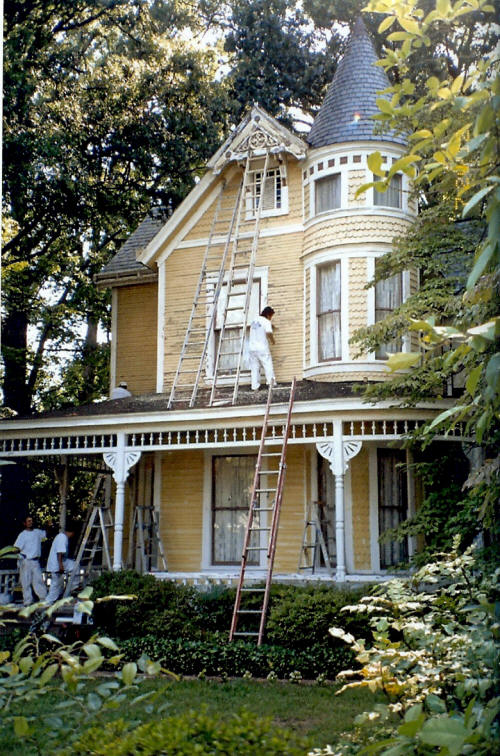
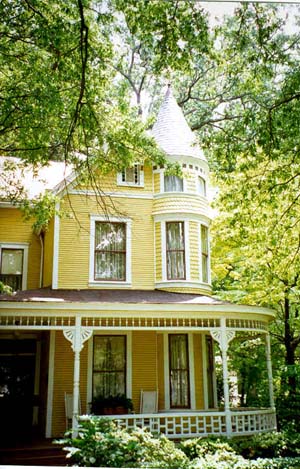
Tucked in among tall trees behind a cast-iron fence on a narrow residential lot is Victoria, a late nineteenth century frame house. Moved to its present location in the early twentieth century, it was previously located on North Tryon Street, once one of the finest residential streets of the city, now the main street of the commercial section. The asymmetrical structure appears strongly vertical as a result of the tall front end gable and the engaged two-and-one-half story tower, circular in section with a conical roof. The exterior wall covering is narrow horizontal siding, except on the tower and attic gables where fish scale shingles are used. The roof is slate. Windows are two-over-two double hung sash with flat board architraves with molded tops.

In plan, the front two-story section of the house is T-shaped with the stem of the T-towards the street. To the rear are kitchen and bedroom wings. A one-story shed porch having a low rail, a geometric screen-like balustrade, turned posts, and sawn sunburst brackets supporting a row of spindles, wraps around the advanced bay beginning at the recessed entry on the left and curving around the base of the tower terminating against the front of the cross gable on the right. The doors to the entrance vestibule on the left are set in a heavy flat board chamfered architrave which is slightly ramped at the base. Applied panels scalloped at the bottom occur where the architrave is ramped as well as at the upper corners and center. Beneath the beveled glass transom (a replacement) are nicely carved natural oak double screen doors that have recently been filled in with glass.

To the left of center on the front gable end in both the first and second stories is slightly wider than a normal window. The centrally placed attic window contains a central louvered panel surrounded on the top and sides by small square stained glass panes. At the peak, the eaves are decorated with alternating rectangular faceted panels and roundels. The bargeboard has a carved curvilinear decoration. The corner tower has three window at each level. The third level, slightly narrower than the first two, has single pane casement windows. Above these is a band of square wood panels encircling the tower.

The blank bay wall on the right side of the house to the rear of the tower on the second floor is adorned with a shield set in a gabled frame. The projecting cross gable end has double windows on all three levels. At the peak, the bargeboard is ornamented with a trellis motif; on the opposite side, the left side of the house, the gable is treated in a similar fashion except that the trellis is diagonal. A window is placed on this facade midway between the first and second level. To the rear of the cross gable the roof continues down to shelter the back rooms onto which the one-story gable roof kitchen and flat roof back porch and bathroom are attached.

The interior of Victoria is characterized by a free flowing yet compact plan and exuberant detail typical for the late nineteenth century. In the stem of the T there is a side hall on the left side of the house containing a closed string stair rising on the outside wall. To the right are front and rear parlors entered through single and sliding double doors respectively and connected by sliding double doors. Across the rear, forming the crosspiece of the T, are two large rooms flanking a narrow hall. The kitchen wing is enclosed on two sides by a porch. The second floor plan resembles that of the first.

One of the most interesting features of the house is the extensive use of handsome ornamental tiles. The main stair has square cream colored tiles set in the square carved newel on the exposed sides of the cap and base; and these tiles also occur between every second baluster, being framed by the square balusters and interrupting the turned ones. The tiles, said to have come from Italy, are variations of a circle of swirl motif, either abstract such as a circle set in field of diagonal squares of realistic such as the profile of a Roman soldier set within a circle. Tiles are also used to decorate the fireplace hearths and surrounds. In the front parlor, the hearth has a geometric pattern, the surround features a floral pattern, but the individual tiles are subtly modeled to compose large figures in low relief extending across several tiles–standing figures on the sides and a reclining figure across the top. The rear parlor and dining room fireplaces have figure and floral designs respectively in higher relief.

Also of note in the interior is the treatment of wood details. Window and door architraves are symmetrically molded with roundel corner blocks topped with a flat peaked finial with an incised half sunburst. Doors have seven panels, usually with chamfered rails and styles (the wainscot in the hall is done in a similar fashion). The original hardware, which is silverplate, is extant to a large degree. Delicate bent wood and spindle-work screens decorate the upper openings of the parlors’ double doors and the opening into the bay formed by the tower off the front porch.

Well executed mantels demonstrate a variety of woodworking techniques. In the front parlors, freestanding truncated colonnettes with floral pattern gougework support a low arch with faceted pattern in the spandrel which in turn carries the mantel shelf. An elaborate overmantel containing a faceted mirror is decorated with the same faceted pattern and carries a spindle-work canopy. An mantel similar in form but with no overmantel occurs in the rear parlor. The dining room mantel is the most elaborate, having spindle-work shelves, two glazed cabinets, a gougework panel and three beveled mirrors. The second floor mantels and trim are simpler.

Victoria is said to have been built about 1895 by R. M. Miller as a wedding gift for his son, R. M. Miller, Jr. Miller and his sons were substantial members of the Charlotte business community. He was an alderman for Ward One, president of the North State Club, and shared business interests with his sons in wholesale groceries, grains, cotton, tobacco, and was president of the D. A. Tompkins Company (consulting and contracting engineers and dealers in machinery), as well as a member of the board of directors of the Commercial National Bank. Victoria was owned by the brother of R.M. Miller Jr., John Walter Miller.

Originally one of two identical houses, Victoria stood beside its mate, located at the corner of Tryon and Seventh Streets. Soon this central urban location was usurped by downtown commercial expansion and Victoria was moved to its present, quiet, residential site and the other house was demolished. This was believed to have taken place between 1910 and 1920. During the first half of the twentieth century the house served a variety of owners and purposes; the property was a boarding house for a period of time. The current owners have enthusiastic, long range plans for the restoration and preservation of the structure.

Note:  In August, 2012, Victoria was re-painted, see below photographs for before and after.

victoriaaug2012victoria20123


Villalonga-Alexander House

THE VILLALONGA-ALEXANDER HOUSE
This report was written on June 4, 1978
villa

1. Name and location of the property: The property known as the Villalonga-Alexander House located at 301 E. Park Ave. in Charlotte, N.C.

2. Name, address and telephone number of the present owner and occupant of the property:
The present owner of the property is:
Mrs. Ouida Dasher Brown
301 E. Park Ave.
Charlotte, N.C. 28203

Telephone: 332-2234

The present occupants of the property are:
Mrs. Ouida Dasher Brown
Mrs. Inez Dasher
An aggregate of roomers
301 E. Park Ave.
Charlotte, N.C. 28203

Telephone: 332-2234

3. Representative photographs of the property: This report contains representative photographs of the property.

4. A map depicting the location of the property: This report contains a map depicting the location of the property.

villalonga-map

5. Current Deed Book Reference to the Property: The most recent reference to this property is recorded in Mecklenburg County Deed Book 1625 at Page 180. The Tax Parcel Number of the property is 12307101.

6. A brief historical sketch of the property:

Mr. John L. Villalonga, president and treasurer of the Charlotte Roof and Paving Co. and president of the Charlotte Brick Co., began the construction of his residence in Dilworth in the summer of 1900.l A perusal of the local newspapers reveals that the edifice was regarded as one of the handsomest and most complete houses in Charlotte.”2 Indeed, The Charlotte Daily Observer of March 4, 1901, urged the public to visit the J. H. Wearn Co. for purposes of viewing and appreciating the “quartered oak doors” which Mr. George W. Farrington had made “for the new house of Mr. J. L. Villalonga.” The newspaper reported that the panels of the doors were fashioned from “the very finest grade of curly-quartered oak” and that the workmanship demonstrated “what North Carolina forest products and what Charlotte workmen” could accomplish.3 Mr. Villalonga and his wife, Constance M. Villalonga, moved into their home in late March or early April 1901.4 That Mr. and Mrs. Villalonga were active in community, affairs is certain. He was a member of the Vestry of St. Peter’s Episcopal Church, and she participated in the activities of the Saturday Afternoon Club, a prestigious womens organization of that era.6

In February, 1903, Mr. and Mrs. Villalonga sold their home in Dilworth and moved to New York City.7 The new owner was Robert O. Alexander, a native of Sampson County, N. C., who had most recently resided in Monroe, La., where he had been a cotton broker. He practiced the same profession in Charlotte for over twenty years and was regarded as one of the best authorities on staple cotton in the state.8 Mr. Alexander also acquired the reputation of being a deeply religious and pious individual. A self-proclaimed “sanctificationist ” and member of First Presbyterian Church, he conducted revival meetings in a tent on South Boulevard in September 1903. According to the Charlotte Daily Observer, he preached to “large congregations,” telling them that material prosperity would only come to those who believed as he did. “If you prefer to live on bacon and cornbread, Mr. Alexander proclaimed, keep on living as you are living now. But if you wish to have good fat beefsteak and biscuits and butter be sanctified as I am.”9

Regardless of how one feels about Mr. Alexander’s religious proclivities, one is forced to admit that he did prosper. In addition to being a successful cotton broker, he acquired and developed large tracts of land at Black Mountain, N. C. He was also largely responsible for the development of the Presbyterian Assembly Grounds at nearby Montreat.10 Mr. Alexander died on November 13, 1926, at the age of sixty-three,11 leaving behind a widow and several children.12 May Herndon Alexander, daughter of Mr. and Mrs. Edward Beverly Herndon, was born on July 1, 1876, in Shreveport, LA. It was her that she would meet and marry R. O. Alexander. She moved with her husband to Charlotte in 1901.13 One can imagine the excitement which Mrs. Alexander must have experienced when occupying her new home in February 1903. According to some sources, Mrs. Alexander had told her husband that she would be happy to live in North Carolina if she could reside in the house which Mr. J. L. Villalonga had erected in Dilworth. Local tradition holds that it was this news which prompted Mr. Alexander to purchase the structure.14 Of course, he always insisted that Divine Providence had played a part in the transection.15 A glimpse into the lavish social life which occurred in the Alexander’s new abode is provided by an article which appeared in the Charlotte Daily Observer on April 24, 1903. It described a reception which had taken place in the house the previous evening. The rooms, the article reported, were beautifully decorated, the color scheme of pink, white and green being exquisitely carried out in roses, carnations and smilax.” The newspaper went on to relate that palms were placed throughout the house and that “music was furnished by the Academy orchestra.” 16 Mrs. Alexander lived in the house until 1936, when the Federal Government foreclosed a mortgage which it held on the property. 17 She rented a room in an apartment house next door and continued to reside there until her death on May 10, 1958.18 Despite the urgings of the subsequent owners of the property, Mrs. Alexander never entered the home again. Apparently, her emotions would not allow her to do so. 19 Mrs. Alexander was survived by seven children, four daughters and three sons. They included Mrs. T. E. Hemby, Mrs. McAlister Carson, Mrs. Ruth A. Roberts, Mra. Phillip Hasel, Mr. E. Herndon Alexander, Mr. Robert O. Alexander, Jr. and Mr. John McKnitt Alexander. All had grown up in the home at 301 E. Park Ave.20

In 1938, the property was purchased by Julian E. Dasher and his two sisters, Doris and Ouida.21 They in turn granted a life estate in the property to their mother, Clara E. Dasher.22 The younger Dashers and their spouses resided in the house, and Clara Dasher began to rent rooms to boarders. This practice continued until May 21, 1953, when Mrs. Dasher expired.23 Ouida Dasher Brown and her husband, J. Arthur Brown, assumed the responsibility of managing the property. Mr. Brown, who was in the wholesale lumber business, died on August 24, 1964, at the age of seventy-seven. Mrs. Brown continues to reside in the structure and to rent rooms to boarders.24 The most dramatic event in the physical history of the Villalonga-Alexander House occurred on March 14, 1948. A fire destroyed the greater portion of the interior of the center of the structure, including the roof and dormers.25 “Fire gutted the old Alexander home at 301 East Park Avenue early yesterday morning,” the Charlotte Observer reported. “A stairway leading to the second floor,” the newspaper explained, “acted as a perfect draft, drawing the flames upward through the roof. The rear of the house wee damaged slightly by water.”26 The owners of the property were forced to live in a small house on Cleveland Ave. while extensive repairs were made to the main house. Financial considerations made restoration of the structure impossible. However, the owner did attempt to be sensitive in the changes and alterations which they were compelled to make.27


Footnotes:
1 Charlotte City Directory 1902, p. 460. The Charlotte Daily Observer (September 11, 1900) p. 5.

2 The Charlotte Daily Observer (February 3, 1903) p. 5.

3 The Charlotte Daily Observer (March 4, 1901) p. 6.

4 The Charlotte Daily Observer (March 10, 1901) p. 6.

5 The Charlotte Daily Observer (January 7, 1902) p. 5.

6 The Charlotte Daily Observer (November 6, 1901) p. 5.

7 Mecklenburg County Deed Book 174, p. 318. The Charlotte Daily Observer (February, 3, 1903) p. 5.

8 Mecklenburg County Death Book 26, p. 1036. The Charlotte Observer (November 14, 1926) sec. 1, p. 4.

9 The Charlotte Daily Observer (September 21, 1903) p. 5.

10 The Charlotte Daily Observer (November 14, 1926) sec. 1, p. 4.

11 Mecklenburg County Death Book 26, p. 1036.

12 The Charlotte Daily Observer (May 11, 1958) p. 15E.

13 Ibid.

14 The Charlotte News (March 15, 1948) p. 5A.

15 The Charlotte Daily Observer (September 21, 1903) p. 5.

16 The Charlotte Daily Observer (April 24, 1903) p. 5.

17 Mecklenburg County Deed Book 901, p. 154.

18 The Charlotte Observer (May 11, 1958) p. 15E.

19 Interview of Mrs. Ouida Dasher Brown by Dr. Dan L. Morrill (May 16, 1978). Hereafter cited as Interview.

20 The Charlotte Observer (May 11, 1958) p. 15E.

21 Mecklenburg County Deed Book 953, p. 67.

22 Mecklenburg County Deed Book 953, p. 66.

23 Interview

24 Ibid.

25 For a photograph of the structure immediately following the fire, see The Charlotte News (March 15, 1948) p. 5A.

26 The Charlotte Observer, (March 15, 1948) p. 1B.

27 Interview.


7. A brief architectural description of the property: This report contains an architectural description prepared by Ms. Ruth Little-Stokes, architectural historian.

8. Documentation of wky and in that ways the property, meets the criteria set forth in N. C. G. S. 160A-399.4:


a. Historical and cultural significance: The historical and cultural significance of the property known as the Villalonga-Alexander House rests upon three factors. First, it is an early example of Colonial Revival style architecture in the City of Charlotte. Second, it is one of the oldest mansions which survives in Dilworth, Charlotte’s initial streetcar suburb. Third, it has associative ties with individuals of local prominence.

b. Suitability for preservation and restoration: The structure and grounds are in an excellent state of repair. On balance, the house is well preserved, except for damage which resulted from the fire on March 14, 1948. Sufficient documentation exists to permit the restoration of the exterior of the structure.

c. Educational value: The Villalonga-Alexander House has educational value because of the historical and cultural significance of the property.

d. Cost of acquisition, restoration, maintenance or repair: At present, the Commission has no intention of securing the fee simple or any lesser included interest in this property. The Commission presently assumes that all costs associated with restoring and maintaining the property will be paid by the owner or subsequent owner of the property.

e. Possibilities for adaptive or alternative use of the property: The Villalonga-Alexander House is currently zoned for office use (O6 ). The Commission believes that the structure is best suited for residential use, either single or multi-family.

f. Appraised value: The Current tax appraisal of the improvements on the property is $710. The current tax appraisal of the .312 acres of land is $22,410. Tho most recent annual tax bill on the property was $388.42. The Commission is aware that designation would allow the owner to apply for a deferral of 50% of the Ad Valorem taxes on all or any portion of the property which becomes “historic property”.

g. The administrative and financial responsibility of any perrson or organization willing to underwrite all or a portion of such costs: As stated earlier, the Commission presently has no intention of purchasing the fee simple or any lesser included interest in this property. Furthermore, the Commission presently assumes that all costs associated with the property will be paid by the present or subsequent owners of the property.

9. Documentation of why and in what ways the Property meets the criteria established for inclusion in the National Resister of Historic Places: The Commission judges that the property known as the Villalonga-Alexander House does meet the criteria of the National Register of Historic Places. Basic to the Commission’s judgment is its knowledge that the National Register of Historic Places, established by the National Historic Preservation Act of 1966, represents the decision of the Federal Government to expand its recognition of historic properties to include those of local, regional and State significance. The Commission believes that its investigation of the property known as the Villalonga-Alexander House demonstrates that the property possesses local historical and cultural importance. Consequently, the Commission Judges that the property known as the Villalonga-Alexander House does meet the criteria of the National Register of Historic Places.

10. Documentation of why and in what ways the property is of historical importance to Charlotte and/or Mecklenburg County: The property known as the Villalonga-Alexander House is historically important to Charlotte and Mecklenburg County for three reasons. First, it is an early example of Colonial Revival style architecture in the City of Charlotte. Second, it is one of the oldest mansions which survive in Dilworth, Charlotte’s initial streetcar suburb. Third, it has associative ties with individuals of local prominence.


Chain of Title
1. Mecklenburg County Deed Book 1625, Page 180 (August 7, 1953).
Grantors: Doria Dasher Henley & husband, John D. Henley Julian E. Dasher & wife, Florine Hallman Dasher, Alva Lee Dasher & wife, Inez Long Dasher
Grantees: Ouida Dasher Brown

2. Mecklenburg County Deed Book 953, Page 66 (July 22, 1938).
Grantors: Ouida D. Brown & husband J. Arthur Brown Doris Dasher Henley & husband, John D. Henley Julian E. Dasher & wife, Florine H. Dasher
Grantee: Clara E. Dasher (Life Estate)

3. Mecklenburg County Deed Book 953, Page 65 (July 22, 1938).
Grantor: Ouida D. Erown & husband, J. Arthur Brown Doris Dasher Henley & husband, John D. Henley Julian E. Dasher & wife, Florine H. Dasher
Grantee: Alva Lee Dasher (one-fourth interest)

4. Mecklenburg County Deed Book 953, Page 67 (July 22, 1938).
Grantee: C. O. Dulin & wife, Eva Faubert Dulin
Grantor: Ouida Dasher Brown, Doria Dasher Henley & Julian E. Dasher

5. Mecklenburg County Deed Book 944, Page 29 (March 11, 1938).
Grantor: Hoae Owners’ Loan Corporation of Washington, D.C.
Grantee: C. O. Dulin & wife, Eva Faubert Dulin

6. Mecklenburg County Deed Book 901, Page 154 (November 28, 1936).
Grantor: T. C. Abernethy, Commissioner
Grantee: Home Owners’ Loan Corporation of Washington, D.C.
7. Mecklenburg County Deed Book 797, Page 235 (December 8, 1933).
Grantor: Mrs. May Herndon Alexander (Widow)
Grantee: Home Owner’s Loan Corporation of Washington, D. C. (Deed of Trust)

8. Mecklenburg County Deed Book 617 , Page 427 (June 24, 1926).
Grantor: E. B. Herndon
Grantee: Hay Herdon Alexander

9. Mecklenburg County Deed Book 624, Page 250.
Grantor: Wardlaw P. Thomson, Trustee
Wardlaw P. Thomson & wife, Elizabeth Alexander Thomson May H. Alexander (widow)
Grantee: E. B. Herndon .

10. Mecklenburg County Deed Book 614, Page 203 (August 1, 1925).
Grantor: E. B. Herndon
Grantee: Wardlaw P. Thomson

11. Mecklenburg County Deed Book 445, Page 443 (May 16, 1921).
Grantor: Thaddeus A. Adams, John A. Coke, Jr., Trustees
Grantee: E. B. Herndon

12. Mecklenburg County Deed Book 358, Page 157 (March 15, 1916).
Grantor: R. O. A1exander & wife, May H. Alexander
Grantee: Thaddeus A. Adams & John A. Coke, Jr. (Deed of Trust)

13. Mecklenburg County Deed Book 174, Page 318 (February 2, 1903).
Grantor: J. L. Villalonga & wife, Constance M. Villalonga
Grantee: Robert O. Alexander

14. Mecklenburg County Deed Book 168, Page 178 (Apri1 28, 1902).
Grantor: Charlotte Consolidated Construction Co.
Grantee: Constance M. Villalonga, wife of J. L. Vlllalonga

15. Mecklenburg County Deed Book 156, Page 227 (May 10, 1900).
Grantor: Walter Brem & wife, H. C. Brem
Grantee: Mrs. Constance M. Villalonga

16. Mecklenburg County Deed Book 150, Page 609 (May 10, 1900).
Grantor: Charlotte Consolidated Conatruotion Co.
Grantee: Mrs. Constance M. Villalonga


Date of Preparation of this Report: June 4, 1978

Prepared by: Dr. Dan L. Morrill, Director
Charlotte Mecklenburg Historic Properties Commission
139 Middleton Dr.
Charlotte, N.C. 28207

Telephone: (704) 332-2726


Architectural Description
residence-of-jl-villalonga

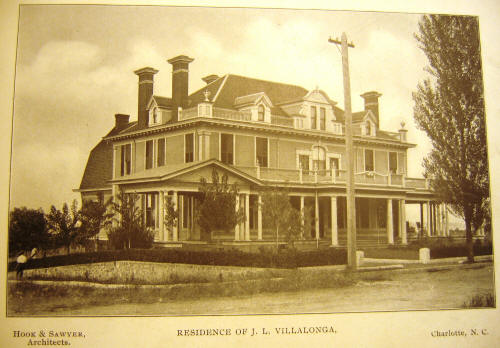
Residence of J.L. Villalonga was featured in “Some Designs,” a promotional booklet published by Hook & Sawyer ca. 1902.

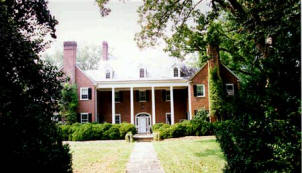
The Villalonga-Alexander House, 301 East Park Avenue, Charlotte, built in 1900-1901, is the largest remaining private residence in the early suburb of Dilworth. The Colonial Revival style two and one-half story frame house has an unusually wide classical front porch which extends on the west side as a porte-cochere and on the right side as a balancing side porch. The well-preserved site contains a formally landscaped lawn, divided by a low rusticated granite retaining wall with granite cornerposts. A wide sidewalk leads to the center entrance and a driveway leads beneath the porte-cochere. Although the entrance hall, stair well, and roof of the house were destroyed by a 1948 fire and rebuilt, the remainder of the interior and exterior is well-preserved. The Villalonga-Alexander House is a product of the turn-of-the-century industrial boom which marked the beginning of the New South, yet retains the polite dignity and generosity of scale expressive of the Old South. The main block, five bays wide and four bays deep, rests on an unusually deep full brick basement, laid in random common bond, and is surmounted by a deep gable-on-hip (British gambrel) roof. The main facade is strongly centralized by the ornate center entrance, the scrolled pediment design of the porch balustrade above the center bay, the Palladian window in the center bay of the second story, and the large center roof dormer. The entrance consists of a replacement door (due to fire damage) set within an interesting classical framework, with fluted pilasters resting on a chair rail which continues across the entire main facade beneath the front porch. Flattened Ionic capitals cap the pilasters and support a lintel with an applied garland motif giving the appearance of hanging from the capitals. The Palladian window is a two-over-two round-arched sash with flanking one-over-one rectangular sash, set within a surround with a keystone over the center window. The gabled dormer, a replacement following the fire, has a solid curvilinear bargeboard and a one-over-one sash. A comparison of the present main facade with a photograph of the house in Art Work of Charlotte, North Carolina, a photographic album published in 1905, indicates that the roofline is considerably less ornate than it was originally. The flanking sash of the Palladian window originally had lozenge window panes, the newels of the porch balustrade were crowned with wooden finials, the dormers had ornate pediments, the center pediment adorned with a swag and scroll brackets, and a balustrade stretched between the dormers along the eaves, with heavy corner newels surmounted by large metal urns, These decorative details were not replaced after the 1948 fire, although the urns were rescued and are now stored in the basement.

A second front entrance is located in the western bay of the main facade, This double glazed door, located in the front face of the bay, has a single pane transom and replaces an original window. A corresponding bay is located on the other side of the main facade, but contains sash windows, The windows of the main block are one-over-one sash, with plain surrounds with molded lintels. These originally had louvered shutters. The door surrounds are identical to those of the windows, The walls are covered with narrow German siding. At each corner is a fluted cornerboard with an Ionic capital, echoing the main entrance treatment, eave treatment consists of a wide frieze and a boxed, molded cornice. The original roof was covered with wooden shakes, the post-fire replacement is covered with composition shingles. The three dormer windows of the main facade, also replacements, have one-over-one sash windows and gabled roofs with solid, curvilinear bargeboards. Two tall brick, interior end chimneys project from each side elevation, An additional chimney projects from the rear slope of the roof near the junction of the rear wing, Each chimney stack has a molded metal collar. The one-story rear wing is treated identically to the main block, except that the roof has a gambrel form, with dormer windows along the flanks, and an interior end chimney on the gambrel end. A door in the center west side bay of the wing leads to a rear stair. The outside steps which originally provided exterior access to this stair have been removed. The shed porch along the east side of the wing is a later addition. The one-story porch which stretches the length of the main facade is supported on Doric posts, paired on each side of the main entrance and tripled at the corners. The porch gives a tripartite division to the facade design, for the west porte-cochere bay and the east porch bay are each capped by a shallow pediment with a rough finish stucco tympanum and overhanging boxed, molded eaves. Between the pedimented bays is a roof balustrade with turned balusters, square newels with molded caps, and a scrolled pediment design in the railing above the entrance bay.

The twelve foot wide porch matches the other measurements of the house in scale. The porch originally extended partially along the east elevation, but has been enclosed. The wooden carriage steps leading from the driveway up to the porch floor, beneath the porte-cochere, are still in place. The interior finish of the Villalonga-Alexander House represents the lavish eclecticism of turn-of-the-century American architecture. The plan, true to the pre-Revolutionary houses which the Colonial Revival style was based upon, has no center hall. A series of rooms is arranged in a circular pattern around the fireplace and stair in the center of the house. Unlike Colonial floor plans, the rooms of the Villalonga-Alexander House were originally linked by double sliding doors so that the entire first floor became a relatively continuous open space. All of these double doors remain except those in the side walls of the entrance hall, which were not replaced during the post-fire reconstruction. The plan consists of a center entrance hall, at the rear of which is the main stair, with a parlor and library on the west, another parlor and dining room on the east The rear wing contains the kitchen with a butler’s pantry between the main block and the kitchen. Directly behind the entrance hall is a room which was originally the conservatory, with two-over-two sash windows lining the east wall. The partition between the butler’s pantry and conservatory was removed and this large room is now a den. The second floor contains a large center hall, with a narrower hall extending to a bathroom on the east end, with five bedrooms flanking the hall. In the northwest corner of the stair landing to the second floor is a stair leading to the large attic. The rear wing has a narrow hall along the east side and a large bedroom and bath. The rear stair, accessible from the outside, opens into this hall. The rear wing probably served as servants’ quarters. The center area of the house, including the entrance hall and stair, a portion of the dining room, and the second floor hall and attic, was destroyed by the 1948 fire. This has been rebuilt in a compatible style but is obviously of more recent vintage. The entrance hall, originally the most ornate room in the house, had a parquet floor, a carved oak wainscot, exposed ceiling joists, ornate paneled oak doors, and an unusual brick fireplace. The only original feature which survived the fire is the fireplace, which did not burn because it is constructed completely of brick and terra cotta tile.

The origin of its design and placement beneath the staircase is in the Colonial Revival style houses constructed in the 1880s in New England by H. H. Richardson. In his designs, he intermingled round brick arches and richly molded tilework derived from Romanesque European architecture with native 18th century forms. He also favored the use of the medieval entrance hall, with the fireplace and stair as the physical and symbolic core of the house. His houses were the models for many Colonial Revival architects during the late 1900s and early 1900s. Most notable were McKim, Mead, White, who worked primarily in New York and New England. Designers in Norch Carolina generally followed the Queen Anne and Neo-Classical Revival styles, and the Colonial Revival style did not attain general popularity in the South until the 1920s. The Villalonga-Alexander House entrance hall fireplace consists of a broad, elliptically arched opening with four molded tile archivolts (semicircular molded bands), a brick shelf with a double egg and dart cornice, and a flat-paneled brick overmantel outlined by a rich tile surround with interlace designs. It was probably imported from the North. The dining room, the largest room in the house and now the most ornate room in the house, has a parquet floor, paneled doors with applied, hand-carved wooden garland ornament, and a magnificent Renaissance Revival style mantel with overmantel. This room also had a paneled wainscot, but it was removed because of damage during the 1948 fire. The mantel is executed in darkly stained oak, and contains terns (pedestals tapering towards the base and merging at the top into a mythical animal) which support the frieze and shelf. The shafts of the terms are decorated with applied floral ornament reflecting the influence of Pompeiian wall decoration which was revived in the Renaissance. At the top of each tern is a ferocious lion with bared teeth. This mantel was probably also imported. The light fixture of Tiffany design which originally hung above the dining room table is now in storage, and is the only original light fixture which has survived. The decorative finish of the remaining rooms is Neo-Classical Revival in style, and is typical of the woodwork found in most North Carolina houses of this period. It is in sharp contrast with the New England flavor of the entrance hall fireplace and the Baroque richness of the dining room mantel.

The mantels, no two of which are alike, have free-standing or engaged classical columns or posts, friezes adorned with applied floral and garland ornament, and molded shelves, often with a paneled overmantel. The first floor mantels are more ornate than those on the second floor. The hearth and fireplace surrounds are paved with ceramic tile, and have iron surrounds. At least one of the fireplaces has an ornate metal lining. The other fireplace openings have been sealed, and are not visible. The walls and ceilings throughout are plastered. The first floor main block rooms have parquet floors in a herring bone pattern of identically stained oak strips, with a herring bone border of oak strips of alternating dark and light stains around tile perimeter of each room. Throughout the remainder of the house are narrow plain oak floors. The original door and window trim of the first floor main block consists of wide surrounds with small egg and dart moldings. The second floor of the main block and both floors of the rear wing have simple molded door and window surrounds. The single doors throughout the house are flat-paneled. The aprons of the windows in the two front parlors and the library are flat-paneled, with flanking wide pilasters supporting wide window sills. Several of the pilasters have a fluted effect created by attached wooden strips. Several of the bathrooms retain interesting, original built-in marble sinks. The kitchen has a huge gas hotel range bought in 1938. This was necessary to feed the numerous boarders that the present owner and her mother before her have kept. The basement, which occupies the entire space beneath the main block, is one of the most unusual areas of the house because of its height…approximately fifteen feet.



Wade House

THE HOWARD MADISON WADE HOUSE
This report was written on May 1, 1983

wade

1. Name and location of the property: The property known as the Howard Madison Wade House is located at 530 Hermitage Road, in Charlotte, North Carolina.

2. Name, address and telephone number of the present owner and occupant of the property: The present owner and occupant of the property is:

John H. Cutter and wife Rita F. Cutter
1500 E. Fourth Street
Charlotte, NC 28204

Telephone: (704) 334-2489

3. Representative photographs of the property: This report contains representative photographs of the property.

4. A map depicting the location of the property: This report contains a map which depicts the location of the property.

wade-map

5. Current Deed Book Reference to the property: The most recent deed to this property is listed in Mecklenburg County Deed Book 4056 at Page 981. The Tax Parcel Number of the property is: 155-053-07.

6. A brief historical sketch of the property: This report contains a brief historical sketch of the property prepared by Dr. William H. Huffman.

7. A brief architectural description of the property: This report contains an architectural description of the property prepared by Thomas W. Hanchett, architecture historian.

8. Documentation of why and in what ways the property meets the criteria set forth in N.C.G.S. 160A-399.4:


a. Special significance in terms of its history, architecture, and/or cultural importance: The Commission judges that the property known as the Howard Madison Wade House does possess special significance in terms of Charlotte-Mecklenburg. The Commission bases its judgment on the following considerations: 1) the Howard Madison Wade House, erected in 1928-30, was designed by Charles Barton Keen, an architect of national significance; 2) the grounds of the Howard Madison Wade House, were designed by Earle S. Draper, the most important landscape architect and planner in the southeastern United States in the first half of the twentieth century; 3) the Howard Madison Wade House is one of the finer, local examples of the Colonial Revival style; 4) the Howard Madison Wade House is situated at the intersection of Hermitage Road and Granville Road directly across from a park making the site extremely important to the overall integrity of Myers Park; 5) Howard Madison Wade (1876-1961), the original owner was a businessman of regional importance, specializing in custom interior woodworking.

b. Integrity of design, setting, workmanship, materials, feeling and/or association: The Commission contends that the attached architectural description by Mr. Thomas W. Hanchett demonstrates that the Howard Madison Wade House meets this criterion.

9. Ad Valorem Tax Appraisal: The Commission is aware that designation would allow the owner to apply for an automatic deferral of 50% of the Ad Valorem taxes on all or any portion of the property which becomes “historic property.” The current appraised value of the 1.857 acres of land is $96,000. The current appraised value of the improvements is $325,840. The total current appraised value is $421,840. The property is zoned R12.

Date of Preparation of this Report: May 1, 1983

Prepared by: Dr. Dan L. Morrill, Director
Charlotte-Mecklenburg Historic Properties Commission
218 N. Tryon Street
Charlotte, North Carolina 28202

Telephone: 704/376-9115

Special Note: Please note that Charles Barton Keen sometimes spelled his name with a final “e.” Dr. Huffman uses the latter spelling in his essay, and Mr. Hanchett uses the former spelling in his essay.


Historical Overview


WlLLIAM H. HUFFMAN
March, 1983

When Howard Madison Wade (1876 – 1961) came to Charlotte in 1906, he wanted to apply his seemingly unlimited energy to business pursuits that could grow with the town which seemed “an up and coming place,” and the climate would possibly be better for his wife, the former Rosalie Tarver (1878 – 1956), to whom he was married in 1900. 1 Born on a farm outside Columbus, Georgia, on August 21, 1876 Mr. Wade earned a B. A. degree from Emory University, at that time located in Oxford, Georgia, following which he became the principal at Columbus High School, where he taught Latin and Greek as well as modern and medieval history. In 1901, he decided to leave the teaching profession and apply his talents to the business world, and so he traveled north to enroll in the Eastman Business College, Poughkeepsie, New York, where he studied commerce and banking. After graduation, Wade returned to Columbus, where he became vice president of the Georgia Manufacturing Co., and from 1903 to 1906, was the secretary – treasurer of the Massey – Perkins Yarn and Hosiery Manufacturing Company. 2

After his arrival in Charlotte, the thirty-year-old entrepreneur started the Wade Manufacturing Company, located off South Graham Street between Stonewall and Hill Streets near the railroad tracks. For over seventy years, Wade Manufacturing produced custom interiors, primarily of fine polished wood, including fixtures, furnishings and paneling, for stores, banks, churches and other similar establishments. Expert craftsmen were brought over from Europe to make the furnishings, examples of which may still be seen at 630 South Graham Street, now the office of Southern Shows, Inc. H. M. Wade had chosen his new home well, for not only did he and his company participate fully in Charlotte’s steady, at times rapid growth of the next few decades, but they also supplied customers throughout North and South Carolina, Georgia and other Southern states. 3

Following the birth of their daughter, Isabelle Tarver, in 1911, the Wades decided to move from their residence at 610 North Church Street in the city to a place in the country, and so they purchased a lot about two miles south of the Square in September of that year. 4 The one-and-a-half-acre site they chose on Hermitage Road facing a small park was located in the newly-opened Myers Park, a suburban development by businessman George Stephens of the 1200 acre farm owned by his father-in-law, John Springs Myers. At the time, the Wades were one of the first property owners in the newly-designed area which was originally laid out by John Nolen, a professional landscape architect and town planner from Cambridge, Massachusetts. Providence Road was yet to be paved for a few years, and the first streetcar leaving the Square and passing through the gates on Queens Road on its way to Queens College did not make the journey until a year after they purchased their new home site. 5 The enterprising Mr. Wade designed their first Hermitage Road residence himself, and had it built by workers from his manufacturing company. His daughter, Isabelle Wade Bacon, described it thus:


It was a white shingle house, and he drew the plans himself. Downstairs it had a living room, library, dining room, breakfast room, kitchen, bedroom and bath . Then on the second floor it had four bedrooms and two baths. The feature we all loved was an old-fashioned porch, all open, and we all sat around on it.

The house was elevated. You had to go up a round driveway, and it was one of the old houses with the porte-cochere that the driveway goes up underneath. 6

In the years following the Wade’s move to the “country,” Myers Park began to grow and change as more and more business and professional families came out to build homes along the suburb’s curved, tree-lined streets. In 1915, John Nolen brought to Charlotte another young landscape architect and town planner, Earle S. Draper, to prepare landscape plans for each purchaser of a lot in the development. Two years later, Draper went into business for himself, and helped continue the planning and landscape designs for Myers Park, and other developments. The prosperity of the Teens and Twenties in Charlotte was accompanied by many fine homes being constructed around the Wades. In 1919, a nearby mansion, White Oaks, was purchased and greatly enlarged by James B. Duke, and is now on the National Register of Historic Places. Another neighbor at 611 Hermitage Road, across from the Duke house, was John H. Cutter, a real estate investor-developer and cotton broker, the grandfather of the present owner of the Wade house, who after having lived at the then fashionable North Tryon Street purchased the residence in 1921. One block away, on Providence Road, John M. Jamison, the Stonewall Hotel owner, had put up his stone house (1912 – 13), and next to it Charles P. Moody built his red brick residence (c. 1913) at number 830. 7

In the nineteen-twenties, Mr. Wade had been in Winston-Salem and seen some of the fine large houses there designed by Philadelphia architect Charles Barton Keene (1868 – 1931). 8 Keene, who received his architectural training at the University of Pennsylvania, was first brought in to North Carolina to design the Reynolda House for R. J. Reynolds in 1917, a sixty-room “bungalow” outside Winston-Salem. After this commission, Keene, a nationally known architect, was in much demand to design other houses there, which he executed over the next fourteen years. In Charlotte, a neighbor of H. M. Wade, Charles E. Lambeth, one-time mayor of the city and prominent realtor, had Keene draw the plans for a house at 435 Hermitage Road, which was constructed about 1927. 9

A year later, Howard Wade hired the Philadelphia architect to draw the plans for a house to replace the one of his own design. While many owners are quite happy to leave the design and construction of a house to the architect and builder, just the opposite was the case with Mr. Wade who meticulously involved himself in the most minute details of both the planning and building of his new home. Once he and Keene had agreed on a design the manufacturer personally dealt with the contractors in negotiating construction bids from whom he required various options on using different materials and features. The successful bidder, B. Lowndes Jackson, agreed to construct the house for $63,865.00, but before he was accepted, H. M. Wade required him to submit the names and reputations of all the subcontractors he planned to use. In a letter of September 20, 1928, Jackson complied: Carpenter, H. Wright, who was foreman on Mr. Ivey’s house; bricklaying foreman, P. A. Jackson; millwork, J. H. Wearne Co.; structural steel, Southern Engineering Company; slate roof and metal work. G. G. Ray Co.; and plastering, M. P. Braswell. 10

After about three more months of negotiations, Wade was finally satisfied, and on the date after Christmas of 1928 he took out a building permit from the city so that construction could begin. 11 It took nearly three years to complete the steel-girdered, Georgian Colonial mansion, which was finished with fine moldings plastering, metalwork, marble floors, antique fire places as well as numerous other fine features. One of the many personal touches put in the plans at Wade’s insistence was that of the dining room: its design is a replica of the Baltimore Room in the Metropolitan Museum, which the Wades had seen on a trip to New York. Another is an unusual chimney flue on the third floor, which goes at a sharp angle from above the fireplace on the outer wall of the drawing room, where Wade required it to be placed, to the chimney on the inner wall, where Keene said it had to be. 12 A year after construction began on the sixteen-room home, Earle Draper was hired to design the landscaping for the site, and many of the plantings and other features of his original design remain, including the restored pool in the garden behind the house. 13 Draper, who built a house not too far away at 1621 Queens Road in 1923 and built his planning business into one of the largest in the country with offices in Atlanta, Washington and New York, became Director of Town Planning and Housing for the Tennessee Valley Authority from 1932 to 1940, and head of wartime housing for the FHA from 1940 to the end of World War II in 1945. 14

When the construction of the stately house was completed and the decorating finished, the Wades could look forward to many years of enjoying their commodious, yet surprisingly intimate residence. Rosalie Wade, who was an avid gardener and kept the small park across the street well planted in addition to her own grounds, was very active in the DAR, Colonial Dames and Alexander House activities, and many meetings of these groups were held at the home. 15 The family life was characteristic of people of means of that time and of that particular area. To maintain the household, the service staff included a chauffeur-butler, a cook, a maid and a gardener. For thirty-seven years, the chauffeur-butler was O’Dell Roberts, who was known to everyone by his courteous and gentlemanly manner. The house was also witness to two gala events: the wedding receptions for daughter Isabelle, and, when it was the turn of another generation, that of granddaughter Rosalie. 16

When H. M. Wade, who was president of the Charlotte Country Club for twenty five years, retired from the manufacturing business in 1954, he went into the real estate business with an office in the Latta Arcade. It was said of the indefatigable industrialist that “when he ‘retired,’ he had one secretary, and afterward had two.” Over the years he had acquired a good deal of real estate, much of it in the area around his manufacturing plant. 17 In 1956, Rosalie Wade passed away, and a year later H. M. Wade married her first cousin, Mrs. Louise Watkins Powe, who became the new mistress of the Wade mansion. 18 After Mr. Wade died in 1961, she lived in the house for another sixteen years, but decided she could no longer maintain the estate when some of the longtime servants retired because of age and health. 19

Thus in 1978, ownership of the Wade house passed to John H. Cutter, III, the grandson of H. M. Wade’s former neighbor and good friend, and his wife, Rita. 20 The Cutters, who have taken a keen interest in the history of the house, have undertaken extensive renewal and restoration of the fine home to bring it back to nearly as new condition. Their efforts are of clear historical significance, because the Wade mansion will be one of the few, if not the only, house of its size (fourteen thousand square feet or above) in Charlotte that is essentially intact as originally built. 21 The city will therefore be fortunate in having one of its fine larger houses in the early Myers Park area preserved indefinitely. The area is a fragile one, under constant threat from commercial encroachment, and thus to have such an excellent reflection of a particular way of life from another era, designed by an architect of national prominence, and which reflects in its details the personal desires and close interest of the owner, preserved in its original state, will be a significant step in maintaining Charlotte’s historical heritage.


NOTES
1 Charlotte News, April 25, 1961, p. 1 B; interview with Louise Watkins Powe Wade, Charlotte, N. C ., 8 March 1983.

2 Charlotte Observer, April 25, 1961, p. 1B.

3 Interview with Louise Wade.

4 Charlotte City Directory, 1910; Deed Book 283, p. 71, 12 September 1911.

5 Information on file at Charlotte Mecklenburg Historic Properties Commission.

6 Interview with Isabelle Tarver Wade Bacon, New York, 12 March 1983.

7 Interview with John H. Cutter, III, 15 February 1983; information on file at Charlotte Mecklenburg Historic Properties Commission.

8 Interview with Isabelle Wade Bacon.

9 Information on file at Charlotte Mecklenburg Historic Properties Commission.

10 Correspondence in the possession of John H. Cutter, III.

11 Building Permit No. 9693, 26 December 1928.

12 Interviews with Louise Wade, Isabelle Wade Bacon, and John H. Cutter, III.

13 Plans in possession of John H. Cutter, III.

14 Information on file at Charlotte Mecklenburg Historic Properties Commission.

15 Charlotte News, February 10, 1956, p. 10B; interview with Isabelle Wade Bacon.

16 Interview with Louise Wade.

17 Ibid.

18 Charlotte News, April 25, 1961, p. 1 B.

19 Interview with Louise Wade.

20 Deed Book 4056, p. 981, 10 May 1978.

21 Interview with John H. Cutter, III.


Architectural Description


by Thomas W. Hanchett
March 19, 1983

The 1930 H. M. Wade residence is an imposing red brick Colonial Revival style mansion in the heart of Charlotte’s elite Myers Park neighborhood. The house is the work of Charles Barton Keen of Philadelphia, one of America’s foremost designers of “country houses”, as suburban estates were known in the early twentieth century. Today both the house and its grounds by landscape architect Earle Sumner Draper are in excellent original condition. Because of the caliber of its architect and landscape designer, and because of its prominent location at the corner of Hermitage and Granville roads facing one of the neighborhood’s two small parks, the Wade mansion is of architectural significance to Charlotte and Mecklenburg County.

Of special note is the fact that the present owner still has most of the plans and correspondence dealing with construction of the house. The collection has over fifty items, including detailed drawings of everything from floorplans to precise layout of flagstones in outside walkways, contracts with craftsmen, letters between Keen, Wade, and Draper, fixture brochures and wallpaper samples, and more. According to Dr. Margaret Smith, art historian at Wake Forest University who is studying Keen’s work in the South, such a body of material is of great scholarly interest.

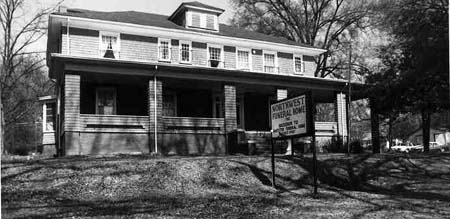
Viewed from the street, the Wade mansion consists of three gable-roofed, two-story wings arranged in a “C” around an inset front porch. The main wing is three bays wide, with the central front door topped by a delicate fanlight. A pair of end chimneys bracket the ridgeline and three clapboard-sided dormers pop through the front roof. The two flanking wings are set with their ridgelines at right angles to the main wing’s roof. Each flanking wing has an end chimney facing the street.

Roofs are of thick gray slate and eaves are quite shallow. The red brick walls are laid in Flemish bond. The white exterior woodwork is simple in design. The porch has a modillion cornice and unusually slender two-story columns. Windows are six-over-six-pane double-hung sash. The overall effect that Keen achieved with these touches was a simplicity and flattening of detail. Such an approach was a far cry from the elaborately textured exteriors of Colonial Revival dwellings built in the city in the early 1920s, for example Martin Boyer’s 1920 design for the J. L. Snyder mansion at 1830 Queens Road, now known as Queens College’s Carol Hall.

At the rear of the Wade house, the north flanking wing is extended back to provide garage space with servants’ quarters above. Nestled in the resulting “L” between the servants’ wing and the main block of the house is a formal garden designed for outdoor entertaining. A brick walk surrounds a lawn with a pool and fountain at its center. French doors from the grand dining room open onto one side of the space, and at the other a low carved stone wall of Neoclassical design provides seating niches under the trees. Hedges and shrubbery wall off this garden from the rest of the grounds, creating a spacious “outdoor room.”

This formal area was evidentially the main contribution to the estate’s design by landscape architect Earle Sumner Draper. It represents one of Draper’s later residential works, executed in 1930 three years before Draper gave up private practice to become head of planning for the Tennessee Valley Authority. A hand-colored rendering of the garden drawn in Draper’s office now hangs in the Wade house. Much of Draper’s work on the sides and front of the residence consisted of adapting the planting done for Wade’s earlier dwelling to the new house. The earlier design had been created in 1919 by J. Franklin Meehan, a Philadelphia landscape architect, and one of Meehan’s planting plans survives in the present owner’s collection.

The interior of the house shows the same restraint in decoration that characterizes the exterior. Keen’s main emphasis seems to have been on creating an elegant flow of spaces, rather than on decoration for its own sake. Downstairs rooms feature delicate plasterwork and molding. The quality of the cabinetry and woodwork throughout the house shows evidence of store-fixture manufacturer Wade’s care, and much of it is said to have been produced by craftsmen from his factory.

The main entrance of the mansion opens into a large oval foyer with black and white marble parquet floors. The ceiling has a cast plaster medallion in the center. A cast plaster cornice circles the room and four antique brass sconces highlight the walls. The sweeping cantilevered stair has handwrought bronze balusters, each numbered by its maker for its specific position.

At the right of the foyer is the library. This room is paneled in Norwegian pine and has built-in bookshelves. Several stacks of shelves were hidden under paneling, to be uncovered as the owner’s book collection expanded. A carved wooden cornice runs along the ceiling and the floor is laid with random width boards. The highlight of the room is the fireplace with a veined marble surround and a rustic carved mantel depicting goats at play, said to have come from a Spanish castle.

At the left of the foyer is the large drawing room. It features an elegant molded plaster cornice. Molds for this cornice and the one in the foyer are still in the house. A plaster medallion adorns the center of the ceiling. The room is lit by a Bohemian Crystal chandelier and six French gold and crystal wall sconces. Walls feature panel and chair rail molding. The focus of the room is the Adamesque mantel of white marble with sienna inserts.

Behind the drawing room is the sun parlor, which opens onto a side porch. The room has a molded plaster cornice similar to that in the drawing room. An ornamental fountain of stone dominates one wall.

Directly in front of the main entrance, behind the foyer and adjoining the sun parlor, is the formal dining room. It, too, has an antique marble inlaid fireplace, a large crystal chandelier, and crystal wall sconces. Tall french doors look out onto the formal garden at the rear of the house. There are two spacious storage closets flanking the short hall between the sun parlor and dining room which are equipped for hanging storage of the residence’s draperies.

The last “public space” on the ground floor is a corridor next to the library that leads to the side entrance to the house. On the left of this corridor is a small bathroom with jade green ceramic tile on the floor and halfway up the walls. Also opening onto the corridor is the telephone room, a small closet-like space frequently found in the houses of Charlotte’s wealthy built in this era when the telephone was still something of a novelty.

The right rear of the ground floor is the service area of the Wade mansion. Opening off the dining room is the butler’s pantry. It has a built in electric plate warmer and it is lined with superbly crafted built in cabinets and shelves with glass doors for storage of china and crystal. Next to it is the kitchen, which features more cabinetry. A rustic fireplace has recently been added to this room to make it the everyday eating area for the Cutters and their two children.

Next to the kitchen is the small breakfast room. A servants’ stair rises from this room, as does a compact electric elevator. The elevator, manufactured by the Ace Elevator company, was installed after the house was completed and services both the two main floors and the attic and basement.

The second floor of the house contains a small sitting area at the top of the grand stair, and four large bedrooms. Each has its own bath with tile floors and wainscoting, and porcelain fixtures. The master bedroom has a sleeping porch with built-in brass screens which overlooks the rear garden. In addition to ample closet space in bedrooms there are two large linen closets with shelves and drawers built in, a broom closet, a general storage closet, and a sewing room.

A corridor from the second floor sitting area leads back to the servants’ wing. This area comprises three small bedrooms and a pair of bathrooms. Beneath is a three-car garage.

At the top of the servants’ stair is a full attic over the entire house. It includes a game room with built-in drawers, and a pair of huge walk-in closets, and three large unfinished storage areas. At the bottom of the servants’ stair is the basement. It holds a laundry room fed by a chute from the upper floors, a furnace room, storage rooms, and a bathroom. The unfinished portion is an earthen floor which has been packed and smoothed until it resembles adobe. There is a series of open tunnel walkways leading to various heat ducts and junctions which provide ready access for maintenance.


Note: The description of Wade house interior is based in part on a 1970s description provided by Carson Realty Company of Charlotte and now in the collection of the Cutter family.


Wadsworth House

THE GEORGE PIERCE WADSWORTH HOUSE
This report was written on 20 March 1994

wadsworth

1. Name and location of the property: The property known as the George Pierce Wadsworth House is located at 400 S. Summit Avenue in the Wesley Heights neighborhood of Charlotte, Mecklenburg County, North Carolina.

2. Name address and telephone number of the present owner of the property: The owner of the property is:
Mr. Charles McClure
McClure Properties, Inc.
3027 Maple Grove Drive
Charlotte, North Carolina 28208

(704) 332-1559

3. Representative photographs of the property: This report contains representative photographs of the property.

4. Maps depicting the location of the property: This report contains maps which depict the location of the property.

wadsworth-map

5. Current deed book references to the property: The George Pierce Wadsworth House is sited on Tax Parcel Number 071-24-11 and listed in Mecklenburg County Deed Book 3914 at page 503.

6. A brief historical sketch of the property: This report contains a brief historical sketch of the property prepared by Frances P. Alexander.

7. A brief architectural description of the property: This report contains brief architectural description of the property prepared by Frances P. Alexander.

8. Documentation of why and in what ways the properties meet criteria for designation set forth in N.C.G.S. 160A-400.5:


a. Special significance in terms of history, architecture, and cultural importance: The Commission judges that the property known as the George Pierce Wadsworth House property does possess special significance in terms of Charlotte and Mecklenburg County. The Commission bases its judgement on the following considerations:
1) the George Pierce Wadsworth House was designed in 1910 by prominent North Carolina architect, Louis H. Asbury;
2) the George Pierce Wadsworth House is one of the earliest houses in the westside streetcar suburb of Wesley Heights;
3) the George Pierce Wadsworth House was the home of an important local businessman, whose enterprises illustrate the economic activities of the city during the early twentieth city;
4) the George Pierce Wadsworth House, and subsequent residential construction in Wesley Heights, illustrate the expansion of the city through the suburban subdivision of surrounding farmsteads; and
5) the George Pierce Wadsworth House property contains a servant’s quarters/carriage house, an increasingly rare building type in the city of Charlotte.

b. Integrity of design, setting, workmanship, materials, feeling, and association: The Commission contends that the architectural description by Frances P. Alexander included in this report demonstrates that the George Pierce Wadsworth House property meet this criterion.

9. Ad Valorem Tax Appraisal: The Commission is aware that designation would allow the owner to apply for an automatic deferral of 50% of the Ad Valorem taxes on all or any portion of the property which becomes a designated historic landmark. The current appraised value of the improvements to the George Pierce Wadsworth House is $153,210.00. The current appraised value of the George Pierce Wadsworth House, Tax Parcel Number 071-024-11 is $54,700.00. The total appraised value of the George Pierce Wadsworth House is $207,910.00. Tax Parcel Number 071-024-11 is zoned 02.
Date of Preparation of this Report: 20 March 1994

Prepared by: Frances P. Alexander, M.A.
for
Charlotte-Mecklenburg Historic Landmarks Commission
P.O. Box 35434
Charlotte, North Carolina 28235

(704) 376-9115


Physical Description


Location and Site Description

The George Pierce Wadsworth House is located in the Wesley Heights neighborhood, an early twentieth century streetcar suburb, of Charlotte, North Carolina. The Wadsworth House sits on a corner lot at the junction of South Summit Avenue and West Second Street, two blocks north of the West Morehead Street thoroughfare. The tracks of the former Piedmont and Northern Railway follow Litaker Street, one block south of the Wadsworth House. This house is one of the larger and earlier houses in this residential neighborhood of tree-lined streets. Much of the surrounding neighborhood dates to the 1920s and 1930s.

Facing Summit Avenue, the George Pierce Wadsworth House is sited off-center on its lot with a curved drive and porte cochere on the West Second Street side and a circular drive between the rear of the house and the servant’s quarters. Portions of the original scored carriage driveway with high rounded curbs remain. The servant’s quarters/carriage house is located directly to the rear of the main house. An original walkway runs along the front of the house with a walkway and steps connecting the front walk with the rear drive. The gardens and yard are found on the south and southwest sides of the house. Vestiges of the terraced lawn survive as do some original plantings, including now mature oak and maple trees. The Wadsworth House is now operated as a funeral home.

The proposed designation includes the house, the servant’s quarters/carriage house, and the surrounding yard.


Architectural Description


Main House

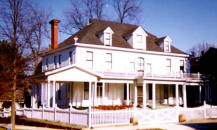
The George Pierce Wadsworth House is a large, two and one-half story, frame house sheathed in wood shingles. The house has a truncated L-shaped plan formed by the rectangular massing of the main block and the two story rear ell. The house has a raised, brick foundation, a hip roof covered in asphalt shingles, overhanging eaves, and hip roofed dormers. A hip roofed porch extends across the facade and terminates in a porte cochere on the north side. The wide porch has shingled box piers and a shingled skirt between the piers. The facade has four irregularly placed bays and an off-center entrance. The wide entrance has divided sidelights and transom, and the door has a multiple light upper section. The windows vary in size and type, but most are sixteenover-one light, double hung, wooden sash. Banks of Craftsman style windows are located in the southwest corner of the second floor, corresponding to a sleeping porch. An inset summer porch beneath the sleeping porch has a hipped roof bay on the southwest elevation and a single entrance, with transom, on the rear elevation. The window openings in the bay and rear door are screened. The house has both interior and exterior brick chimneys. A molded projecting cornice divides the two main floors of the house.

The rear ell has an irregular massing. The first floor has a gable roof with an engaged porch roof over an enclosed porch. A modern double loading door and a single door are found on the rear elevation of the enclosed porch. The second floor is smaller than the first and has a hip roof extending from the roof of the main block.

The interior has a wide, formal entrance hall which extends to the rear porch. A horizontal paneled door separates the rear porch from the entrance hall. The front hall is flanked by a long living room and a dining room. The entrance hall now has linoleum floors, but the plaster walls, wide, molded door surrounds, base moldings, and a tall chair railing are original. A broad staircase, with square, classical box balusters and curved newel, rises to a landing with a segmental arched, stained glass window. The window has a fixed light transom, and the lower section is a casement window. The stairs are now carpeted. At the stair landing, there is a door opening which originally contained a staircase to the attic. This opening is now closed.

The long living room is separated from the hall by paneled pocket doors. Opposite the hall doorway is a fireplace with a paneled mantel. The ceiling has exposed wooden beams, with original drop globe lamps, and the hardwood floors of the living room are now carpeted. Double multiple light doors in the southwest corner of the room open into the summer porch.

The dining room also has plaster walls and exposed ceiling beams, paneled wainscoting, and Arts and Crafts chandelier, but no fireplace. A paneled door in the northwest corner opens into a butler’s pantry which, in turn, leads into the kitchen. The hardwood floors in the dining room are carpeted. The butler’s pantry has built-in cabinets along the interior walls.

Behind the living room is a small study. The study opens off a small hall, with a closet and small bathroom. Opposite the hall door to the study is a multiple light door, opening onto the summer porch. The doors and windows repeat the broad, molded surrounds, and there is a wide, flat chair railing. The study has a notable oversized fireplace mantel constructed of brick. The mantel is composed of a flat, brick back wall from which a molded classical mantel projects. The room also contains original Arts and Craft wall light fixtures. The hardwood floors in the study are also carpeted.

Located in the rear ell, the kitchen has undergone little alteration although it is now used as a preparation room for the funeral home. The kitchen repeats the wide, molded door and windows surrounds, and the use of horizontally paneled doors. Some original fixtures are intact. To the rear of the kitchen is the laundry room. Along the south side of the kitchen and laundry room is the enclosed porch which contains an open rear staircase leading to the second floor main staircase landing. The staircase has box balusters and newel. The walls and ceiling of the porch have the original vertical wood paneling except along the south wall where the porch has been enclosed. One window, along the kitchen wall, has been infilled. The second floor has four bedrooms, two sleeping porches, and two bathrooms. The second floor hall runs the width of the house, although a portion of the hall on the south side has a door opening to close off two bedrooms and a bathroom. The hall has original light fixtures. The bedrooms all have original horizontal paneled doors, wide, molded surrounds, and plaster walls and ceilings. The hall and the bedrooms are all now carpeted. Two of the bedrooms have fireplaces, and the paneled mantels are original. The bathrooms have their original fixtures, including freestanding tubs, sinks, and tile. The sleeping porch on the south side was used as a kitchen when this portion of the second floor was converted to an apartment, probably in the late 1940s. However, the kitchen fixtures are freestanding and have required little alteration.

The house has undergone relatively little alteration despite the change in function. Some general deterioration is evident, notably in the rear service areas of the house, but otherwise the historic fabric is intact.

Servant’s Quarters/Carriage House

The Servant’s Quarters/Carriage House is located at the rear of the property and is separated from the main house by the circular driveway. This building is a one story tall, frame building with a rectangular plan. This building has a brick foundation, shingled veneer, and asphalt shingled, hip roof. The two bays of the garage occupy the northern half of the building, and the living quarters the southern portion. The hinged, double doors to the garage appear to be replacements. The living portion of the building has an engaged porch at the south end, and the porch is supported by classical box piers. This south elevation has three irregular bays. The door occupies the easternmost bay, and there are two windows. The east elevation is symmetrical with a central entrance, covered by a modern metal awning, and two flanking windows. The windows in this building, as in the main house, are sixteen-over-one light, double hung, wooden sash. The building has one interior, brick chimney. The garage is still used as such, and the servant’s quarters are used for storage. The building has good integrity.


Historical Overview


The George Pierce Wadsworth House was designed by prominent North Carolina architect, Louis H. Asbury, in 1910, and construction was completed in 1911 (Louis H. Asbury, Book of Commissions, Job No. 71, July 1910). Local businessman, George Wadsworth commissioned Asbury to build his new house on property which the Wadsworth Land Company had recently subdivided into Wesley Heights, a middle class suburb located west of downtown between West Trade Street and W. Morehead Street. The George Pierce Wadsworth House was one of the first houses built in the new suburb which was called Wesley Park on early plans (C.G. Hubbel, Wesley Park Map, July 1910).

By 1892, much of the hillside between Tuckaseegee Road and Sugaw Creek had been acquired by George Wadsworth’s father, John W. Wadsworth (1835-1895), who ran the largest livery stable in Charlotte. In addition to his livery at North Tryon Street and Sixth Street, Wadsworth also assisted in operating the first horsedrawn streetcar system in the city. Coming to Charlotte in 1857, John Wadsworth began with a small drove of mules and gradually built a large livestock, carriage, and harness business while acquiring extensive land holdings in the city and county (Hanchett, 1984: 14; Mull, 1985: 1). On the westside parcel, where the George Pierce Wadsworth House was later built, Wadsworth operated the “J.W. Wadsworth Model Farm”, which was known for its Holstein cattle. At his death in 1895, Wadsworth’s heirs incorporated the livery and livestock business as Wadsworth Sons Company and subdivided the farm. However, development was delayed after 1909, when the West Trade Street trolley began service north of the property. With streetcar service, the Wadsworths began plans for developing the former farm, but construction was again largely stalled until after World War I when the Charlotte Investment Company bought the land.

George Wadsworth was born in 1879 to John Wadsworth and Margaret Cannon Wadsworth, sister of J.W. Cannon, founder of Cannon Mills. After college in Virginia and Baltimore, George Wadsworth returned to Charlotte to assume the presidency of Wadsworth Sons Company in 1902. George Wadsworth soon began diversifying the family business interests, a necessary step as automobile travel began replacing horsedrawn conveyances. In 1912, he organized Smith-Wadsworth Hardware Company, and in 1914, he helped establish the Carolina Baking Company, which later was subsumed within the Southern Baking Company. Wadsworth was also associated with the Charlotte National Bank as a director. In 1925, Wadsworth Sons Company was liquidated, ending seventy years of local livery and livestock operations. Wadsworth continued his business interests with the Wadsworth Land Company and the Wadsworth-Seborn Company, a sales operation for Reo cars throughout the Carolinas. His other real estate operations included serving as an officer for the Pegram Land Company. The holdings of both Wadsworth and the Pegram Company were platted as North Charlotte (Mull, 1985: 2).

George Wadsworth commissioned Charlotte architect, Louis H. Asbury to design the house at 400 South Summit in 1910, two years after his marriage and the birth of two children. A Charlotte native, Asbury (1877-1975), had established his practice in the city only two years before the Wadsworth commission. Prior to returning to his hometown, Asbury had received his professional training at the Massachusetts Institute of Technology and had worked for the nationally known firm of Cram, Goodhue, and Ferguson, in either its New York or Boston office. Later joined by his son, Asbury had an extensive regional practice until his retirement in 1956. A founding member of the North Carolina Chapter of the American Institute of Architects, Asbury was among a group of early architects in the city who brought a degree of sophistication, urbanity, and professionalism to early twentieth century building in Charlotte. His clients, exemplified by George Wadsworth, tended to be the businessmen responsible for the growing importance of Charlotte as a regional center for the textile and banking industries (Farnsworth, 1975: 16).

The Wadsworth family continued to live in the house after the sudden death of George Wadsworth in 1930 at the age of 51. James Dallas Ramsey, an officer of the Textron-Southern Company, and his wife, Pearl Shelby Ramsey bought the house in 1936. The Ramseys converted a portion of the west side of the second floor to an apartment and adapted a small sleeping porch as a kitchen, probably during the late 1940s. The Ramseys moved in 1967, and the house stood vacant for two years. In 1969, Mrs. Ramsey sold the property to prominent businessman, Worthy D. Hairston (1902-1969) and his wife, Marie S. Hairston. Hairston, a funeral director who had established the Hairston’s House of Funerals in 1930, moved his business from its Beatties Ford Road location to the Wadsworth House in 1969 (McClure Interview, 29 November 1993).

A Biddleville resident and the son of a Presbyterian minister, Worthy D. Hairston, had attended Charlotte public schools, Harbison College, and Johnson C. Smith University. Prior to forming the funeral home, Hairston was a builder, having trained as a carpenter, and a teacher in Mecklenburg and Gaston counties. His local building projects included the Murkland School in Providence Township, the first school for blacks constructed of stone, and the Grand Theater. Mr. Hairston also served as the first agent for the Washington National Insurance Company in Charlotte. In 1930, Hairston and a partner formed Hairston’s House of Funerals, but after his partner’s death in 1933, Hairston became the sole owner. Worthy Hairston lived less than a year after moving the funeral home to the Wadsworth House, and the Hairstons’ daughter, Marie H. Pettice, operated the business until her death in the mid-1970s. In 1977, Mrs. Hairston’s nephew, Charles McClure, bought the Wadsworth House property. McClure, vho already had an extensive real estate business as well as other commercial operations, continued to operate Hairston’s House of Funerals. McClure changed the name to Northwest Funerals Homes, Inc., and the business is still in operation at this site today (Mull, 1985: 4-5).

Unlike the other early streetcar suburbs in Charlotte, such as Myers Park, Dilworth, and Elizabeth, Wesley Heights was platted without the wide boulevards along which the streetcars ran and which were developed with large, impressive residences. Streetcar service, which was essential to the development of outlying locations prior to the widespread use of automobiles, was available nearby, but did not run through the Wesley Heights neighborhood. After World War I, the Charlotte Investment Company platted roughly half the land, including Summit Avenue, Grandin Road, and Walnut Avenue. The plat extended from West Trade Street and Tuckaseegee Road southwest of the interurban line of the Piedmont and Northern Railway which bisected the former farm parcel (Hanchett 1984: 15). (The Wadsworth House is located one block northeast of the railroad tracks.)

Wesley Heights was the work of Charlotte real estate developer, E.C. Griffith. Griffith, a Virginia native, was pivotal in the construction of many early twentieth century neighborhoods in Charlotte, and Wesley Heights was his first solo project in the city. Griffith had come to Charlotte to work in the real estate department of the American Trust Company, founded, with F.C. Abbott and Word Wood, by George Stephens. Stephens, who was responsible for subdividing the farm of his father-in-law, J.S. Myers, as Myers Park, employed Griffith to oversee the final construction of this streetcar suburb (Blythe, 1961: 306). From Myers Park, Griffith continued his real estate career with Wesley Heights in the early 1920s, but developed the Rosemont subdivision of Elizabeth and Eastover during the same period. By the 1930s, Griffith had been responsible, in some capacity, for the streetcar suburbs which encircled the city.

Development in Wesley Heights was slow initially, but as the population of Charlotte more than doubled between 1910 and 1930, real estate sales improved (Blythe, 1961: 173). In 1928, the second half of Wesley Heights was platted, extending Summit, Grandin, and Walnut Avenues across the railroad to West Morehead Street (Hanchett, 1984: 16). As part of the Wesley Heights project, Griffith focused on the development of West Morehead, which until 1927 had been a minor downtown street. By extending the street across Irwin Creek through the edge of Wesley Heights, Griffith made West Morehead an important link between downtown and Wilkinson Boulevard, the first highway in North Carolina, leading from Charlotte to Gastonia. Griffith encouraged industry to take advantage of these good transportation connections, and persuaded J.B. Duke’s Piedmont and Northern Railway to extend a spurline south to parallel the new thoroughfare (Hanchett, 1984: 17).

Wesley Heights was platted with a grid street pattern, and the lots along the principal northeast-southwest streets were long and narrow, to maximize proximity to the street rail system. House construction was determined, in part, because of the limited streetcar service, and frame bungalows predominated in the area during the l910s and early 1920s. During the late 1920s and 1930s, construction included numerous examples of one story, brick, cross gable cottages, making Wesley Heights a homogeneous neighborhood of bungalows, restrained Tudor Revival cottages, small four unit apartment houses, as well as some earlier and later exceptions to this pattern. The George Pierce Wadsworth House is one of the earliest, and perhaps only architect designed houses in this middle class neighborhood of tree-lined streets.

The changes in ownership and function of the George Pierce Wadsworth House since 1969 illustrate changes in the composition of some older Charlotte neighborhoods. The extensive urban renewal programs of the l950s and 1960s displaced large segments of the black population and put many blacks onto the housing market. In inner city neighborhoods, such as Wesley Heights, housing pressures transformed the formerly white neighborhood. By the 1970s, virtually all residents of Wesley Heights were black. The conversion of the Wadsworth House to a funeral home, after purchase by a long-standing black business family, exemplifies the metamorphosis of this residential area.

Conclusion

Designed by a well-known local architect for a wealthy patron, the George Pierce Wadsworth House breaks with the surrounding homogeneity of Wesley Heights in the size of the parcel, the layout of house and gardens, and the architectural sophistication of the house. Occupying the equivalent of three lots, the Wadsworth House is a large, two and one-half story residence in an area of relatively dense, one story bungalows and cottages. The house, large gardens (vestiges of which remain), carriage drive, and servant’s quarters form an ensemble which contrasts to the uniformly middle class composition of the surrounding area. The survival of the servant’s quarters/carriage house is rare and further underscores the contrast with later construction. Architecturally, the irregular massing, materials, and detailing make the George Pierce Wadsworth House an impressive and rare local example of the Arts and Crafts movement from the early twentieth century.


Bibliography
Bishir, Catherine. North Carolina Architecture. Chapel Hill: University of North Carolina Press, 1990.

Blythe, LeGette and Charles Raven Brockmann. Hornets’ Nest: The Story of Charlotte and Mecklenburg County. Charlotte: McNally of Charlotte, 1961.

Farnsworth, Julie. “Louis Asbury: Builder of a City.” Charlotte Observer, 24 March 1975.

Hanchett, Thomas W. Charlotte Neighborhood Survey: An Architectural Inventory. Volume III. Charlotte-Mecklenburg Historic Properties Commission, November 1984.

Hubbel, C.G. Plat Map. Wesley Park, Section 1, Wadsworth Lend Company, Charlotte, North Carolina. Records of the Charlotte-Mecklenburg Historic Landmarks Commission.

Interview with Charles McClure, 23 April 1985. Interview conducted by Barbara M. Mull. Records of the Charlotte-Mecklenburg Historic Landmarks Commission.

Interview with Charles McClure, 29 November 1994. Interview conducted by Frances P. Alexander and Robert Drakeford, Charlotte-Mecklenburg Historic Landmarks Commission Member.

Mull, Barbara M. Historical Sketch of the Wadsworth-Ramsey House. April 1985. Records of the Charlotte-Mecklenburg Historic Landmarks Commission.

Sanborn Fire Insurance Company. Sanborn Fire Insurance Maps, 1929.


Walker House

THE LUCIAN H. WALKER HOUSE
walker-lucian

This report was writen on January 2, 1989

1. Name and location of the property: The property known as the Lucian H. Walker House is located at 328 East Park Avenue, Charlotte, N.C.

2. Name, address and telephone number of the present owner of the property:
The owner of the property is:

Scott C. Lovejoy
Hedrick, Eatman, Gardner & Kincheloe
P.O. Box 30397
Charlotte, N.C., 28230

Telephone: 704/377-1511

3. Representative photographs of the property: This report contains representative photographs of the property.

4. A map depicting the location of the property: This report contains a map which depicts the location of the property.

lucian-walker-map

5. Current Deed Book Reference to the property: The most recent deed to this property is recorded in Mecklenburg County Deed Book 5828, Page 269.
The Tax Parcel Number of the property is: 123-076-10

6. A brief historical sketch of the property: This report contains a brief historical sketch of the property prepared by Dr. William H. Huffman, Ph.D.

7. A brief architectural description of the property: This report contains a brief architectural description of the property prepared by Dr. Dan L. Morrill, Ph.D.

8. Documentation of why and in what ways the property meets the criteria for designation set forth in N.C.G.S. 160A-399.4:


a. Special significance in terms of its history, architecture, and/or cultural importance: The Commission judges that the property known as the Lucian H. Walker House does possess special significance in terms of Charlotte-Mecklenburg. The Commission bases its judgment on the following considerations: 1) the Lucian H. Walker House, erected in 1894, belongs to the most significant concentration of pre-l900 suburban homes in Charlotte, N.C.; 2) the Lucian H. Walker House, most likely designed by architect Charles Christian Hook (1869-1938), is one of the oldest homes in Dilworth, Charlotte’s initial streetcar suburb, and exhibits architectural features, especially its overall form and massing, which are unique among the extant pre-l900 houses in Dilworth; and 3) the Lucian H. Walker House, situated on a corner lot on the southwestern quadrant of the intersection of E. Park Ave. and Euclid Ave., occupies a place of strategic importance in terms of the surrounding Dilworth streetscapes.

b. Integrity of design, setting, workmanship, materials, feeling, and/or association: The Commission contends that the architectural description by Dr. Dan L. Morrill which is included in this report demonstrates that the Lucian H. Walker House meets this criterion.

9. Ad Valorem Tax Appraisal: The Commission is aware that designation would allow the owner to apply for an automatic deferral of 50% of the Ad Valorem taxes on all or any portion of the property which becomes “historic property.” The current appraised value of the improvement is $115,650. The current appraised value of the .241 acres of land is $30,000. The total appraised value of the property is $145,650. The most recent tax bill on the property was $1,827.18. The property is zoned R6-MF.

Date of Preparation of this Report: January 2, 1989

Prepared by: Dr. Dan L. Morrill
Charlotte-Mecklenburg Historic Properties Commission
1225 S. Caldwell St. Box D
Charlotte, N.C. 28203

Telephone: 704/376-9115


Historical Overview


Dr. William H. Huffman
June, 1988

The Walker house, located at the southwest Corner of Park and Euclid Avenues in Dilworth, was built in 1894 by Lucian H. and Annie S. Walker, and the architect was probably C. C. Hook, one of Charlotte’s outstanding practitioners of that art.

Dilworth, the city’s first streetcar suburb, was a product of the growth spurred by late nineteenth-century New South industrialization based on cotton mills in and around the city. It was developed by entrepreneur Edward Dilworth Latta ( 1851-1925). The Princeton-educated South Carolina native opened a men’s clothing store in Charlotte in 1876, and in 1883, as part of the city’s industrial boom of that decade which centered around cotton mills and mill machinery suppliers, he opened a men’s pants factory. In 1890, Latta formed a development firm, the Charlotte Consolidated Construction Company (known locally as the 4C’s) and bought 422 acres a mile or so southwest of town, and had a new subdivision laid out in a grid pattern.

Along the main boulevards and some major side streets, large houses would be built for the well-to-do, with more modest bungalows being built on most of the side streets. To draw prospective buyers out from the city, in 1891 Latta bought out the city’s horse-drawn streetcar line and installed a new electric trolley system that ran from the Square out to Dilworth. Other attractions were a major amusement park (Latta Park) with boating lake, a pavilion for traveling shows, ball fields and a racetrack. Sales promotion was boosted by selling lots on easy installment terms, so that a prospective buyer could be persuaded to use the “rent money” to purchase a new home. Lucian Walker was a bookkeeper at the Mecklenburg Iron Works in 1894 when he and his wife Annie commissioned the 4C’s to build a house for them on Park Avenue.2 It is most likely that the architect of the house was C. C. Hook, who worked for the 4C’s at the time.

Charles Christian Hook ( 1869-1938) was born to German immigrants in Wheeling, W.Va., and received his higher education at Washington University in St. Louis. When he came to Charlotte in 1900, his first position was as a teacher of mechanical drawing in the old South school. He began the practice of architecture by designing houses for Latta’s 4C’s in 1893. A contemporary newspaper article of that date elaborates:” E. D. Latta has arranged to introduce some new styles of architecture at Dilworth, and Mr. Hook will provide plans for five new style residences. The will include the “Queen Anne,” “Colonial,” and “Modern American” styles of architecture. All of the buildings will be built in the best manner, with slate roofs, fine interior finish and ornamental stairways.”3 Hook’s career eventually spanned forty-five years, during which he undertook many landmark commissions in the city and various parts of the state. At times, he was in partnership with others: Frank Sawyer. 1902-1907, Willard Rogers, 1912-1916, and with his son, W. W. Hook, 1924-1938. Among his best-known designs in Charlotte are the old Charlotte City Hall, the Charlotte Women’s Club, the J. B. Duke mansion, the Belk Department Store Trade Street facade of 1927, and the William Henry Belk mansion. Statewide, they include the west wing of the state capital in Raleigh, the Richmond County courthouse, Phillips Hall at UNC-Chapel Hill, the Science Hall at Davidson College, and the State Hospital in Morganton.4

In September, 1894, the Charlotte Observer, in its “Dilworth Dots” column, reported that “The McDowell, Walter, Harrill and Jones houses at Dilworth are in various stages of completion. Each would be an ornament to the city.”5 The following month, the reporter assigned to the Dilworth beat noted, “‘Wonder what color Mr. Walker is to paint the lower part of his house, as he is painting the roof yellow,'” the Observer has often heard asked. The combination will be white, yellow and green – new and effective.” The Harrill, Walker, McDowell, and Jones houses are all handsome additions to Dilworth.6

In December, “Dilworth Dots” recorded the completion of the Walker’s new home, after a note on some amenities in the new suburb: The people living in Dilworth will have almost as many conveniences as the people living in the city. Sewer pipes are now being laid along the boulevard. With this the houses can easily connect. Mr. and Mrs. Lucian Walker will be on the move early this morning.7 By 1902, the Charlotte City Directory records that Lucian Walker was a teller at the Charlotte National Bank, and lived on East Avenue. Annie Walker was shown as the Principal of the Primary Department of the Presbyterian College for Women (a forerunner of Queens College that was built on College Street in 1900-01).8 The following year the Walkers no longer appear in the Directories, and it seems probable that they moved from the city. Prom 1905 to 1912, the house was owned by Mrs. N. H. Bispham, a widow, who sold it to George M. Rose, Jr., and Mary Crow Rose, in which family it remained until 1965. 9 It subsequently passed through a number of owners as Dilworth has re-emerged as a vibrant, revitalized neighborhood and Historic District.

As a representative of the early houses in Dilworth and the early work of C. C. Hook, the Walker house is an important part of that community’s historic fabric.


Notes
1 Dan L. Morrill, “Edward Dilworth Latta and the Charlotte Consolidated Construction Company (1890-1925): Builders of a New South City, ” The North Carolina Historical Record 62(1985).293-316.

2 Charlotte City Directory, 1896/7, p. 86.

3 Charlotte Observer, June 4,1893, p.6.

4 Information on file at the Charlotte Mecklenburg Historic Properties Commission office

5 Charlotte Observer. September 15, 1894, p. 3.

6 Charlotte Observer. October 13,1894, p.4.

7 Charlotte Observer. December 4, 1894, p.6.

8 Charlotte City Directory. 1902, p. 463

9 Mecklenburg County Deed Books 198, p. 388; 291, p.634; 2653, p.537. Rose was a cotton broker with Rose-Webb & Co.: Charlotte City Directory. 1912, p. 368.


Architectural Description


The Lucian H. Walker House is a two story, frame dwelling with a brick pier foundation with subsequent brick in-fill, two off-center, interior brick chimneys, a large, wraparound columned porch with balustrade, shed dormers, and a gable roof and cross gables. Erected in 1894 on the southwestern quadrant of the intersection of Euclid Avenue and East Park Avenue in Dilworth, Charlotte’s initial streetcar suburb, it belongs to an assemblage of suburban houses that occupies a place of seminal influence in the architectural history of Charlotte and Mecklenburg County. “Dilworth’s noteworthy residential architecture today includes not only some of the city’s few surviving Victorian houses, but also Charlotte’s first experiments with the Colonial Revival,” writes architectural historian Thomas W. Hanchett.1

Colonial Revivalism, which emphasizes classical ornamentation, geometric massing and, at least in North Carolina, simplicity of detail in comparison with the more adventuresome specimens of this motif found in the major cities of the North and Midwest, was probably the most popular example of historic electicism which emerged in the late 1800’s and early 1900’s in the United States, including the South. This widespread acclaim was in no small part due to the fact that Colonial Revivalism provided compelling images which enabled wealthy suburbanites to satisfy their “search for order” and their desire to live in an “idyllic escape from the overcrowding, crime, and ethnic strife identified with the city.” 3

It is true that Charlotte’s residential architecture began to undergo a fundamental but gradual transformation away from Vernacular and Victorian motifs and toward so-called “period house” styles, especially Colonial Revivalism, when Edward Dilworth Latta and his Charlotte Consolidated Construction company began selling lots and erecting suburban homes for affluent and middle class residents of Dilworth.3 “Early Dilworth was a curious concoction because its conception was more European than anything in America at the time,” contends historian David R. Goldfield. “Unlike most American suburbs but similar to most European neighborhoods,” he continues, “Dilworth presented a mixture of elite and middle-class residences.” According to Goldfield, this socio-economic heterogeneity gave rise to a “mixture of architectural styles” in Dilworth.4

Goldfield’s excessive claims for Dilworth’s uniqueness in American suburbanization notwithstanding, the neighborhood does contain a rich variety of architectural styles. Not surprisingly, most of the first houses were built on corner lots, where the owners could gain greater separation from their neighbors, at least on one side. Among them are the Harrill-Porter House, a Vernacular style Victorian house similar in its austere simplicity to many houses once found in the center city, including the back streets of Fourth Ward, and, even more significantly, the Mallonee-Jones House and the Robert J. Walker House, two Queen Anne style residences designed by Charles Christian Hook (1869-1938), a native of Wheeling, W. Va, graduate of Washington University in St. Louis, Mo., and an architect of local and regional importance.5

On June 4, 1893, the Charlotte Observer announced that: Mr. E. D. Latta has arranged to introduce some new styles of architecture at Dilworth, and Mr. Hook will provide plans for five new-style residences. They will include the “Queen Anne,” “Colonial,” and “Modern American” styles of architecture. All of the buildings will be built in the best manner, with slate roofs, fine interior finish and ornamental stairways.6

C. C. Hook was especially interested in ushering Colonial Revivalism into the local built environment. Commenting upon Hook’s intentions, the Charlotte Observer exclaimed in September, 1894, that Hook planned to erect a:


genuine, ‘ye olden time’ house . . . after the style of the typical Southern home, with four large columns, two full stories high, surmounted by a classical pediment. Mr. Hook . . . will make the plans after the true classical style of architecture, which at one time predominated in the South and is being revived. The most striking feature of the house will be its simplicity of design and convenience of arrangement. The so-called ‘filigree’ ornamentation will not consideration, and only the true design wit carried out and thus give Charlotte another style . . . 7

The earliest Colonial Revival style residence in Dilworth which is definitively attributable to C. C. Hook is the Gautier-Gilchrist House at 320 East Park Avenue.8 Its symmetrical facade, large gable roof with dormers, and modillion cornice stand in sharp contrast with the essentially asymmetrical massing and ornate decorative detail of Hook’s Mallonee-Jones House at 400 East Kingston Avenue and his Robert J. Walker House at 329 East Park Avenue.9 The Jones-Garibaldi House at 228 East Park Avenue, erected in 1894, is an even earlier example of Colonial Revivalism in Dilworth; it was probably designed by C. C. Hook, as, most likely, was the Lucian H. Walker House.10

The Lucian H. Walker House is difficult to classify in terms of architectural style. Its symmetrical massing, unadorned molded eaves, Palladian-like tripartite window arrangement near the top of the large, front pediment, and the wraparound porch which is bordered by a balustrade and attenuated, wooden Roman Doric columns with annulets, place the house within the traditions of classical design. Other features of the Lucian H. Walker House, however, most especially the off-center placement of the front entrance, which has sidelights and a transom, and the less than completely balanced fenestration (the majority of the windows are 1/1 sash), suggest that the house does not conform to Colonial Revivalism, such as one clearly encounters with the Jones-Garibaldi House, which was built in the same year, or the Villalonga-Alexander House, which C. C. Hook definitely designed. 11 Perhaps the Lucian H. Walker House is an example of what the Charlotte Observer called the “Modern American” style.12

The rear of the Lucian H. Walker House has experienced considerable modifications, including the interior rooms. Otherwise, the interior of the house retains its essential integrity. A somewhat clumsily-placed, center hallway bisects the first floor, with the parlor and its replacement mantel to the left front. The other mantels in the house are original, as are the ceramic tile fireplace surrounds and hearths. Base moldings, picture moldings, and crown moldings are typical of those found in other homes in the oldest section of Dilworth.

The most dramatic interior feature is an L-shaped stairway and balustrade which leads from the room on the right front to the second floor. On balance, however, the most significant architectural feature of the Lucian H. Walker House is its role in documenting the evolution of Charlotte’s suburban built environment in the late nineteenth century.


Footnotes
1 For a detailed analysis of the architecture of North Carolina’s early twentieth century suburbs, see Catherine W. Bishir and Lawrence S. Early, Early Twentieth-Century Suburbs in North Carolina: Essays on History, Architecture and Planning (Raleigh: Archeology and Historic Preservation Section, Division of Archives and History, North Carolina Department of Cultural Resources, 1985), hereinafter cited as Suburbs. Thomas W. Hanchett, “Charlotte: Suburban Development in the Textile and Trade Center of the Carolinas.” In Suburbs, p. 72. The Colonial Revival style arose in the 1880’s and is attributed to the architectural firm McKim, Mead and White (Charles Fallen McKim, W. R. Mead, Stanford White). For additional information, see Marcus Whiffen, American Architecture Since 1780: A Guide to the Styles (Cambridge: M.I.T. Press, 1969), pp.l59-165.

2 David R. Goldfield, “North Carolina’s Early Twentieth-Century Suburbs and the Urbanizing South”, Suburbs, p. 9. Margaret Supplee Smith, “The American Idyll in North Carolina’s First Suburbs: Landscape and Architecture”, Suburbs, p. 23.

3 For a comprehensive history of Dilworth, see Dan L. Morrill, “Edward Dilworth Latta and the Charlotte Consolidated Construction Company (1890-1925): Builders of a New South City” The North Carolina Historical Review (July, 1985), pp. 293-316.

4 David R. Goldfield, “North Carolina’s Early Twentieth-Century Suburbs and the Urbanizing South”, Suburbs, p. 9. For an explanation of the term “period house”, see John Poppeliers, S. Allen Chambers, and Nancy B. Schwartz, “What Style Is It? Part Four.” Historic Preservation (January-March, 1977), pp. 14-23.

5 Dr. Dan L. Morrill and Caroline Mesrobian, “Survey and Research Report On The Mallonee-Jones House” (Charlotte-Mecklenburg Historic Properties Commission, January 2, 1980). Hereinafter cited as Mallonee-Jones. Dr. Dan L. Morrill and Thomas W. Hanchett, “Survey and Research Report On The Harrill-Porter House” (Charlotte-Mecklenburg Historic Properties Commission, January 6, 1982). Dr. Dan L. Morrill and Caroline Mesrobian, “Survey and Research Report On The Robert J. Walker House” (Charlotte-Mecklenburg Historic Properties Commission, November 5, 1980). Hereinafter cited as Robert J. Walker.

6 Charlotte Observer, June 4, 1893.

7 Charlotte Observer, September 19, 1894. Hook’s earliest Colonial Revival design was for a house which no longer stands.

8 Dr. Dan L. Morrill and Caroline Mesrobian, “Survey and Research Report On The Gautier-Gilchrist House” (Charlotte-Mecklenburg Historic Properties Commission, January 7, 1981).

9 Mallonee-Jones. Robert Walker.

10 Dr. William H. Huffman and Dr. Dan L. Morrill, “Survey and Research Report On The Jones-Garibaldi House” (Charlotte-Mecklenburg Historic Properties Commission, February 5, 1986). Hereinafter cited as Jones-Garibaldi.

11 Jones-Garibaldi. Dr. Dan L. Morrill and Ruth Little-Stokes, “Survey and Research Report On The Villalonga-Alexander House (Charlotte-Mecklenburg Historic Properties Commission, June 4, 1978). The Villalonga-Alexander House was substantially damaged by fire on March 14, 1948.

12 Charlotte Observer, September 19, 1894.