


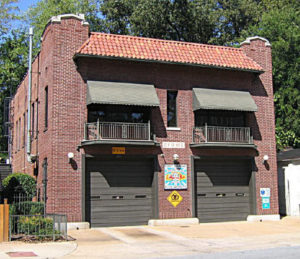
- Name and location of the property: The property known as Charlotte Fire Station 7 is located at 3210 North Davidson Street in Charlotte, N.C.
- Name, address, and telephone number of the current owner of the property:
City of Charlotte
c/o Curt Walton, City Manager
600 East 4th Street
Charlotte, N.C. 28202-2816
Telephone: (704) 336-2244
- Representative photographs of the property: This report contains representative photographs of the property.
- A map depicting the location of the property: This report contains maps depicting the location of the property. The UTM of the property is 17 517722E 3900253N
- Current Tax Parcel Reference to the property: The tax parcel number of the property is 083-085-15.
- A brief historical sketch of the property: This report contains a brief historical sketch of the property prepared by Dr. Dan L. Morrill.
- A brief architectural description of the property: This report contains a brief architectural description prepared by Stewart Gray.
- Documentation of why and in what ways the property meets the criteria for designation set forth in N.C.G.S 160A-400.5.
- Special significance in terms of its history, architecture and/or cultural importance: The Commission judges that the property known as Charlotte Fire Station 7 possesses special significance in terms of Charlotte-Mecklenburg. The Commission bases its judgment on the following considerations:
1) Charlotte Fire Station 7 stands as originally built in 1935, when the city of Charlotte established the station to service the North Charlotte neighborhood.
2) Charlotte Fire Station 7 represents the economic importance and social vitality of the North Charlotte neighborhood, even as it has seen the area evolve from a mill town to a thriving, local historic district.
3) Charlotte Fire Station 7 has special historical and institutional significance as a structure that originally housed both a fire company and a jail cell.
4) Charlotte Fire Station 7 has special significance architecturally as a typical local example of the “storefront style” urban fire station designed to blend in with the pre-existing built environment.
- Integrity of design, setting, workmanship, materials, feeling and/or association: The Commission contends that the architectural description prepared by Stewart Gray demonstrates that Charlotte Fire Station 7 meets this criterion.
- Ad Valorem Tax Appraisal: The Commission is aware that designation would allow the owner to apply for an automatic deferral of 50% of the Ad Valorem taxes on all or any portion of the property which becomes a “historic landmark.” The current appraised value of the building is $297,300. The current appraised value of the 1.335 acres of land is $66,800. The property is zoned C700. The property is exempt from the payment of Ad Valorem Taxes.
A Brief History of Charlotte Fire Station #7
The historical significance of Fire Station Number 7 is best understood within the context of the evolution of firefighting in Charlotte, N.C. Like other emerging industrial and commercial cities, Charlotte had to find ways to prevent widespread destruction of its man-made environment by fire. The increased concentration of structures, many built with highly combustible materials, and some soaring to unprecedented heights, jeopardized the viability of urban life and necessitated the development of more systematic means to combat conflagrations. 1

Fire Truck in front of Fire Station 7
As elsewhere, the first firefighting companies in Charlotte were made up of volunteers. Three were operating by 1865, the Hornet Steam Engine and Hose Company, the Independent Hook and Ladder Company, and the Neptune Hand Engine Company, the last organized and manned by African Americans.2 Theretofore, the residents of Charlotte, like those in other cities, had joined together as volunteers in bucket brigades to put down flames.
The City of Charlotte established the Charlotte Fire Department on August 1, 1887, after the volunteer firemen resigned over disagreements with the City.3 Volunteer firefighters throughout the country were generally not held in high esteem. The public saw them as a “public menace,” as a rowdy bunch that exhibited many of the worst habits of male behavior.4 The heroic image of firemen as rescuers did not fully emerge until the late nineteenth century, when firefighters became municipal employees and began to emphasize the saving of human life rather than the protection of property.5

Charlotte’s First Municipal Fire Station
Charlotte’s first municipal fire station, destroyed in the 1970s, stood near the intersection of East Trade Street and College Street. A major improvement in Charlotte’s firefighting facilities occurred in 1891, when an imposing municipal building was erected at the corner of North Tryon and Fifth Sts. This City Hall and Fire Station served Charlotte until October 1925, when the City moved its operations to a new municipal complex on East Trade St. and the former City Hall was destroyed.6 Architecturally, Charlotte’s first two fire stations were grand, lavishly decorated brick structures. Partly a manifestation of the design tastes of the era, these buildings, it was hoped, would serve as commodious living quarters for firefighters and thereby improve their sense of morality and civic duty and underscore their heroic image. “. . . the picture of the fireman risking all to save a child from a burning building was utmost in everyone’s mind,” writes historian Rebecca Zurier.7

This photograph, taken of a parade on E. Trade St. for the Confederate Veteran’s Parade in 1929, shows the original Fire Station in the streetscape on the left.
Charlotte Fire Station Number 7 was built in 1935 and was designed by Charles Christian Hook (1870-1938), an architect of local and regional importance in the late nineteenth and early twentieth centuries.8 A native of Wheeling, W. Va. and graduate of Washington University in St. Louis, Mo., Hook had settled in Charlotte in 1891 to teach mechanical drawing in the Charlotte Public Schools and had established an architectural practice here the next year. Initially involved primarily in the design of homes in Dilworth, Charlotte’s first streetcar suburb, Hook would go on to be the architect for a broad array of structures in Charlotte and its environs, including many municipal buildings.9

- C. Hook

Former Fire Station No. 1. The building is not extant.
Also the architect for the new City Hall and Fire Station on East Trade St. that opened in 1925, Hook fashioned Fire Station Number 7 as a facility reflective of the design principles and programmatic needs that had come to be associated with firehouses by the 1920s.10 The replacement of horses by the first motorized fire engines in Charlotte in 1911 meant that stations thereafter would not have to accommodate draft animals.11 “With the shift ‘from oats to gasoline,’ the requirements of the fire station changed,” states Rebecca Zurier.12 A greater ability to focus upon the health of firefighters now became possible, which led to the incorporation of such amenities as cement floors rather than wooden floors, ample windows for ventilation, and the placement of kitchens in stations to support a two-platoon system of labor, thereby shortening the work week for firemen.13

Charlotte Fire Station No. 6
Architects were also increasingly called upon to design fire stations that would be acceptable to suburbanites, many of whom were irate over the prospect of institutional buildings appearing in their neighborhoods.14 That Hook was able to respond effectively to this requirement is demonstrated by his design for Charlotte Fire Station No. 6, erected in 1928-29 on Laurel Avenue, which continues to function as a firehouse on the edge of the fashionable Eastover neighborhood.15 Fire Station No. 7 responds to the same desire to be sensitive to its streetscape. Situated in the commercial core of the North Charlotte Mill Village, it takes on the characteristics of the surrounding buildings in terms of scale, style, and construction materials.16 Also reflective of its industrial neighborhood was the fact that a jail cell was placed in the building, most likely to hold “rowdy” textile workers who labored in the nearby Highland Park Manufacturing Plant No. 3, the Mercury Mill, and the Johnston Mill.17

North Charlotte Textile Workers On An Outing
Only three pre-World War Two fire stations in Charlotte continue to serve their original purpose. They are Fire Station Number 6, Fire Station Number 7, and Fire Station Number 5 erected in 1929 on Tuckaseegee Road, now Wesley Heights Way.18 Two other pre-World War Two properties survive in Charlotte that once belonged to the Charlotte Fire Department. They are: former Fire Station Number 2, erected on South Boulevard in 1909 in Dilworth and the Palmer Fire School on Monroe Road on the edge of the Elizabeth neighborhood.19
Fire Station No. 5

Palmer Fire School

Fire Station No. 2
Click Here For An Architectural History Of The Property.
1 Mark Tebeau, Eating Smoke: Fire in Urban America, 1800-1950 (Baltimore: The Johns Hopkins University Press, 2003), passim. This is the most complete treatment of the history of firefighting in the United States. Much of the information contained herein on Fire Station No. 7 is taken from Guy Aiken, “Survey and Research Report on Charlotte Fire Station 7,” a manuscript completed in December 2007 for a graduate course at the University of North Carolina at Charlotte.
2 Sally Young and Douglas D. Hickin, Charlotte Fire Department Since 1887 (Dallas: Taylor Publishing Company, 1988), 6.
3 Rebecca Zurier, The American Firehouse: An Architectural and Social History (New York: Abbeville Press, 1978), 40.
4 Young and Hickin, 7.
5 Ibid., 9.
6 Ibid. 19.
7 Ibid., 20.
8 Lois Moore Yandle, The Spirit of a Proud People: Pictures and Stories of Highland Park Manufacturing Mill #3 and the People in the Village of North Charlotte (Columbia, SC: Lois Moore Yandle, 1997), 7. Charlotte Building Permit No. 506 (December 15, 1934).
9 Levine Museum of the New South, Cotton Fields to Skyscrapers: Charlotte and the Carolina Piedmont in the New South, permanent exhibit (Charlotte, 2002).
10 Yandle, 8.
11 Charlotte Building Permit 506 (December 15, 1934).
12 Charlotte News (September 17, 1938).
13 Zurier, 32.
14 Ibid., 81.
15 Ibid.
16 Ibid., 72 (caption), 71 (caption).
17 Aiken, Yandle. For additional information on the development of the North Charlotte Mill Village see surveys&rmeckmill.htm , surveys&rjohnstonmill.htm , surveys&rhighlandmill3.htm
18 Young and Hickin.
Click here to view Charlotte Observer Article on the Fire Station #6
This report was written on April 4, 1988
1. Name and location of the property: The property known as Charlotte Fire Station No. 6 is located at 249 S. Laurel Ave. in Charlotte, North Carolina.
2. Name, address and telephone number of the present owner of the property: The owner of the property is:
City of Charlotte
c/o Charlotte City Manager’s office
Charlotte City Hall
600 E. Trade St.
Charlotte, N.C. 28202
Telephone: 704/336-2241
The tenant of the building is the Charlotte Fire Department. For information contact:
Mr. Robert Ellison
Assistant Chief for Administration
Charlotte Fire Department
125 S. Davidson St. Charlotte, N.C. 28202
Telephone: 704/336-2051
3. Representative photographs of the property: This report contains representative photographs of the property.
4. A map depicting the location of the property: This report contains a map which depicts the location of the property.
5. Current Deed Book Reference to the property: The most recent reference to this property is recorded in Mecklenburg Deed Book 717, Page 361. The Tax Parcel Number of the property is: 155-034-17.
6. A brief historical sketch of the property: This report contains a brief historical sketch of the property prepared by Dr. William H. Huffman, Ph.D.
7. A brief architectural description of the property: This report contains a brief architectural description of the property prepared by Joseph Schuchman.
8. Documentation of and in what ways the property meets the criteria for designation-set forth in N.C.G.S. 160A-399.4:
a. Special significance in terms of its history, architecture, and/or cultural importance: The Commission judges that the property known as Charlotte Fire Station No. 6 does possess special significance in terms of Charlotte-Mecklenburg. The Commission bases its judgment on the following considerations: 1) Charlotte Fire Station No. 6, erected in 1928-1929, was designed by Charles Christian Hook (1864-1938), an architect of local and regional significance; 2) Charlotte Fire Station No. 6 has served from the outset as the fire station for the Eastover, Myers Park, Crescent Heights, and Elizabeth neighborhoods; 3) Charlotte Fire Station No. 6, one of three fire stations which Hook designed in Charlotte and which, happily, survive, was part of a major expansion program instituted in the 1920’s by Hendrix Palmer, Charlotte Fire Chief; and 4) Charlotte Fire Station No. 6 is an excellent example of non-residential architecture which harmonizes successfully with the surrounding neighborhood.
b. Integrity of design, setting, workmanship, materials, feeling, and/or association: The Commission contends that the architectural description by Joseph Schuchman which is included in this report demonstrates that Charlotte Fire Station No. 6 meets this criterion.
9. Ad Valorem Tax Appraisal: The Commission is aware that designation would allow the owner to apply for an automatic deferral of 50% of the Ad Valorem taxes on all or any portion of the property which becomes “historic property.” The current appraised value of the improvement is $116,860. The current appraised value of the .434 acres of land is $51,000. The total appraised value of the property is $167,860. The property is zoned R6MF.
Date of Preparation of this Report: April 4, 1988
Prepared by: Dr. Dan L. Morrill
Charlotte-Mecklenburg Historic Properties Commission
1225 S. Caldwell St. Box D
Charlotte, N.C., 28203
Telephone: 704376-9115
by Dr. William H. Huff man
August, 1985
One of the most charming of the city’s official buildings remaining from the time of its unprecedented growth in the pre-Depression era is the Charlotte Fire Station #6. Built in 1928-29 to serve newly annexed suburbs south of the city center, it was designed by one of the city’s premier architects, Charles C. Hook.
The need for new suburban fire stations was a result of forty-some years of rapid expansion from the late 1880s to the end of the 1920s. Charlotte’s growth during this period was fueled by its location as a rail center in the heart of the fast-paced New South industrialization of the Piedmont Carolinas based on cotton growing, shipping and cloth manufacturing. Mecklenburg County was in itself an important cotton manufacturing center (at one point it was second only to Gaston County), but it was the city’s importance as a banking and distribution center which served the surrounding industry that was responsible for its rapid growth and rising prosperity. 1 The advent of the electric streetcar in the 1890s coincided with boom times for the city, and made possible suburban development out from the city center, which attracted wealthy and middle class buyers. To the south, suburban growth served by the streetcar included Elizabeth (1891-1920s), Crescent Heights (1907-09), and Myers Park (1912-1920s). In 1927, developer E. C. Griffith, who was a subcontractor for the building of part of Myers Park for George Stephens, laid out the first suburb based on the automobile, Eastover, which was originally bounded roughly by Laurel, both sides of Cherokee, Colville, and Cherokee Place. Eastover and its extensions were filled in mainly from the 1930s to the 1960s. 2
In 1928, the city annexed Elizabeth, Crescent Heights and Myers Park, and then proceeded to provide for fire protection in the newly acquired areas. To do so, it bought a lot at the northeast edge of the brand-new Eastover subdivision in September of that year from the E. C. Griffith Company, and commissioned Charlotte architect C. C. Hook to design a new, two-bay fire station for the location. 3 Charles Christian Hook (1864-1938) was one of the city’s outstanding architects. A Washington University (St. Louis) graduate, he began practicing architecture in Charlotte in 1893 following three years of teaching in the public schools. From time to time he was in partnership with others: Frank Sawyer, 1902-1907; Willard Rogers, 1912-1916; and with his son, W. W. Hook, 1924-1938. Beginning with design work for the new suburb of Dilworth in the 1890s, Hook eventually produced many of the city’s important landmarks, including the Charlotte City Hall, the Charlotte Women’s Club, the J. B. Duke mansion on Hermitage Road, the Belk Brothers Trade Street facade of 1927, and the Belk mansion on Hawthorne Lane. Among his many works to be found throughout the state are the west wing of the state capital in Raleigh, the Richmond County courthouse, Phillips Hall in Chapel Hill and the State Hospital in Raleigh. 4 On April 9, 1929, the city commissioners (of Public Safety and Public Works) inspected the newly completed facility from “top to bottom” with Fire Chief Hendrix Palmer and Louis Sutherland of C. C. Hook’s office, and gave it their official approval. The same day they also inspected a companion building, also designed by Hook, that had a brick facade instead of the stone on Station #6, in Seversville ( Fire Station #5, now on Tuckaseegee Road). As reported in the Charlotte Observer, “When they returned to the city hall they said they were very well satisfied with the new stations and gave high praise to the Carolina company, contractor for the work.” The new stations were to be put in service in a week, with a crew of twenty-eight firemen each: “To start with, three experienced firemen and two of the appointed [new] ones will be on each truck and engine company.” It was noted that the stations would “keep Charlotte in the Class A group of cities to insure the lowest possible rate of insurance.” 5
Indeed, for many years Charlotte was known statewide and nationally for its leadership in firefighting, primarily because of its longtime chief, Hendrix Palmer (1884-1955). Palmer, a forty-year veteran of the department who was chief from 1927 to 1948, was recognized internationally as a progressive innovator in firefighting. He was twice elected president of the North Carolina Firemen’s Association, and helped organize the N.C. Fire Chiefs Association and served as its first president. The highlight of his career came in 1940, when he was elected president of the International Association of Fire Chiefs, the most prestigious post of his profession. Among other distinctions, he is given credit for “designing and promoting the manufacture of the first enclosed fire truck in America,” which went on to become standard equipment throughout the country. Palmer also promoted the building of a fire training school in Charlotte (completed in 1940), which bears his name and became the main fire training school for departments from around the state. 6
Charlotte Fire Station #6, which is still in use today, has not really changed at all, and completely retains all its original charm. To walk in through its inviting stone and brick facade and experience its human-size scale and tidy atmosphere is to walk back to an earlier time when life seemed much more orderly, and certainly less complex.
Notes
1 Thomas Hanchett, “Charlotte Neighborhood Survey,” Charlotte Mecklenburg Historic Properties Commission, 1984.
2 Ibid.
3 Mecklenburg County Deed Book 717, P. 361, 1 Sept. 1928; Map Book 4, p. 317; plaque on the wall of Fire Station #6.
4 Information on file at the Charlotte Mecklenburg Historic Properties Commission.
5 Charlotte Observer. April 9, 1929, Section 2, p. 1; see note 1.
6 William H. Huffman, “A Historical Sketch of the Palmer Fire School,” Charlotte Mecklenburg Historic Properties Commission, October, 1984.
by Joseph Schuchman
November 8, 1985
Throughout the late nineteenth and early twentieth centuries, few public buildings were allowed a stylistic latitude permitted private homes. Firehouses were a notable exception. Since there was no prevailing opinion of the “proper” style for a fire station, architects experimented with the popular decorative ideas of the day, resulting in some notable and, at times, whimsical civic architecture. With the development of the residential suburb, architects designed a new type of firehouse, one intended to respect the aesthetics of the surrounding neighborhood. 1
In 1928, Charlotte architect C.C. Hook (1864-1938) was commissioned to design a two-bay fire station on Laurel Avenue in the new Eastover subdivision. 2 The end result was a picturesque two story structure which survives largely intact and which remains a perfect companion to the surrounding residential fabric. Hook incorporated a variety of stylistic elements including classical symmetrical massing, round arched windows which are a typical feature of the Colonial Revival style and tiled roof vigas, which recall the motifs of the Spanish Mission style.
The main facade is symmetrically composed; the use of a random fieldstone veneer creates an immediate impression of strength and security. Squat corner towers, with buttress supports, frame the elevation. Each tower is veneered in random fieldstone and brick and rises to a pedimented roofline parapet. A tiled roof viga, with bracket supports, runs between the towers and shelters the five bay second story openings. These round arched openings contain paired vertical casement windows which are set beneath a fanlight. The relieving arch is composed of randomly placed fieldstone. Bold round arches distinguish the engine bays and flank either side of a central round arched transom. The multi-paneled single doors, within the engine bays, slide vertically and are believed to be original. Random fieldstone covers the projecting first story; relieving arches display cut and dressed fieldstone blocks. A smaller tiled viga, with underside brackets, carries across the entrance pavilion.
While the main facade is handsomely detailed, side and rear elevations are more simply executed. Both the sides and rear are veneered in varying hues of red brick arranged in stretcher bond. Openings are surmounted by a soldier course lintel; windows display a projecting sill composed of brick headers. Both side elevations are similarly executed. Along the linear five bay wall, first story windows are paired; on the second story, two single lights, grouped together and separated by a narrow band of the brick wall surface, are placed above the first story openings.
Six/one sash are the primary glazing material. Openings are set within molded surrounds. Aluminum storm windows have been placed over the original window lights. On each side, the flat wall surface carries forward to the projecting mass of the corner tower. To further distinguish the side of each tower, its wall surface is faced in random fieldstone and brick. Fieldstone lintels surmount the first and second story openings. The main pedestrian entrance to the fire station is located in the base of the west tower. The rear elevation is randomly arranged. Three entrance doors are contained within the first story; two window openings, of unequal height, are placed in the second floor.
The interior is largely unaltered; while designed to be functional in nature, the structure also conveys a very human scale. Detailing is minimal. Walls are plastered. Concrete covers the first story floor surface. The ceiling height in several rooms has been lowered and covered with celotex panels. Window openings, except where otherwise noted, are framed by molded surrounds and display projecting sills.
The engine bays lead into the engine house, the largest of the building’s interior spaces. Round cast iron piers run down the length of the chamber and rise to plastered ceiling piers, which carry across the width of the room. Two brass fire poles are located at the front and rear of the engine house. A handsome stair is placed within the west tower; the closed string, three tread stair, the primary access to the second floor, features rectangular newel posts and balusters which support a shaped handrail. An elegant semi-circular landing lends a sense of decoration to the otherwise functional space. The stair wall and string are faced in a vertical tongue and groove ceiling. A narrow lavatory is set within the east tower.
A rectangular-shaped office projects from the rear wall of the engine house; its openings are set within plain surrounds. Both the inner and outer wall surfaces are encircled by a tongue and groove wainscot which is set between a molded baseboard and a molded chair rail. The remaining wall surface is dominated by sliding glass windows. Smaller rooms are located at the rear of the main floor. Each room is rectangular-shaped and is similarly sized and detailed. The single entrance doors, between the engine house and these rear chambers, are each framed by a molded surround and set beneath a six light vertical-placed transom. A narrow rear entrance hall separates the two rear chambers. A closed string half-turn stair with winders provides a secondary access to the second floor; plain balusters support the shaped handrail. An enclosed quarter-turn stair, of wood construction, leads to the unfinished basement. The two-room basement occupies the rear one-fourth of the structure. The exposed brick walls are arranged in a 1:5 pattern of common bond. Interior openings rise to a segmental arch. Two rectangular casement windows, one on each side wall, provide a minimal amount of exterior light. Architect Hook’s ingenuity is evident even in the most unlikely of places; at the top of the basement stairs, the concrete floor has been contoured to allow for the opening and closing of the door which leads to the basement stairwell.
The second floor contains a recreation room at the front, a larger dormitory in the middle and kitchen and bathroom facilities at the rear. Plain surrounds frame door openings; on each door, eight light glass panels are placed above paired rectangular wood panels. The two door openings into the recreation room each display a horizontally-placed six light transom. On the front wall of the recreation room. the round arched openings have no surrounds but display plain sills. A molded baseboard encircles the room; a molded chair rail carries across the rear and down the rear half of the east and west sides. The dormitory retains its original ceiling height and is enclosed by a molded baseboard and chair rail. The narrow rear stair hall separates the kitchen and bath, both of which have been modernized.
Fire Station #6 is recessed from the street and is surrounded by simply landscaped grounds. Handsome cast iron street lamps delineate the entrance to the property. A fieldstone well lies to the east of the building. A steel hose tower stands immediately adjacent to the rear entrances.
Fire Station #6 is a notable monument to a simpler time. More importantly, it is an excellent example of a public building which is able to maintain its historic and architectural character while continuing to be of service to the community.
Notes
1 Rebecca Zurier, The American Firehouse, An Architectural and Social History, New York; Abbeville Press, 1982), pages 131 and 138.
2 Dr. William Huffman, A Historical Sketch of the Charlotte Fire Station #6, prepared for the Charlotte-Mecklenburg Historic Properties Commission, August, 1985, p. 2.

1. Name and location of the property: The property known as the Charlotte Fire Station Number 5 is located at 224 Wesley Heights Way in Charlotte, N.C.
2. Name, address, and telephone number of the current owner of the property:
City of Charlotte
600 East Trade Street
Charlotte, N.C. 28202
3. Representative photographs of the property: This report contains representative photographs of the property.
4. A map depicting the location of the property: This report contains a map depicting the location of the property.

5. Current Deed Book Reference to the property: The most recent deed to the property is recorded in Mecklenburg County Deed Book #17833, page 916.
6. A brief historical sketch of the property: This report contains a brief historical sketch of the property prepared by Dr. Dan L. Morrill.
7. A brief architectural and physical description of the property: This report contains a brief architectural and physical description of the property prepared by Stewart Gray.
8. Documentation of why and in what ways the property meets the criteria for designation set forth in N.C.G.S 160A-400.5.
a. Special significance in terms of its history, architecture and/or cultural importance: The Commission judges that Charlotte Fire Station No. 5 possesses special significance in terms of Charlotte-Mecklenburg. The Commission bases its judgment on the following considerations:
1) Fire Station No. 5 was designed by Charles Christian Hook, an architect of local and regional importance.
2) Fire Station No. 5 is reflective of the architectural design of firehouses in the 1920s.
3) Fire Station No. 5 is an instructive artifact in the history of firefighting in Charlotte.
b. Integrity of design, setting, workmanship, materials, feeling and/or association: The Commission contends that the architectural description prepared by Stewart Gray demonstrates that Fire Station No. 5 meets this criterion.
9. Ad Valorem Tax Appraisal: The Commission is aware that designation would allow the owner to apply for an automatic deferral of 50% of the Ad Valorem taxes on all or any portion of the property which becomes a “historic landmark.” The appraised value of the building is $326,600. The current appraised value of the 9882 square feet of land is $19,800. The total appraised value of the property is $346,400. The property is zoned R-22MF. The Tax Parcel Number of the property is 07101706 .
10. Amount of Property Proposed for historic landmark designation. The exterior of the building, the interior of the building, and the entire tax parcel.
Date of Preparation of this Report: March 1, 2009
A Brief History Of Charlotte Fire Station Number 5
Dr. Dan L. Morrill
|
|
|
Photograph from Charlotte Fire Department Since 1887 |

The historical significance of Fire Station Number 5 is best understood within the context of the evolution of firefighting in Charlotte, N.C. Like other emerging industrial and commercial cities, Charlotte had to find ways to prevent widespread destruction of its man-made environment by fire. The increased concentration of structures, many built with highly combustible materials, and some soaring to unprecedented heights, jeopardized the viability of urban life and necessitated the development of more systematic means to combat conflagrations.1
As elsewhere, the first firefighting companies in Charlotte were made up of volunteers. Three were operating by 1865, the Hornet Steam Engine and Hose Company, the Independent Hook and Ladder Company, and the Neptune Hand Engine Company, the last organized and manned by African Americans.2 Theretofore, the residents of Charlotte, like those in other cities, had joined together as volunteers in bucket brigades to put down flames.
|
|
|
Members of the Neptune Volunteer Fire Department. Photograph from Charlotte Fire Department Since 1887 |

The City of Charlotte established the Charlotte Fire Department on August 1, 1887, after the volunteer firemen resigned over disagreements with the City.3 Volunteer firefighters throughout the country were generally not held in high esteem. The public saw them as a “public menace,” as a rowdy bunch that exhibited many of the worst habits of male behavior.4 The heroic image of firemen as rescuers did not fully emerge until the late nineteenth century, when firefighters became municipal employees and began to emphasize the saving of human life rather than the protection of property.5
Charlotte’s first municipal fire station, destroyed in the 1970s, stood at East Trade Street and College Street. A major improvement in Charlotte’s firefighting facilities occurred in 1891, when an imposing municipal building was erected at the corner of North Tryon and Fifth Sts. This City Hall and Fire Station served Charlotte until October 1925, when the City moved its operations to a new municipal complex on East Trade St. and the former City Hall was destroyed.6 Architecturally, Charlotte’s first two fire stations were grand, lavishly decorated brick structures. Partly a manifestation of the design tastes of the era, these buildings, it was hoped, would serve as commodious living quarters for firefighters and thereby improve their sense of morality and civic duty and underscore their heroic image. “. . . the picture of the fireman risking all to save a child from a burning building was utmost in everyone’s mind,” writes historian Rebecca Zurier.7
|
|
|
This building doubled as the City Hall and the Fire Station. |
The1891 City Hall also housed Charlotte’s Fire Station. |

|
|
|
This 1916 photograph shows a mixture of horse-drawn and engine equipment. |

Charlotte Fire Station Number 5 was built in 1928-29 and was designed by Charles Christian Hook (1870-1938), an architect of local and regional importance in the late nineteenth and early twentieth centuries.8 A native of Wheeling, W. Va. and graduate of Washington University in St. Louis, Mo., Hook had settled in Charlotte in 1891 to teach mechanical drawing in the Charlotte Public Schools and had established an architectural practice here the next year. Initially involved primarily in the design of homes in Dilworth, Charlotte’s first streetcar suburb, Hook would go on to be the architect for a broad array of structures in Charlotte and its environs, including many municipal buildings.9
|
|
|
C. C. Hook in his twenties. |
Also the architect for the new City Hall and Fire Station on East Trade St. that opened in 1925, Hook fashioned Fire Station Number 5 as a facility reflective of the design principles and programmatic needs that had come to be associated with firehouses by the 1920s.10 The replacement of horses by the first motorized fire engines in Charlotte in 1911 meant that stations thereafter would not have to accommodate draft animals.11 “With the shift ‘from oats to gasoline,’ the requirements of the fire station changed,” states Rebecca Zurier.12 A greater ability to focus upon the health of firefighters now became possible, which led to the incorporation of such amenities as cement floors rather than wooden floors, ample windows for ventilation, and the placement of kitchens in stations to support a two-platoon system of labor, thereby shortening the work week for firemen.13
|
|
|
The opening of the new Fire Station Number 1 on E. 4th St. in 1925 necessitated the building of Fire Station Number 4 to provide protection for the west side of the center city. This building is not extant. |
Architects were also increasingly called upon to design fire stations that would be acceptable to suburbanites, many of whom were irate over the prospect of institutional buildings appearing in their neighborhoods.14 That Hook was able to respond effectively to this requirement is also demonstrated by his design for Charlotte Fire Station No. 6, erected in 1928-29 on Laurel Avenue, which continues to function as a firehouse on the edge of the fashionable Eastover neighborhood.15 Fire Station No. 5 responds to the same imperative of being sensitive to its surroundings. Fire Station No. 5 continues to serve two of Charlotte’s early 20th century neighborhoods, Wesley Heights and Seversville.16
Only three pre-World War Two fire stations in Charlotte continue to serve their original purpose. They are Fire Station No. 5, Fire Station Number 6 (1929), and Fire Station Number 7 built on North Davidson St. in the North Charlotte mill village in 1935. 19

|
Charlotte Fire Station No. 6 (1928-29) |
|
|
|
Charlotte Fire Station No. 7 |

Three other pre-World War Two properties survive in Charlotte that once belonged to the Charlotte Fire Department. They are: former Fire Station Number 2, erected on South Boulevard in 1909 in Dilworth, former Fire Station Number 4 built on W. Fifth St. in 1925, and the former Palmer Fire School on Monroe Road on the edge of the Elizabeth neighborhood.20
|
|
|
Former Palmer Fire School |
|
|
|
Former Charlotte Fire Station No. 2 |
 |
| Former Charlotte Fire Station No. 4 |
Architectural Description Of Charlotte Fire Station No. 5
——————————————————————-
1. The most complete treatment of the history of firefighting in the United States is found in Mark Tebeau, Eating Smoke. Fire in Urban America, 1800-1950 (Baltimore & London: The Johns Hopkins University Press, 2003).
2. Charlotte Observer (July 29, 1987).
3. For information on the first 100 years of the Charlotte Fire Department see Sally Young and Douglas D. Hickin, “A Brief History of the Charlotte Fire Department” in Charlotte Fire Department Since 1887 (Dallas: Taylor Publishing Company, 1988).
4. Rebecca Zurier, The American Firehouse. An Architectural and Social History (New York: Abbeville Press, 1978), p. 119.
5. Tebeau. p. 3.
6. http://landmarkscommission.org?surveycityhall.htm.
7. Zurier, p. 119.
8. Charlotte Building Permit 9628 (December 3, 1928). The building permit estimated that the fire station would cost approximately $16,000 to construct. The building contractor was the Carolina Company. The building went into service on April 24, 1929, the same day as Charlotte Fire Station No. 6. on Laurel Avenue. 10 firemen initially worked at Fire Station No. 5. Captain R. F. Barkley and Lieutenant A. W. Phillips were in charge. Charlotte News (April 23, 1929). Charlotte Observer (April 24, 1929).
9. http://landmarkscommission.org?surveycityhall.htm.
10. Charlotte News (September 17, 1938), p. 12.
11. Charlotte Observer (July 29, 1987).
12. Zurier, pp. 159-160.
13. Zurier, pp. 160-163.
14. Zurier, pp. 163-166.
15. http://landmarkscommission.org/surveys&rfirestation6.htm
16. Charlotte News (April 23, 1929). Charlotte Observer (April 24, 1929). C. C. Hook demonstrated throughout his career of more than four decades a marked ability to adjust to changing architectural philosophies. Illustrative of this fact is the design he and his then-partner Frank Sawyer fashioned sometime before 1902 for a fire station in Durham, N.C. The Durham station stands in bold contrast to the contextual sensitivity exhibited by Charlotte Fire Station No. 5 and Charlotte Fire Station No. 6. See 1892-1902 Some Designs By Hook & Sawyer Architects (Charlotte: Queen City Printing and Paper Company, 1902).
 |
17. Charlotte Observer (July 29, 1987).
18. Charlotte Observer (September, 1981; September 12, 1997).
19. Charlotte Fire Department Since 1887 (Dallas: Taylor Publishing Company, 1988).
20. http://cmhpf.org/essays/FireStation2.html.; http://landmarkscommission.org/surveys&rpalmer.htm
1. Name and location of the property: The property known as the Charlotte Fire Station Number 4 is located at 420 West Fifth St. in Charlotte, N.C.
2. Name, address, and telephone number of the current owner of the property:
| ALFRED PENNYWORTH COMPANY LLC | 2820 SELWYN AV #856 CHARLOTTE NC 28209 |
3. Representative photographs of the property: This report contains representative photographs of the property.
4. A map depicting the location of the property: This report contains a map depicting the location of the property. The UTM coordinates of the property are 17 514056E 3898492N.

5. Current Deed Book Reference to the property: The most recent deed to the property is recorded in Mecklenburg County Deed Book #17833, page 916.
6. A brief historical sketch of the property: This report contains a brief historical sketch of the property prepared by Dr. Dan L. Morrill.
7. A brief architectural and physical description of the property: This report contains a brief architectural and physical description of the property prepared by Stewart Gray.
8. Documentation of why and in what ways the property meets the criteria for designation set forth in N.C.G.S 160A-400.5.
a. Special significance in terms of its history, architecture and/or cultural importance: The Commission judges that Charlotte Fire Station No. 4 possesses special significance in terms of Charlotte-Mecklenburg. The Commission bases its judgment on the following considerations:
1) Fire Station No. 4 was designed by Charles Christian Hook, an architect of local and regional importance.
2) Fire Station No. 4 is reflective of the architectural design of firehouses in the 1920s.
3) Fire Station No. 4 is the only pre-World War Two extant building in center city Charlotte that once served as a fire station and one of only six pre-World War Two extant buildings in Charlotte that are or were associated with firefighting.
4) Fire Station No. 4 is an instructive artifact in the history of firefighting in Charlotte.
b. Integrity of design, setting, workmanship, materials, feeling and/or association: The Commission contends that the architectural description prepared by Stewart Gray demonstrates that Fire Station No. 4 meets this criterion.
9. Ad Valorem Tax Appraisal: The Commission is aware that designation would allow the owner to apply for an automatic deferral of 50% of the Ad Valorem taxes on all or any portion of the property which becomes a “historic landmark.” The appraised value of the building is $109,300. The current appraised value of the 0.478 acres of land is $1,041,100. The total appraised value of the property is $1,150,400. The property is zoned Downtown District 1. The Tax Parcel Number of the property is 07805307.
10. Amount of Property Proposed for historic landmark designation. The exterior of the building, the interior of the building, and the entire tax parcel.
Date of Preparation of this Report: September 20, 2007
A Brief History Of Charlotte Fire Station Number 4
Dr. Dan L. Morrill
 |
| Photograph from Charlotte Fire Department Since 1887 |
The historical significance of Fire Station Number 4 is best understood within the context of the evolution of firefighting in Charlotte, N.C. Like other emerging industrial and commercial cities, Charlotte had to find ways to prevent widespread destruction of its man-made environment by fire. The increased concentration of structures, many built with highly combustible materials, and some soaring to unprecedented heights, jeopardized the viability of urban life and necessitated the development of more systematic means to combat conflagrations.1
As elsewhere, the first firefighting companies in Charlotte were made up of volunteers. Three were operating by 1865, the Hornet Steam Engine and Hose Company, the Independent Hook and Ladder Company, and the Neptune Hand Engine Company, the last organized and manned by African Americans.2 Theretofore, the residents of Charlotte, like those in other cities, had joined together as volunteers in bucket brigades to put down flames.
|
|
|
Members of the Neptune Volunteer Fire Department. Photograph from Charlotte Fire Department Since 1887 |
The City of Charlotte established the Charlotte Fire Department on August 1, 1887, after the volunteer firemen resigned over disagreements with the City.3 Volunteer firefighters throughout the country were generally not held in high esteem. The public saw them as a “public menace,” as a rowdy bunch that exhibited many of the worst habits of male behavior.4 The heroic image of firemen as rescuers did not fully emerge until the late nineteenth century, when firefighters became municipal employees and began to emphasize the saving of human life rather than the protection of property.5
Charlotte’s first municipal fire station, destroyed in the 1970s, stood at East Trade Street and College Street. A major improvement in Charlotte’s firefighting facilities occurred in 1891, when an imposing municipal building was erected at the corner of North Tryon and Fifth Sts. This City Hall and Fire Station served Charlotte until October 1925, when the City moved its operations to a new municipal complex on East Trade St. and the former City Hall was destroyed.6 Architecturally, Charlotte’s first two fire stations were grand, lavishly decorated brick structures. Partly a manifestation of the design tastes of the era, these buildings, it was hoped, would serve as commodious living quarters for firefighters and thereby improve their sense of morality and civic duty and underscore their heroic image. “. . . the picture of the fireman risking all to save a child from a burning building was utmost in everyone’s mind,” writes historian Rebecca Zurier.7
|
|
|
This building doubled as the City Hall and the Fire Station. |
The1891 City Hall also housed Charlotte’s Fire Station. |
|
|
|
This 1916 photograph shows a mixture of horse-drawn and engine equipment. |
Charlotte Fire Station Number 4 was built in 1925-26 and was designed by Charles Christian Hook (1870-1938), an architect of local and regional importance in the late nineteenth and early twentieth centuries.8 A native of Wheeling, W. Va. and graduate of Washington University in St. Louis, Mo., Hook had settled in Charlotte in 1891 to teach mechanical drawing in the Charlotte Public Schools and had established an architectural practice here the next year. Initially involved primarily in the design of homes in Dilworth, Charlotte’s first streetcar suburb, Hook would go on to be the architect for a broad array of structures in Charlotte and its environs, including many municipal buildings.9
|
|
|
C. C. Hook in his twenties. |
Also the architect for the new City Hall and Fire Station on East Trade St. that opened in 1925, Hook fashioned Fire Station Number 5 as a facility reflective of the design principles and programmatic needs that had come to be associated with firehouses by the 1920s.10 The replacement of horses by the first motorized fire engines in Charlotte in 1911 meant that stations thereafter would not have to accommodate draft animals.11 “With the shift ‘from oats to gasoline,’ the requirements of the fire station changed,” states Rebecca Zurier.12 A greater ability to focus upon the health of firefighters now became possible, which led to the incorporation of such amenities as cement floors rather than wooden floors, ample windows for ventilation, and the placement of kitchens in stations to support a two-platoon system of labor, thereby shortening the work week for firemen.13
|
|
|
The opening of the new Fire Station Number 1 on E. 4th St. in 1925 necessitated the building of Fire Station Number 4 to provide protection for the west side of the center city. This building is not extant. |
Architects were also increasingly called upon to design fire stations that would be acceptable to suburbanites, many of whom were irate over the prospect of institutional buildings appearing in their neighborhoods.14 That Hook was able to respond effectively to this requirement is also demonstrated by his design for Charlotte Fire Station No. 6, erected in 1928-29 on Laurel Avenue, which continues to function as a firehouse on the edge of the fashionable Eastover neighborhood.15 Fire Station No. 4 responds to the same imperative of being sensitive to its surroundings. Most of West Fifth Street in the 1920s was composed of two-story, brick commercial buildings. Hook accordingly selected a similar motif for Fire Station No. 4.16
|
|
|
Charlotte Fire Station No. 6 (1928-29) |
Charlotte Fire Station Number 4 served as a firehouse until 1972, when it was replaced by a new fire station that still functions at 525 North Church St.17 The building has accommodated several adaptive reuses over the years, including an art gallery and currently a firefighting museum.18 Only three pre-World War Two fire stations in Charlotte continue to serve their original purpose. They are Fire Station Number 6, Fire Station Number 7 built on North Davidson St. in the North Charlotte mill village in 1935, and Fire Station Number 5 erected in 1929 on Tuckaseegee Road, now Wesley Heights Way.19
|
|
|
Charlotte Fire Station No. 5 |
|
|
|
Charlotte Fire Station No. 7 |
Two other pre-World War Two properties survive in Charlotte that once belonged to the Charlotte Fire Department. They are: former Fire Station Number 2, erected on South Boulevard in 1909 in Dilworth and the Palmer Fire School on Monroe Road on the edge of the Elizabeth neighborhood.20
|
|
|
Palmer Fire Station |
|
|
|
Charlotte Fire Station No. 2 |
Architectural Description Of Charlotte Fire Station No. 4
Stewart Gray
CLICK HERE TO VIEW THE ARCHITECTURAL DESCRIPTION
——————————————————————-
1. The most complete treatment of the history of firefighting in the United States is found in Mark Tebeau, Eating Smoke. Fire in Urban America, 1800-1950 (Baltimore & London: The Johns Hopkins University Press, 2003).
2. Charlotte Observer (July 29, 1987).
3. For information on the first 100 years of the Charlotte Fire Department see Sally Young and Douglas D. Hickin, “A Brief History of the Charlotte Fire Department” in Charlotte Fire Department Since 1887 (Dallas: Taylor Publishing Company, 1988).
4. Rebecca Zurier, The American Firehouse. An Architectural and Social History (New York: Abbeville Press, 1978), p. 119.
5. Tebeau. p. 3.
6. http://landmarkscommission.org?surveycityhall.htm.
7. Zurier, p. 119.
8. Charlotte Building Permit 9628 (December 3, 1928). The building permit estimated that the fire station would cost approximately $16,000 to construct. The building contractor was the Carolina Company. The building went into service on April 24, 1929, the same day as Charlotte Fire Station No. 6. on Laurel Avenue. 10 firemen initially worked at Fire Station No. 5. Captain R. F. Barkley and Lieutenant A. W. Phillips were in charge. Charlotte News (April 23, 1929). Charlotte Observer (April 24, 1929).
9. http://landmarkscommission.org?surveycityhall.htm.
10. Charlotte News (September 17, 1938), p. 12.
11. Charlotte Observer (July 29, 1987).
12. Zurier, pp. 159-160.
13. Zurier, pp. 160-163.
14. Zurier, pp. 163-166.
15. http://landmarkscommission.org/surveys&rfirestation6.htm
16. Charlotte News (April 23, 1929). Charlotte Observer (April 24, 1929). C. C. Hook demonstrated throughout his career of more than four decades a marked ability to adjust to changing architectural philosophies. Illustrative of this fact is the design he and his then-partner Frank Sawyer fashioned sometime before 1902 for a fire station in Durham, N.C. The Durham station stands in bold contrast to the contextual sensitivity exhibited by Charlotte Fire Station No. 5 and Charlotte Fire Station No. 6. See 1892-1902 Some Designs By Hook & Sawyer Architects (Charlotte: Queen City Printing and Paper Company, 1902).
|
17. Charlotte Observer (July 29, 1987).
18. Charlotte Observer (September, 1981; September 12, 1997).
19. Charlotte Fire Department Since 1887 (Dallas: Taylor Publishing Company, 1988).
20. http://cmhpf.org/essays/FireStation2.html.; http://landmarkscommission.org/surveys&rpalmer.htm