Charlotte-Mecklenburg Historic Landmarks Commission

Day: October 6, 2016

Atherton Mill House

This report was written May 6, 1981.

1. Name and location of the property: The property known as the Atherton Mill House is located at 2005 Cleveland Ave. in Charlotte, N.C.

2. Name, address and telephone number of the present owner and occupant of the property:

The present owner and occupant of the property is:
Ruth A. Purser
2005 Cleveland Ave.
Charlotte, N.C. 29203

Telephone: none

3. Representative photographs of the property: This report contains representative photographs of the property.

4. A map depicting the location of the property: This report contains a map which depicts the location of the property.


5. Current Deed Book reference to the property: The most recent deed to this property is listed in Mecklenburg County Deed Book 3090 on Page 540. The Tax Parcel Number of the property is 121-067-11.

6. A brief historical sketch of the property:

The Atherton Cotton Mill in Dilworth, which opened in April 1893, was the first mill which the D. A. Tompkins Company, named for its founder and president, Daniel Augustus Tompkins (1851-1914), owned and operated. 1 A native of Edgefield County, S.C., and graduate of Rensselaer Polytechnic Institute in Troy, N.Y., Tompkins had arrived in Charlotte in March 1883. 2 Having served for several years as a chief machinist of the Bethlehem Iron Works in Bethlehem, Pa., he secured a franchise from the Westinghouse Machine Company to sell and install steam engines and other industrial machinery, and selected Charlotte as the location for his company because of the excellent railroad facilities which the community possessed. 3 The D. A. Tompkins Company opened for business on March 27, 1883. 4


D. A. Tompkins
 

Daniel Augustus Tompkins exercised a profound influence upon the socioeconomic development of the South during the late nineteenth and early twentieth centuries. Through such organs as the Charlotte Observer, which he established in February 1892, he became an effective advocate of the industrialization and agricultural diversification of his native region. 5 In keeping with his commitment to these priorities, Tompkins promoted and encouraged the establishment of cotton mills and cotton seed oil mills throughout the South. In 1887, he became a co-founder of the Southern Cotton Oil Company, which constructed and operated eight cotton seed oil mills covering a region from Columbia, S.C., to Houston, Tex. Indeed, Tompkins is regarded as a pioneer in the cotton seed oil business. 6 Between 1885 and 1895, for example, the D. A. Tompkins Company designed and erected at least forty-seven mills for processing cotton seeds. 7 In October 1906, Tompkins stated that his firm had “built something over 100 cotton mills and not less than 250 cotton seed oil mills. “ 8

Construction of the Atherton Mill at Dilworth began on August 23, 1892. 9 Containing ten thousand producing spindles and five thousand twisting spindles, the plant manufactured two to four ply yarns, sizes twenty to fifty. 10 An essential component of the operation was the mill village. On February 23, 1893, the D. A. Tompkins Company purchased an entire block in Dilworth on which to erect twenty houses for its workers at the Atherton. 11 Remarkably, seven of these dwellings survive, six on Euclid Ave. and one on Cleveland Ave. 12

The houses in the Atherton mill village attained regional importance, because D. A. Tompkins used them as illustrations in textbooks, most notably his Cotton Mill: Commercial Features (1899), which he published to instruct and assist the builders of cotton mills. 13 According to one scholar, Tompkins’ books were the “most influential of all publications in this period. ” 14 In Cotton Mills: Commercial Features, Tompkins provided specifications and plans for five types of mill houses. 15 He also set forth the fundamental principle which undergirded his concepts of design. “The whole matter of providing attractive and comfortable habitations for cotton mill operatives in the South,” Tompkins asserted, “may be summarized in the statement that they are essentially rural people. ” 16 He spoke to the same point in a letter which he wrote on October 15, 1906, to a textile official in Patterson, N.J. Tompkins defended his practice of not placing closets, bathrooms or hot water in his mill houses by explaining that the majority of his laborers had grown up in rural areas, where such “modern improvements” were unknown. “Sometimes they would object to ordinary clothes closets,” he reported, “on the plea that they were receptacles for worn out shoes and skirts that ought to be thrown away and destroyed.” In the same letter, Tompkins answered the charge of those who insisted that he was derelict in not erecting brick row houses like those found in the industrial cities of the North. Again, he justified his actions by emphasizing the rural background of his mill workers. He argued that frame cottages on individual lots were more in keeping with the desires and proclivities which his laborers had brought from the farm. Tompkins went on to explain that his mill villages contained “three or four different standard houses” which were scattered throughout the community to create the impression that they had been built “by individuals instead of by the corporation. ” 17

Plan for Mill House published in D. A. Tompkins’s Cotton Mills:  Commercial Features

The D. A. Tompkins Company took pride in its ability to create what it regarded as an hospitable environment for its workers. The Atherton Lyceum on South Boulevard offered evening courses for the mill hands, many of whom were women and children. 18 Indeed, examples of paternalism abounded at the Atherton. “Arrangements should be made to inspect at regular intervals the operatives houses and yards,” Tompkins exclaimed. 19 Tompkins often boasted about the nurturing relationship which he had with his mill hands. For example, he acquired flower seeds and vegetable seeds for them and even gave them trees to plant in their yards. He went so far as to award an annual cash prize for the best garden in the village. On July 4, 1907, he sponsored a picnic at the Catawba River, where his workers were served sandwiches and lemonade. 20 No doubt Tompkins was pleased by the comments of a group of textile executives who visited the Atherton community in May 1900. “The Atherton and its surroundings are marvels of beauty,” one declared. “There is nothing to approach it in any factory settlement I have seen in the North. ” 21

There is ample reason to believe that life in the Atherton mill village had its disadvantages. Tompkins used the so-called “rough rule” in assigning families to his residential units, meaning that a mill hand was to be supplied for every room in the house. The rent ranged from 75 cents to $1.00 per room per month. 22 Cotton mills were noisy and dangerous places. Indeed, the people of Charlotte called them “hummers” because of the deafening din which their machines produced. 23 Accidents at the Atherton were numerous, such as the mangling of a worker’s hands in June 1893 or the death of an overseer in the carding room in October 1902, when he became entangled in the belting apparatus. “He was dead in six seconds,” the Charlotte Observer reported. 24

Daniel Augustus Tompkins died on October 18, 1914, at his home in Montreat, N.C. 25 The Atherton Mill continued to operate until the mid 1930’s, however. 26 And the factory building still stands at 2136 South Boulevard. 27 According to Tompkins’ biographer, the three textile mills which Tompkins owned and operated, including the Atherton at Dilworth and mills at High Shoals, N.C., and Edgefield, S.C., “were the enterprises which, in large measure, molded Tompkins’ social and political philosophy. ” 28 Consequently, these mills and their attendant mill villages possess enormous historic significance in terms of the evolution and development of the Southern textile industry in the late nineteenth and early twentieth centuries. This truth is even more obvious when comes to understand that houses like those at 2005 Cleveland Ave. in Charlotte were manifestations of standards which had a regional impact.


Notes

1 Howard Bunyan Clay, “Daniel Augustus Tompkins: An American Bourbon,” (An unpublished doctoral dissertation at the University of North Carolina, Chapel Hill, N.C.), p. 103. Charlotte Observer (April 12, 1893), P. 4.

2 Clay, p. 25.

3 Ibid., p. 24.

4 Ibid., p. 25.

5 Ibid., p. 59.

6 Ibid., p. 32.

7 Ibid., p. 34.

8 “D. A. Tompkins to R. T. Daniel,” (A letter in the D. A. Tompkins Papers in the Southern History Collection at the University of North Carolina, Chapel Hill, N.C.).

9 Charlotte Observer (August 31, 1892), p. 4. 10 Clay, p. 104.

11 Mecklenburg County Deed Book 90, Page 310. Charlotte Observer (March 22, 1893).

12 The houses are at 2005 Cleveland Ave. and at 2000, 2004, 2016, 2020, 2024 and 2028 Euclid Ave. The house at 2005 Cleveland Ave. is the least altered from the original.

13 D. A. Tompkins, Cotton Mill: Commercial Features (Observer Printing House, Charlotte, N.C., 1899).

14 Brent Glass, “Southern Mill Hills: Design in a ‘Public’ Place” in Doug Swaim, ed., Carolina Dwelling (The Student Publication of the School of Design, North Carolina State University, Raleigh, N.C., 1978) vol. 26, p. 143.

15 Sketches of these designs are included in this report.

16 Tompkins, p. 117.

17 “D. A. Tompkins to J. A. Barbour,” (A letter in the D. A. Tompkins Papers in the Southern History Collection at the University of North Carolina, Chapel Hill, N.C.).

18 Clay, p. 106. For a photograph of the Atherton Lyceum, see Tompkins, Cotton Mill: Commercial Features, Fig. 44.

19 Tompkins, p. 118.

20 Clay, pp. 110-111.

21 Charlotte Observer (May 12, 1900), p. 8.

22 Clay, p. 105.

23 Charlotte Observer (November 27, 1892), p. 4.

24 Charlotte Observer (June 28, 1893), p. 4. Charlotte Observer (October 14, 1902), p. 5

25 Clay, p. 317. His house at Montreat survives.

26 Hill’s Charlotte City Directory 1934 (Hill Directory Co., Richmond, Va., 1934), p. 602. Hill’s Charlotte City Directory 1935 (Hill Directory Co., Richmond, Va., 1935), p. 645.

27 The old Atherton Mill is at 2136 South Boulevard and houses the Stacey Knit Company.

28 Clay, p. 164.


7. A brief architectural description of the property: This report contains an architectural description of the property prepared by Dr. Dan L. Morrill, Director of the Commission.

8. Documentation of why and in what ways the property meets the criteria set forth in N.C.G.S. 160A-399.4:


a. Special significance in terms of its history, architecture, and/or cultural importance: The Commission judges that the property known as the Atherton mill house does possess special significance in terms of Charlotte-Mecklenburg. The Commission bases its judgment on the following considerations: 1) it is one of the few extant mill houses in Charlotte-Mecklenburg which was initially owned by the D. A. Tompkins Company; 2) it is the best preserved remnant of the Atherton mill village; 3) it is one of the oldest houses in Dilworth, Charlotte’s initial suburb; and 4) it is one of the earliest examples of a type of mill house which D. A. Tompkins promoted in his influential textbooks for mill owners.

b. Integrity of design, setting, workmanship, materials, feeling and/or association: The Commission judges that the architectural description included in this report demonstrates that the property known as the Atherton mill house meets this criterion.

9. Ad Valorem Tax Appraisal: The Commission is aware that designation would allow the owner to apply annually for an automatic deferral of 50% of the Ad Valorem taxes on all or any portion of the property which becomes “historic property.” The current Ad Valorem Tax appraisal on the Atherton mill house is $860. The current Ad Valorem Tax appraisal on the .146 acres of land is $5,080. The land is zoned for industrial use.


Bibliography

Charlotte Observer.

Howard Bunyan Clay, “Daniel Augustus Tompkins: An American Bourbon.” (An unpublished doctoral dissertation at the University of North Carolina, Chapel Hill, N.C.).

Brent Glass, “Southern Mill Hills: Design in a ‘Public’ Place,” in Doug Swaim, ed., Carolina Dwelling (The Student Publication of the School of Design, North Carolina State University, Raleigh, N.C., 1973) vol. 26.

Hill’s Charlotte City Directory 1934 (Hill Directory Co., Richmond, Va., 1934).

Hill’s Charlotte City Directory 1935 (Hill Directory Co., Richmond, Va., 1935).

Records of the Mecklenburg County Register of Deeds Office.

Records of the Mecklenburg County Tax Office.

D. A. Tompkins, Cotton Mill: Commercial Features (Observer Printing House, Charlotte, N.C., 1899).

D. A. Tompkins Papers in the Southern History Collection at the University of North Carolina, Chapel Hill, N.C.

Date of the Preparation of this Report: May 6, 1981.

Prepared by: Dr. Dan L. Morrill, Director
Charlotte-Mecklenburg Historic Properties Commission
3500 Shamrock Dr.
Charlotte, N.C. 28215

Telephone: (704) 332-2726


Architectural Description
 

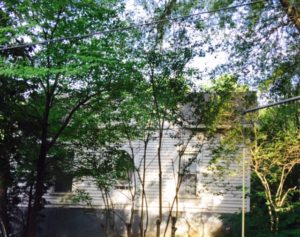
In his Cotton Mill: Commercial Features, D. A. Tompkins sets forth the plans and specifications for what he calls a “Four-Room Gable House.” Moreover, he includes a photograph of this type of abode (Fig. 37). The house at 2005 Cleveland Ave. is a remarkably well-preserved example of this style, which Tompkins estimated in 1899 would cost $400 to erect. It is a one-story frame house with horizontal clapboard siding which is painted white. The structure rests upon brick piers, some of which have been replaced, with cinder or concrete block in-fill of more recent origin. The roof of the three-bay wide by one-bay deep main block is a gable roof of asbestos shingle with a cross gable at the center front. Diamond-shaped ventilators appear in the gable ends and in the cross gable. Rear ells extend from both sides of the back. The windows are four-over-four, double-hung sash throughout. Two brick chimneys with simple, corbeled caps pierce the roof. The original rear porch is unchanged except for the addition of a water closet.

This writer was unable to obtain permission to enter the house. However, he did talk with the daughter of the owner, and she indicated that the interior was essentially unchanged from the original. Initially, the house would have contained four bedrooms, two on each side of a center hall. it is reasonable to infer that they would have been devoid of ornamentation.

athertonmillhse001


Atherton Cotton Mills

atherton-new


This report was written July 14, 1997

1. Name and location of the property: The property known as the Atherton Cotton Mills is located at 2108 South Boulevard in Charlotte, North Carolina.

2. Name, address and telephone number of the present owners of the property:

The owners of the various units in the building and the adjacent parking lot are listed on the attached sheet. The Atherton Condominium Owners Association can be contacted through:

Atherton Condominium Owners Association
c/o Meca Properties
908 South Tryon Street
Charlotte, N.C., 28202

Telephone: 704/372-0005

3. Representative photographs of the property: This report contains representative photographs of the property.

4. A map depicting the location of the property: This report contains a map which depicts the location of the property.


5. Current Deed Book Reference to the property: The most recent references to this property are recorded in Mecklenburg Deed Books by individual unit.

6. A brief historical sketch of the property: This report contains a brief historical sketch of the property prepared by Dr. Richard Mattson and Dr. Dan L. Morrill.

7. A brief architectural description of the property: This report contains a brief architectural description of the property prepared by Dr. Richard Mattson and Dr. Dan L. Morrill.

8. Documentation of why and in what ways the property meets the criteria for designation set forth-in N.C.G.S. 160A-399.4.


a. Special significance in terms of its history, architecture, and/or cultural importance: The Commission judges that the property known as the Atherton Cotton Mills does possess special significance in terms of Charlotte-Mecklenburg. The Commission bases its judgment on the following considerations: 1) the Atherton Cotton Mills was one of only three spinning mills owned and operated by Daniel Augustus Tompkins (1851-1914), a New South industrialist of profound importance in the economic development of Charlotte and its environs, 2) the Atherton Cotton Mills documents the emergence of Charlotte as a major textile manufacturing center in the later nineteenth and early twentieth centuries, and 3) the Atherton Cotton Mills was the first industrial plant in the industrial district of Dilworth, Charlotte’s initial streetcar suburb.

b. Integrity of design, setting, workmanship, materials, feeling, and/or association: The Commission contends that the architectural description by Dr. Richard Mattson and Dr. Dan L. Morrill which is included in this report demonstrates that the Atherton Cotton Mills meets this criterion.

9. Ad Valorem Tax Appraisal: The Commission is aware that designation would allow the owner to apply for an automatic deferral of 50% of the Ad Valorem taxes on all or any portion of the property which becomes “historic property.” The current appraised value of the improvement is $3,771,620. The current appraised value of the land is $1,213,000. The total appraised value of the property is $4,984,620. The property is zoned UMUD.

Date of Preparation of this Report: July 14, 1997

Prepared by: Dr. Dan L. Morrill
Charlotte-Mecklenburg Historic Landmarks Commission
2100 Randolph Road
Charlotte, N.C., 28207

Telephone: 704/376-9115


Statement of Significance. 
The Atherton Cotton Mills is historically significant for its reflection of the emerging textile industry in and around Charlotte during the late nineteenth and early twentieth centuries, and for its association with New South entrepreneur Daniel Augustus Tompkins (1851-1914). Built in 1892 and completed in 1893 along South Boulevard in Charlotte, this mill was the first industrial property in the planned Dilworth factory district, and provided the impetus for the development of this industrial corridor between South Boulevard and the adjacent tracks of the Southern Railway. In the ensuing decades this area would flourish with predominantly textile-related factories, while Charlotte would become the capital of a virtual textile mini-state in the southern Piedmont. The Atherton Cotton Mills was the first mill established by the D.A. Tompkins Company. Tompkins ranks among the preeminent textile industrialists in the South, and during his remarkable career his firm constructed all or portions of 100 cotton mills as well as numerous support industries.

The Atherton Cotton Mills facility also has architectural significance. This well-preserved factory, recently converted into condominiums, clearly represents in its basic form, materials, construction, and restrained design elements textile mills erected throughout Charlotte and the region during the late nineteenth and early twentieth centuries. The mill illustrates the “slow burn,” “standard mill construction” promoted by the New England Mutual fire insurance companies. In a fire, the stair tower, for example, could be closed off from the main facility, thus confining the spread of flames. The hardwood floors and thick structural timbers would char but retain their strength rather than collapsing as iron did in intense heat. The rows of windows along the long brick walls of the mill provided air and natural light for the men, women, and children who typically labored 60 hours per week producing yarn at the Atherton plant.


Young workers at the Atherton Mills
 

Physical Description
 

Location and Site Description

The Atherton Cotton Mills occupies a parcel of land along the South Boulevard industrial corridor of the Dilworth neighborhood in Charlotte. Located approximately in the middle of the block, the tract is bounded by the Norfolk Southern Railway right-of-way to the west, and the Parks-Cramer Company property to the north. Large, paved parking lots have been constructed on the east and west side of the buildings as part of the conversion of the Atherton Cotton Mills into condominiums. The proposed designation includes the exterior of the Atherton Cotton Mills building and all the land beneath and in the parking lots adjacent to the structure.

Architectural Description of the Atherton Cotton Mills Building

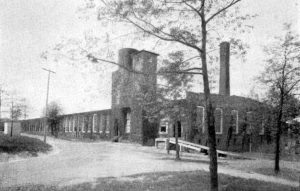
The exterior of the Atherton Cotton Mills building is remarkably intact, having undergone little alteration since the turn of the century, except for loss of its tower and the destruction of part of the powerhouse and machine shop during the conversion of the structure into condominiums. The Atherton Cotton Mills was housed in a single building with the longitudinal plan common to nineteenth century textile factories. Oriented north-south, the building was constructed on a slope, which provided two floors of work space on the west side and a single story on the east, facing South Boulevard. The plan is rectangular although the powerhouse and machine shop and several stairwells and additions do project from the west side, and a small office extends from the east elevation. The building measures 498 feet long and 78 feet wide. The building has a structure of heavy mill construction, reflected in the pilastered brick exterior walls covered in stucco. The foundation is also brick. The roof is a shallow pitched gable, supported by wooden trusses. On the north and south elevations, the roof line is defined by stepped parapets, while on the east and west sides, the gable roof ends in exposed wooden rafters and a wooden fascia. The main floor has numerous tall, recessed, segmental arch windows. New wooden platforms with pipe balustrades and modified doorways have been built to permit access to the condominiums. All the entrances are elevated over a paved drainage ditch which runs the length of the east elevation and the half windows which provide light to the lower floor. The powerhouse and machine shop form one extension from the northwest side of the main mill. On the south side of the powerhouse is a tall, massive square, brick smokestack with flared base and corbeled cap.


Historical Overview
 

Development of the Atherton Cotton Mills

On July 18, 1892, Daniel Augustus Tompkins, R.M. Miller, Jr., and E.A. Smith, business associates in the D.A. Tompkins Company, filed incorporation papers for “The Atherton Mills,” Charlotte’s sixth cotton mill (Mecklenburg County, Record of Incorporations 1892). The factory location was just off South Boulevard at the south edge of Dilworth, a new streetcar suburb of Charlotte. The steam-powered mill, which drew its water from the old Summit Hill Gold Mine, was one of a host of new textile factories taking shape around the city at this time. At the end of July, 1892, the Charlotte Observer enthusiastically declared:

What other city in North Carolina can boast of starting two new factories in one week? The articles of incorporation of the ‘Atherton Mills’–the sixth factory–had scarcely been filed, before a seventh factory was [organized] and in the course of a few months there will be seven cotton factories in full operation in Charlotte. There’s no doubt about it, things are “humming” in the Queen City, and “humming” to the tune of lively progress (Charlotte Observer, July 21, 1892).

Tompkins, Miller and Smith, were New South entrepreneurs who were at the forefront of industrial development in Charlotte and the Piedmont. Miller (1856-1925), a graduate of Davidson College, was secretary-treasurer of the D.A. Tompkins Company, and later headed Charlotte’s tenth mill, the Elizabeth Cotton Mill (Huffman 1983; Morrill 1983). Smith (1862-1933) was a native of Baltimore who first came to Charlotte as sales representative for Thomas K. Carey and Son, an industrial supply firm in Baltimore. After 1901, Smith organized the Chadwick and Hoskins mills in Charlotte, and by 1907, was head of the Chadwick, Hoskins, Calvine (formerly Alpha), and Louise mills in and around Charlotte, and the Dover Cotton Mill in nearby Pineville, North Carolina. When these factories consolidated into the Chadwick-Hoskins Company in 1908, it was the largest textile firm in North Carolina (Huffman 1987; Morrill 1983).

Daniel Augustus Tompkins (1851-1914) played a particularly significant role in the development of the Piedmont textile industry. The son of an Edgefield, South Carolina planter, Tompkins studied engineering at Rensselaer Polytechnic Institute in Troy, New York. He arrived in Charlotte in 1883, as a representative of the Westinghouse Corporation, selling steam engines and machinery to the mills. In 1884, Tompkins launched his own business enterprise in Charlotte and began a remarkable career as one of the leading New South businessmen. In that year he organized the D.A. Tompkins Company, a machine shop and among the most influential contracting and consulting firms for the rising textile industry in the South. Glass (1992, 44) writes that this company was “at the forefront” of machinery manufacturing for the southern textile mills, offering mills “a local alternative to their dependence upon northern suppliers.”


D. A. Tompkins
During his lifetime, Tompkins built all or part of over 100 cotton mills, various fertilizer works, electric light plants, and ginneries. In 1889, he constructed Charlotte’s second, third, and fourth cotton mills (the Alpha, Ada, and Victor), and was a principal in organizing the Charlotte Supply Company, a major supplier of textile machinery and equipment. He transformed the cotton oil of the region from a waste product to a major industry by building approximately 200 processing plants and participating in the organization of the Southern Cotton Oil Company. In 1892, Tompkins purchased the nearly defunct Charlotte Daily Observer, and established the Charlotte Daily Observer, now Charlotte Observer, as a major regional newspaper. He wrote books, notably Cotton Mill: Commercial Features (1899), that codified standard mill and housing designs and set forth investment plans to assist towns in attracting textile mills. Tompkins was also instrumental in establishing textile college programs which would become part of North Carolina State University and Clemson. In sum, asserted the Atlanta Constitution, Tompkins “did more for the industrial south than any other man” (Winston 1920; Clay 1950; Young 1963; Morrill 1983; Huffman 1983; Hanchett 1985, 70; Glass 1992, 4. 32-34, 37-38). The establishment of the Atherton Cotton Mills, states Hanchett (1985), was “an important step in [Tompkins’s] career, for it represented the first cotton mill owned and operated, as well as erected, by the D.A. Tompkins Company.” The construction of the mill complex began shortly after its incorporation. On August 6, 1892, the Charlotte Daily Observer reported that the Atherton site was being cleared, and on Monday, August 8, the groundbreaking ceremony occurred. In November, the newspaper reported on the newly completed factory:

Few locations have a prettier site than the Atherton Mills. The building is in the southern part of the city, just beyond the old fair ground, a few minutes walk off the car lines, and a short distance from the Charlotte, Columbia and Augusta Railroad, which has built a side track to the mill… The management of the business will devolve upon Mr. R.M. Miller, Jr., vice-president and treasurer. Mr. A.M. Price will be superintendent. The company has commenced the construction of the houses for operatives to live in, one cottage being already completed… There will be built twelve four-room houses, six three-room cottages and four two-room cottages (Charlotte Daily Observer, November 27, 1892).

The Atherton Cotton Mills complex developed steadily in the 1890s. Operations began in January, 1893, with 5,000 spindles manufacturing yarn goods. The floor space was equipped for expanding production, and by 1896, the mill housed machinery for 10,000 spindles. In that year, Atherton Mill employed about 300 operatives and included a mill village. This village comprised a school and 50 one-story, frame mill houses, situated along straight streets (mostly Euclid, Tremont, and Cleveland avenues) on the east side of South Boulevard. The village school, called the Atherton Lyceum, was a two-story, frame, multi-purpose facility that taught evening class in the basics of reading and writing and also housed a general store, town hall, and Sunday School classroom (Charlotte Daily Observer, November 17, 1896; April 3, 1897; Thompson 1926, 145; Hanchett 1986).


Atherton Lyceum

The mill complex was both typical of the textile-mill operations appearing throughout the Piedmont, as well as a model which Tompkins could describe in his books on mill construction and design (Glass 1978, 139-142, 147-148; Hall et al. 1987, 115-116; Crawford 1992). Some of the two, three, and four-room mill houses in the Atherton village were illustrated in Tompkins’ s book Cotton Mill: Commercial Features. The mill’s siting in a rural setting outside the city limits of Charlotte was also a common practice, which avoided local property taxes and helped control the activities of workers outside the mill (Tompkins 1899; Hanchett 1985; Glass 1992, 41-42).

In May, 1896, the Charlotte Daily Observer described the Atherton Cotton Mills as “situated in a beautiful oak grove in the southern suburb [Dilworth] of the city,” with mill housing “kept in good repair, neat and nicely painted.” The newspaper declared that “the product of the mill has an enviable reputation; it is well-known in all markets and one hears of it in the East, as much, possibly more so, than any other yarn mill in the South” (Charlotte Daily Observer, May 20,1896). Yet this glowing account obscures the sometimes harsh realities of working in the southern textile industry in the late nineteenth and early twentieth centuries. Work was often tedious and dangerous, and men, women, and children labored at low wages, 10 to 12 hours each weekday, and six hours on Saturday. And, while mill families achieved a measure of independence, life in the company-owned mill village was also largely regulated by mill owners and their supervisors. Guided by a combination of paternalism and pragmatism, owners sought to develop a stable and loyal work force by creating villages which were a tightly controlled and all-encompassing social system (Hall et al. 1987, 114-182). Newspaper accounts of injuries and fatalities at the Atherton Cotton Mills documented the perils of working in the textile factories. Through the years, reports appeared of picking room fires, mangled fingers, and even the death of an overseer, who was entangled in the steam-driven belts in the carding room (Charlotte Daily Observer, June 28, 1893; October 14, 1902).

The location of the Atherton Cotton Mills clearly reflected Charlotte’s emerging status as the hub of the Piedmont textile industry, as well as Dilworth’s role as an industrial as well as residential suburb. During the late nineteenth and early twentieth centuries, Charlotte was transformed from being principally a trading town for local cotton farmers to a major textile center and symbol of the New South.

After the Civil War and the rebuilding and expansion of railroads in the South, leaders of the region began a drive for a New South based on manufacturing and urban growth rather than agriculture (Lefler and Newsome 1954, 474-489). The South’s new economic base was to rest largely on cotton textile production. The Piedmont region was particularly well suited for the textile industry, possessing a good supply of local capital, access to raw materials, good rail connections, and a great supply of labor drawn from nearby tenant farms and the Appalachian mountains (Mitchell 1921; Crawford 1992, 141). Charlotte’s central location in the region led to its rapid industrial growth. Between 1889 and 1908, 13 textile mills and a host of support industries appeared in the city or at its outskirts. As early as 1906, Charlotte boosters celebrated the fact that “within the radius of 100 miles of Charlotte, there are more than 300 cotton mills, containing over one-half the looms and spindles in the South” (Hanchett 1985, 70). By 1910, Charlotte had surpassed the port of Wilmington as the largest city in the state. By the 1920s, the Piedmont South had become the world’s preeminent textile manufacturing region, and Charlotte, boasted a local newspaper article, had become “unquestionably the center of the South’s textile manufacturing industry” (Charlotte Observer, October 28, 1928; Mitchell 1921). The city had become a major New South metropolis, with a population that had skyrocketed from approximately 7,000 in 1880, to over 82,000 by 1929, the largest urban population in the Carolinas (Sixteenth Census 1940).

The New South investors in Charlotte funded not only factories but also a ring of streetcar suburbs, which both reflected and contributed to the local prosperity. Dilworth, situated southeast of downtown Charlotte, was the first of these neighborhoods, beginning in 1891, the same week that trolley or electric streetcar service went into operation. Developed by the Charlotte Consolidated Construction Company (locally known as the Four Cs), whose president was Edward Dilworth Latta, the original Dilworth plan included not only residential streets and a recreational park, but also a factory district. A predecessor of the modern suburban industrial park, this district was located at the western edge of Dilworth, between South Boulevard and the Southern Railway (Morrill 1985, 302-303; Hanchett 1986; Oswald 1987). The first factory established in Dilworth, the Atherton Cotton Mills and its village provided the impetus for both industrial and residential development in the new suburb. Until Tompkins announced the construction of this textile factory complex, the sale of lots in the suburb had been slow, and the Four Cs was in financial peril. Writes Morrill (1985, 303), “[Tompkins’s] mill marked the beginning of the factory district that saved Dilworth from financial failure.” Within a few years this district also included such factories as the Charlotte Trouser Company, the Southern Card Clothing Company, the Charlotte Pipe and Foundry Company, a sash cord plant owned by O. A. Robbins, the Charlotte Shuttle Block Factory, and the Park Elevator Company, producers of pumps, heaters, and elevators (Morrill 1980; Morrill 1985, 302-304; Hanchett 1986) . In October, 1895, the Charlotte Daily Observer described Dilworth as “the Manchester of Charlotte,” and several months later the newspaper observed, “It does one good to go out to Dilworth and see the signs of prosperity and progress. The factories draw the people. Dilworth is beginning to be not only a social but an industrial center” (Charlotte Daily Observer October 23, 1895, January 31, 1896).

The corridor between South Boulevard and the railroad tracks continued to expand throughout the early twentieth century. By the 1920s, the district had also attracted not only the Parks-Cramer complex, but the Lance Packing Company, makers and distributors of snack-food crackers which occupied the 1300 block of South Boulevard, the Tompkins foundry and machine shop (located just north of Parks-Cramer), the Nebel Knitting Mill, the Hudson Silk Mill, a pipe and foundry plant, and assorted laundries, wholesalers, building suppliers, stores, and residences.

The first suburban fire station in Charlotte was located near the north end of the corridor, near Morehead Street, while just west of South Boulevard stood the Exposition Hall for the Made-in-the-Carolinas expositions, which were held during the 1920s to promote the industrial progress of the Carolinas (Miller’s Charlotte City Directory 1929; Bradbury 1992, 53-63). The Atherton Cotton Mills and the Dilworth industrial corridor thrived into the post-World War I years. In 1922, as part of the continuing process of consolidation of individual mills into chains of ownership or large corporations, the Atherton Cotton Mills was purchased by a group of Gaston County textile plant operators headed by John C. Rankin and S.M. Robinson, and reorganized as Atherton Mills, Inc. The Atherton corporate headquarters were also moved to Lowell, North Carolina, in Gaston County (Mecklenburg County, Record of Corporations 1922). The Dilworth industrial corridor began to lose factories by late 1920s and during the Great Depression, as firms shut down or started relocating to larger industrial tracts. In 1933, Atherton Mills, Inc. lost ownership of the South Boulevard plant in foreclosures on deeds of trust that occurred throughout the city. Vacant until 1937, the factory was then owned and operated until the early 1960s by J. Schoenith Company, Inc., manufacturer of “high grade” candy, baked goods, and peanut products. During the Schoenith tenure, a warehouse was constructed north of the mill, on the site of a cotton warehouse, and an office building was erected immediately east of the mill, facing South Boulevard. In recent years the main factory and warehouse have been used by wholesaling and textile-related manufacturing companies, and the former office building has been converted to a restaurant. More recently, the Atherton Mill has been converted into office and residential condominiums.


Notes

1 The authors wish to acknowledge the 1987 draft of the “Survey and Research Report on the Atherton Cotton Mill,” written by Dr. William H. Huffman and Nora Mae Black, and prepared in 1988 by Dr. Dan L Morrill. In particular, the present “Historical Sketch” is based largely on Huffman’s well-researched essay, and, upon consultation with the Charlotte-Mecklenburg Historic Landmarks Commission, is meant to be considered a final edition of that work. A copy of the draft report is available at the Historic Landmarks Commission, Charlotte, North Carolina.


References

Bradbury, Tom. Dilworth, The First 100 Years. Charlotte, N.C.: The Dilworth Community Development Association, 1992.

Charlotte Daily Observer (Charlotte, N.C.).

Clay, Howard Bunyan. “Daniel Augustus Tompkins: An American Bourbon.” Doctoral dissertation, University of North Carolina, Chapel Hill, 1950. Crawford, Margaret. “Earle S. Draper and the Company Town in the American South.” In The Company Town : Architecture and Society in the early Industrial Age. Ed. John S. Gamer. New York: Oxford University Press, 1992, 139-172.

Glass, Brent D. “Southern Mill Hills: Design in a Public Place.” In Carolina Dwelling: Towards Preservation of Place: In Celebration of the North Carolina Vernacular Landscape. Ed. Doug Swaim. Raleigh, N.C.: North Carolina State University School of Design, 1978, 138-149.

The Textile Industry in North Carolina, A History. Raleigh, N.C.: Division of Archives and History, North Carolina Department of Cultural Resources, 1992.

Hall, Jacquelyn Dowd et al. Like A Family, The Making of a Southern Cotton Mill World. Chapel Hill, N.C.: The University of North Carolina Press.

Hanchett, Tbomas W. “Charlotte: Suburban Development in the Textile and Trade Center of the Carolinas.” In Early Twentieth-Century Suburbs in North Carolina. Eds., Catherine W. Bishir and Lawrence S. Early. Raleigh, N.C.: Division of Archives and History, North Carolina Department of Cultural Resources, 1985, 68-76.

“Charlotte and Its Neighborhoods: The Growth of a New South City, 1850-1930.” Charlotte, N.C., 1986. (Typewritten.) Huffman, William H. “Survey and Research Report on the Atherton Cotton Mill.” Charlotte, N.C.: Charlotte-Mecklenburg Historic Properties Commission, 1988. Lefler, Hugh, and Albert Newsome. The History of a Southern State: North Carolina. Chapel Hill: The University of North Carolina Press, 1954.

Mecklenburg County. Record of Corporations, Book A, p. 258.

Miller’s Official Charlotte, North Carolina City Directory. Asheville, N.C.: E. H. Miller, 1920,1929.

Mitchell, Broadus. The Rise of Cotton Mills in the South. Baltimore, Md.: Johns Hopkins University Press, 1921.

Morrill, Dan L “A Survey of Cotton Mills in Charlotte.” Charlotte, N.C.:Charlotte-Mecklenburg Historic Properties Commission, 1979. Survey and Research Report on the Park Manufacturing Company.” Charlotte, N.C.: Charlotte-Mecklenburg Historic Properties Commission, 1980.

“Survey and Research Report on the Atherton Mill House.” Charlotte, N.C.: Charlotte-Mecklenburg Historic Properties Commission, 1981.

“Edward Dilworth Latta and the Charlotte Consolidated Construction Company (1890-1925): Builders of a New South City. The North Carolina Historical Review. 62 (July 1985): 293-316.

Oswald, Virginia. “National Register Nomination for the Dilworth Historic District.” Raleigh, N.C.: Division of Archives and History, North Carolina Department of Cultural Resources, 1987.

Smith, Doug. “Historic Mill to House Home Furnishing Center.” Charlotte Observer. February 8, 1993.

Thompson, Edgar T. Agricultural Mecklenburg and Industrial Charlotte, Chapel Hill, N.C.: The University of North Carolina Press, 1926.

Tompkins, D.A. Cotton Mill: Commercial Features. Charlotte, N.C.: Observer Printing House, 1899.

Sanbom Map Company. Charlotte, Mecklenburg County, North Carolina. 1929, 1946, 1953.

U. S. Department of Commerce, Bureau of the Census, Sixteenth Census of the United States, 1940. Population, vol. 1.

Winston, George T. A Builder of the New South: Being the Story of the Life Work of Daniel Augustus Tompkins. Garden City, New York: Doubleday, Page and Company, 1920.


Armour-Adams House

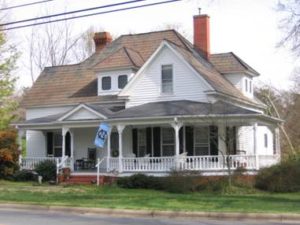
image002


  1. Name and location of the property: The Armour-Adams House is located at 626 North Main Street in Davidson, North Carolina.
  2. Name, address, and telephone number of the present owner of the property: The present owners of the Armour-Adams House are
  3. David Sitton and Camilia Meador
    626 North Main Street
    Davidson, NC
    Representative photographs of the property:

This report contains representative photographs of the property.

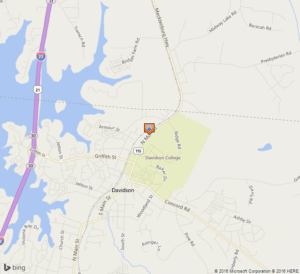
  1. A map depicting the location of the property: The following is a map of the location of the property.  The UTM coordinates for the property are 17 514069E 3929184N.
  2. Current deed book references to the property: The most recent deed to this property is recorded in the Mecklenburg County Deed Book 15850, page 177-179.  The tax parcel number of the property is 003-161-04.
  3. A brief historical sketch of the property: This report contains a brief historical sketch of the property.
  4. A brief architectural description of the property: This report contains a brief architectural description of the property by Stewart Gray.
  5. Documentation of why and in what ways the property meets the criteria set forth in NCGS 160A-400:

    Special significance in terms of historical, architectural, and/or cultural importance:

The Commission judges that the property known as the Armour-Adams House does possess special historic significance for Charlotte-Mecklenburg.  The Commission bases its judgment on the following criteria:

  1. The Armour-Adams House is representative of the evolution of the built environment of Davidson in terms of the emergence of the town’s merchant class.
  2. The Armour-Adams house is a locally distinctive example of the Folk Victorian style of architecture that was made possible by innovations in technology and transportation, and retains a high degree of integrity.
  3. The Armour-Adams House was the long-time home of Margaret H. Adams, a beloved first grade teacher for decades at the Davidson Elementary School.
  4. Integrity of design, setting, workmanship, materials, feeling and/or association. 

The Commission judges that the architectural description included in this report demonstrates that the property known as the Armour-Adams House meets this criterion.

  1. Ad Valorem Tax Appraisal: The current assessed value of the property is   $321,000 ($156,300 building; $162,500 land).  The property is zoned residential.

getmap

This report was prepared by Jane Starnes and revised by Dr. Dan Morrill and Jennifer Payne.

Date of Report: 24 April, 2006

A Brief Historical Sketch of the Property

            The Armour-Adams House, built circa 1900 by Davidson merchant Holt Armour, can best be understood within the context of the evolution of the built environment of Davidson, North Carolina.  The two-story, Folk Victorian style dwelling, which faces west on North Main Street, is representative of the shift in Northern Mecklenburg County during the late nineteenth and early twentieth centuries from an agrarian tradition to a way of life that was increasingly rooted in commerce and industry.  In Davidson, this change was facilitated by the establishment of Davidson College, and was strengthened by the reactivation of the railroad in 1874.  One of the many results of these forces was the emergence of a diverse commercial class in Davidson, of which Holt Armour was a member.  In addition, Davidson is a community that has been historically committed to education, and the Armour-Adams house served as the home of a long-time Davidson teacher who was a part of the movement to bring quality education to the children of Davidson.

Prior to the foundation of Davidson College in 1835, the area surrounding Davidson was rural, fertile farmland.[1]  Farmers such as Robert Armour lived and worked on large swaths of land. The Armours, whose association with the region dates to as early as the 1820s, acquired holdings that stretched “along North Main Street as far south as the cemetery” and “extended westward beyond the railroad and eastward over the area where Davidson College dormitories and Patterson Court now stand.”[2]

The traditional, agricultural life that families like the Armours lived for generations began to be altered in 1835, when a group of Presbyterians chose the spot as the location of their second attempt at providing higher education imbued with Presbyterian values to the youth of the region.  The result of this decision was Davidson College, envisioned as a manual labor institution, and named for William Davidson, who died at the Battle of Cowan’s Ford in the Revolutionary War.[3] The construction of the first College buildings followed; and when Davidson College opened its doors in 1837, several edifices had been constructed for the purposes of housing, educating, and supporting student life.  Twelve buildings had been erected on campus by the close of the antebellum period, including the Chapel, five dormitory rows (of which Elm Row and Oak Row alone still stand), Tammany Hall ( a faculty residence destroyed in 1906), the Old Chambers Building (destroyed by fire in 1921), and the President’s House.[4]

The College drew new residents to the town, some from the surrounding rural environs and some who were associated with the faculty and student populations of the school.  The re-activation of the railroad in 1874 quickened the pace of the town’s growth, and established the community as the commercial center of northern Mecklenburg County.  Residents like the Armour family, who had lived and worked on the land for generations, were drawn to the thriving town in search of new forms of employment in the fledgling merchant class that provided goods and services to the growing population of the town, but whose fortunes were not directly linked to the everyday operations of the College.

The earliest of the Davidson’s merchants was Thomas Sparrow, who operated the first in a long tradition of boarding houses in Davidson.[5] The Helper Hotel, or Carolina Inn, as it is alternatively known, was established in the 1850s by Lewis Dinkins as a store that provided goods to the College population, and was expanded and reestablished as a hotel in the 1860s by Hanson Helper.[6]  The commercial sector of Davidson was augmented in 1890, with the construction of the Delburg Cotton Mill, followed in 1908 by the addition of the Linden Cotton Mill.  By 1910, Davidson, once a relatively isolated college town, had grown into a thriving commercial and industrial center.  Holt Armour took advantage of these circumstances in 1912, when he established Armour Brothers and Thompson, a general retail store that operated out of the brick structure that still stands on the north corner of Brady’s Alley.[7]   Armour Brothers and Thompson was one of several local retail and service firms that operated on the North Main Street commercial corridor, and which also included Goodrum and Company, the White Drug Store, the Jetton Drug Store, and the general merchandise firm of Knox and Brown.[8]  The commercial district that was established by 1920, and which included the Armour Brothers and Thompson store, retains much of the same character that is evident on North Main Street today, because it was hemmed in to the east by the College, to the north and south by residential development, and to the west by the railroad.[9]

The distinctive Armour-Adams House was erected on a lot that Holt Armour received from his father, Robert Armour, in 1899.[10]  Constructed in the popular Folk Victorian style, the Armour Adams House stands as a testament to the innovations in transportation and technology that made the style possible.  The movement stemmed from the Victorian-era architectural forms, such as Queen Anne, that were popular in the last decades of the nineteenth century, in combination with the simple and widespread National or vernacular styles that brought more highly stylized dwellings into the reach of the middle class.[11] The advent of the railroads made lumber and machinery more accessible; the use of manufactured nails replaced the hewn joints which required skilled labor.  The mechanical jigsaw and lathe were two of the most important innovations which aided the growth of this style, and Queen Anne-like scrollwork and brackets, as well as turned porch supports, which were previously only accessible to a few, were now within the realm of possibility for the masses.[12]

In 1919, Holt Armour purchased from his sister, Margaret Armour, the lot adjoining 626 North Main Street to the north.  He sold the original home to J. Hope Adams, who moved with his two adult children to Davidson from York, South Carolina.  The Adams family became longtime residents of the town, and J. Hope’ son, Albert, served as mayor from 1931 to 1933.[13]

  1. Hope’s daughter, Margaret Adams, was a part of the movement in the town to provide a quality education to the town’s children.  Just as the Presbyterians were responsible for bringing higher education to Davidson, they were also the force behind the primary education movement for some of the town’s children. Public instruction in Davidson from 1835 until the 1890s was initially reliant upon individual citizens who operated schools out of their homes or buildings provided by the community for the purpose of education.  However, by the turn of the century, a movement was well under way to provide a consistent public education to the white children of the town.  The cause of public education was spearheaded by the trustees of Davidson College, who in 1892 established the Davidson Academy, which was initially located in the Masonic Hall near the intersection of South Street and South Main Street. The new schoolhouse, which stood on the site of the present Davidson IB Middle School, was completed in 1893 and expanded in 1924.[14] Unfortunately, in a pattern that was familiar to the older residents of Davidson, the expanded school was destroyed by fire in 1946, and classes were held in the gymnasium and in the basement of the Presbyterian Church. Its replacement, which serves today as the Davidson IB Middle School, was completed in 1948.[15] Margaret Adams was a part of the early growth of Davidson education in the twentieth century.   She taught generations of first grade students in Davidson from 1930 until her retirement, and is remembered in town as a “diminutive and greatly loved teacher.”[16]

The Armour-Adams House is an illustration of the evolution of the Town of Davidson from the turn of the twentieth century until the present day.  Its earliest inhabitant, Holt Armour, was a part of the shift from an agrarian tradition to a town life that was centered on commerce and industry and that was facilitated by the establishment of Davidson College and by the reactivation of the railroad.  In its architectural style, the home is evidence of the effect that changes in transportation and technology had on middle class citizens and their ability to build stylized dwellings.  Finally, in its connection to Margaret Adams, the home retains a link to the Presbyterian fervor for quality education for the town’s citizens.


[1] Mary D. Beaty, Davidson: A History of the town from1835 to 1927 (Davidson: Briarpatch Press, 1979), 3.   Information in  this report is taken largely from an initial survey and research report prepared by by Jane Starnes in December, 2005, and from Jennifer Payne and Dr. Dan L. Morrill, “ The Evolution of the Built Environment of Davidson, NC,” available at http://www.cmhpf.org/surveydavidsonpayne.htm.

[2] Ibid., 15.

[3] Cornelia Rebekah Shaw, Davidson College (New York: Fleming H. Revell Press, 1923), 7-16.

[4] Beaty, A History of the Town, 181.

[5] Ibid., 11.

[6] Payne and Morrill.

[7] Beaty, 82.

[8] Starnes; Beaty, 180.

[9] Beaty, 134.

[10] Starnes.

[11] Virginia and Lee McAlester,  A Field Guide to American Houses ( New York: Alfred A. Knopf, 1984), 310.

[12] Ibid.

[13] Starnes.

[14] Beaty, 64, 171.

[15] Kristin Stakel and Dr. Dan L. Morrill, “Survey and Research Report on the Davidson IB Middle School,” December, 2005; Beaty, 64.

[16] Ibid., 82.


Architectural Description

The Armour-Adams House is a very well preserved example of late Queen Anne Style architecture.  While more restrained in terms of ornamentation than many earlier Queen Anne Style houses, the Armour-Adams House demonstrates the asymmetrical massing and machine-made woodwork typical of the style.  In addition, the house is situated in a prominent position on North Main Street.  The house has retained a high degree of integrity in terms of its appearance and historic building material.   

The house sits close to the sidewalk of North Main Street in Davidson and is setback about 40’ from the street, as are most of the neighboring houses.  The house faces west on a lot that slopes down towards the rear of the lot.

The one-and-one-half-story frame house is notable for its asymmetrical massing, and its various roof profiles.  One of the house’s prominent features is the one-story wrap-around hipped-roof porch.  Unlike the typical pier supports found on many early-twentieth-century house, the porch of the Armour-Adams House is supported a continuous single-wythe curtain wall.  Turned post support the porch roof, and are decorated with sawn brackets.  Low guardrails connect the posts, and feature turned balusters and a moulded handrail.  The porch follows the contour of the house, and projects out from a three-sided projecting bay.  The porch is accessed by non-original brick steps. A small gable, featuring a recessed triangular panel, is located over the porch entrance. 

Behind the porch, the façade is dominated by a projecting gabled bay that contrasts with a taller hip roof that covers the principal section of the house.   The house is three bays wide.  A doorway is centered between the three-sided projecting bay on the southern side of the façade, and a single window to the north.  The tall windows appear to be original one-over-one double-hung units, with louvered shutters.  The façade has retained its original three-panel two-light door.  In contrast to the turned woodwork, the fenestration is surrounded with simple trim.  All of the exterior walls are covered with simple weatherboard accented with moulded corner boards. 

Above the porch, the front gable is pierced with a single narrow double-hung window.  The gable is accented with wide and moulded barge and soffit boards, as well as gable returns.  Located over the front entrance is a hipped dormer with two swing-in single-light casements with screens decorated with sawn-work. Moulded trim and a wide freeze-board separates the dormer’s siding from the soffit. With the exception of the porch, the house is covered with metal shingles decorated with a fish-scale pattern.  Two interior chimneys pierce the roof the northern chimney features a corbelled band, and a corbelled flared top.  The southern chimney is plain and of more recent construction. 

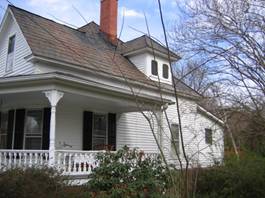
South Elevation

The south elevation of the original house is only two bays deep, with just two windows piercing the wall.  The wrap-around porch extends over only a part of the elevation.  A hipped dormer, like the one on the front of the house, is located on the south side of the house.  Like the south elevation, the north elevation is simple in comparison with the façade. Just two bays wide with a single window in the north-facing gable, the north elevation demonstrates the brick-pier construction of the foundation, the wide water table, and wide freeze board.  An original one-room-deep gabled rear wing is setback slightly from the north elevation.

image006

Front Elevation

image008

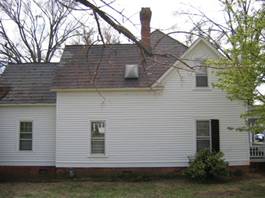
Rear Elevation


The rear elevation is the most altered part of the largely original house.  A single six-over-six is centered in the rear wall of the rear wing.  A similar window is located in the gable.  A shed roof extends from south side of the rear wing, and may have once been a porch.  An enclosed porch extends from the rear of the hipped-roof principal section of the house. A recent deck is located on the rear of the house.  A narrow hipped dormer with a single window is roughly centered over the principal section of the house. 


1.  Name and location of the property.  The property known as the Armature Winding Company Complex is located at 1001 West First Street in Charlotte, N.C.

2.  Name, address and telephone number of the present owner of the property.  The owner of the property is:

Power Products Manufacturing Company

P. O. Box 32277

Charlotte, N.C. 28232

Telephone:  (704) 333-2158

The current occupant of the property is:

The Armature Winding Company

1001 West First Street

Charlotte, N.C. 28202

3.  Representative photographs of the property.  This report contains representative photographs of the property .

4.  A map depicting the location of the property.  This report contains a map depicting the location of the property.  The UTM coordinates for the property are:  17513024E and 3898331N.

5. Current Deed Book Reference to the property: The most recent deed to this property is listed in the Mecklenburg County Deed Books #3811 p 0822. The tax-parcel number of the property is 073-242-18.

6. A brief historical sketch of the property: This report contains a brief historical sketch of the property prepared by Ryan L. Sumner.

7. A brief architectural description of the property: This report contains a brief architectural description of the property prepared by Ryan L. Sumner.

8. Documentation of how and in what ways the property meets the criteria for designation set forth in N.C.G.S. 160A-400.5:

a. Special significance in terms of its historical, prehistorical, architectural, or cultural importance: The Commission judges that the property known as the Armature Winding Company Complex does possess special significance in terms of Charlotte-Mecklenburg. The Commission bases its judgment on the following considerations: 1.) The Armature Winding Company was an important component of the industrial and commercial infrastructure that allowed Charlotte to become a major textile center of the two Carolinas in the early twentieth century. 2.) The Armature Winding Company’s main building, designed by Fred L. Bonfoey, and its associated structures, represent industrial warehouse and mill construction of the early 1900s in Charlotte. 3.) The complex is an important remnant of an industrial district that grew along West Morehead Street in proximity to the Piedmont and Northern Railroad tracks and the Wilmore streetcar line.

b. Integrity of design, setting, workmanship, materials, feeling, and/or association: The Commission contends that the architectural description by Ryan L. Sumner, which is included in this report, demonstrates that the essential form of the Armature Winding Company Complex meets this criterion.

9. Ad Valorem Tax Appraisal: The Commission is aware that designation would allow the owner to apply for an automatic deferral of 50% of the Ad Valorem taxes on all or any portion of the property that becomes a “historic landmark.” The current appraised value of the 2.066 acres of land is $384300. The current appraised value of the improvements is $30,000. The total current appraised value is $431,900. The property is zoned U-I.

Date of Preparation of this Report: September 1, 2002

Prepared by: Ryan L. Sumner and Dr. Dan L. Morrill
Ryan L. Sumner

May 30, 2002

Historical Background Statement

Executive Summary

The Armature Winding Company Complex, erected in 1924-25, is a group of structures that possesses local historic importance because it housed enterprises that made significant contributions to Charlotte’s emergence as a major textile manufacturing and distribution center in the late 19th and early 20th centuries. Founded in 1907, the Armature Winding Company repaired electric components for use in looms and textile equipment, essential to the operations of textile mills in the Piedmont sections of the two Carolinas. It also repaired transformers for Duke Power, manufactured transformer-cooling fans, and distributed electric motors for General Electric Company, along with a variety of other electrical items. Without the support of firms like the Armature Winding Company, cotton mills could not have proliferated in the Piedmont sections of the two Carolinas in the early twentieth century.

The Armature Winding Company Complex, the main building of which was designed by local architect Fred L. Bonfoey (c.1872-1933), also possesses local historic importance because it contains a representative example of a type of commercial and industrial structure constructed in Charlotte in the 1920’s. The complex’s primary building is a one-story brick and steel structure with a low-pitch gable roof. The large windows are multi-pane with metal frames. The building also has exposed beams. The second building, originally a manufacturing plant for silk and cotton products by the Southern Specialties Company, was also constructed in the mid-1920s. This building is brick and has a raised monitor roof with clerestory windows. The owners of the building replaced the original large, multi-light windows with much smaller units on one elevation, and added a storefront. A small house adapted for company use also sits on the property.

Commerce and Industry Context and Historical Background Statement

The Armature Winding Company Complex, erected in 1924, housed enterprises that contributed to Charlotte’s emergence as a major textile manufacturing and distribution center in the late 19th and early 20th centuries. “Among all of North Carolina’s cities, Charlotte enjoyed the most sustained growth and by 1910 had surpassed Wilmington as the largest in the state,” writes historian Brent D. Glass. “The significance of Charlotte’s development,” says Glass, “lay not only in the thirteen textile mills built between 1889 and 1908 but also in the creation of a true urban infrastructure that included engineering firms, financial institutions, and department stores.”1

George and Wilson Stratton

Louis F. Stratton (pres./mgr.), and his two sons: Wilson L. (vice pres.), and George F. Stratton (sec./treas.). founded the Armature Winding Company and Ferrofix Brazing Company in 1907. The business partners first set up shop on West 5th Street, behind the original location of the Textile Mill Supply Company.2 The transfer of Charlotte’s mills from coal-generated steam to electric power resulted in great demand for Armature Winding’s new and rebuilt motors and necessitated that the company expand across the street in 1915.

The company continued to grow through the early 1920s, and the Strattons began to look for a newer, larger facility to house their operations. In 1923, George and Wilson Stratton bought three lots in Charlotte’s McNinchville neighborhood.3 This community was intended to be residential, but the proximity to the Piedmont and Northern Railroad, lack of zoning codes, and cheapness of land, encouraged a series of industrial buildings to be built in the area. The Strattons commissioned local architect Fred L. Bonfoey4 to design the new Armature Winding Company Building,5 which the Thies-Smith Realty Company constructed between May 6, 1924, and sometime in 1925.6 The brothers timed their expansion well, because as the Charlotte Observer noted in 1925: “Charlotte has come to be known in the sales organizations of national manufacturers throughout America as the best point in the Southeast for the distribution of products and for the location of branch plants.” 7

West 5th Street Office, 1915.

Armature Winding employee operates the radial drill in 1927.

Machinist-type work characterized the principal labor done at the Armature Winding Company. A 1927 promotion book published by the company shows workers operating drill presses, removing coils from motors, steam cleaning electrical housings, winding coils, and sanding parts.8 From the pictures and because of the firm’s strong emphasis on repairing motors,9 it seems that work at the Armature Winding Company had more variation and required a higher level of technical skill than the monotonously repetitive labor of most textile jobs.

The Armature Winding Company expanded its operations in the 1930s and 1940s. Beginning in 1936, the Strattons acquired two adjacent lots with three single-family houses along McNinch Street,10 which were converted for use as storage, a spray booth, and employee dressing area.11, 12 In 1942, the firm bought another adjacent parcel with a warehouse building13 built in 1925 by the Southern Specialties Company for the manufacture of silk and cotton products.14 With the purchase of three vacant lots in 1949,15 the Armature Winding Company came to control an entire city block—this final purchase allowed the company to construct several small out-buildings, such as a parts cleaning building, sand-blasting shed, oil-fired stripping oven, coal bin, open storage building, and several fuel tanks.16

Armature Winding Co. in full operation.

On December 31, 1975, George F. and Wilson L Stratton, Inc., the holding company of Armature Winding Company was merged into Power Products Manufacturing Company.17 Power Products Manufacturing Company is the current owner of the property, but still does business as Armature Winding Company at 1001 West First Street. The company ceased refurbishing electrical equipment in 1970s and now servers only as a distributor for equipment manufactured by the General Electric Company.

Architectural Description

Site Description
The Armature Winding Company Complex is located within Charlotte’s Third Ward in the McNinchville community. This community, bounded by Cedar, Morehead, and Second Streets, was divided into lots planned primarily for residential use. However, Mecklenburg County’s lack of zoning codes in the 1920s, inexpensive land, and proximity to rail lines made the neighborhood attractive to industry.

The area surrounding the Armature Winding Company Complex has changed considerably since 1923. At that time, Standard Oil Company’s regional office stood to the east of the site, while a series of horse stables was located across McNinch Street. Trains from James B. Duke’s Piedmont and Northern Railroad rolled past the facility’s south side. Today, the Standard Oil building has become the Charlotte Rescue Mission; newly built houses stand across First Street; and a few former railroad passenger cars are parked  on the former Piedmont and Northern Railroad tracks and can be rented for catered functions.

Armature Winding Company Building from across Piedmont and Northern Railroad tracks.

The Armature Winding complex is bounded on four sides by West First Street, Elliot Street, the former P&N rail line, and McNinch Street. The area is very flat and grassy, inclining slightly downward on the southwest side near the train tracks. The site was obviously built up and leveled; it does not follow the northwesterly downward slope of West First Street, necessitating steep plinths along West First and Elliot Streets.

The current size of the Armature site reflects growth and expansion over time. Originally, this area was a city block, divided and sold as twelve residential-sized lots. The Strattons’ original one story brick and steel building is located in the southeast area of the block on lots #7—9. The company purchased lots #1—2 in 1933, with three houses18—only one of which is extant. About the same time that Armature Winding Company established its operations on McNinch Street, the Southern Specialties Company purchased lots #3—5, constructing a building for the manufacture of silk and cotton products.19 The Southern Specialties Building was purchased by Armature Winding in 1942. Finally, the company purchased the remaining three lots (#10—12) in 1949. (See history section more detail.)

Armature Winding Co. Building on right.  Southern Specialties Co. Building on the left.

The complex’s main building is a one-story red brick (common bond pattern with six course headers) structure with a low-pitch tarred gable roof, with a rectangular plan. Steel columns and heavy wood cross beams support the building throughout. The roof’s overhanging eaves and exposed wood rafters evoke the bungalow-style—architect Fred L. Bonfoey’s specialty. The building is constructed in the mill/industrial style, with large multi-pane windows with metal frames dominating the structure’s architecture.

The north face of the main building is eight bays wide, with seven windows stretching from just under the roofline to about three feet above the ground. These apertures have metal mullions, brick sills, and are laid-out in a 7 pane high by five pane wide configuration, with hopper window insets. A large loading door is on the east (left when facing) side of this wall—this door once connected to a spray booth (adapted from one of the tenant houses)20, but no doubt became an important point for deliveries, as trucks replaced trains as the principal means of receiving and distributing goods to the site. A three-story, non-corbelled, non-shouldered chimney also rises from the north side of the building.

Interior of Armature Winding Company Building

The east elevation of the Armature Winding Company Building (located along McNinch Street) is twenty-one bays wide and is characterized by near continuous band of multi-pane translucent windows running nearly the length of the building and almost the height of the walls. The vast majority of these windows is arranged in four panes by seven patterns and have concrete sills. At the far left (south) of the elevation, a set of double doors, each fenestrated by a three-over-three window, leads to offices. Above this door is a window, five panes wide and four panes high. The last two windows left of the double doors have a slightly smaller three panes wide by seven panes high configuration. At the far right (north), a single door with three-by-three pane inset window leads into the main body of the space. Above this door is a corbelled band of stretchers laid vertically.

The south elevation looks out over the rail line and at the time of its design was likely considered the front of the building. Eleven bays wide, with ten window groups (five panes wide by seven tall), the words “ARMATURE WINDING CO.” was boldly emblazoned above the loading dock door in white letters against a black background. Similarly, “ARMATURE WINDING CO. MOTORS BOUGHT SOLD AND REPAIRED,” was painted underneath the band of windows to the right (east) of the loading door.

Today the south elevation has lost much of its former glory. The huge windows that defined this view of the building are bricked completely up. A hedge of thick foliage runs just a few feet parallel to the building face, and the area in between has become quite overgrown with plants. The view of the building is further obscured by several defunct train cars parked on the railroad track right in front of the building. Although greatly faded, it is still possible to read the two black and white painted signs on the building. The rollup loading dock door, which once allowed the passage of goods to and from waiting railroad cars, is closed and practically useless.

The west side of the Armature Winding Company Building is 21 bays wide, and like the east elevation, contains more glass than brick. A set of double doors located on the left (north) end open between the shop and service yard, which once contained a massive overhead crane, and various outbuildings. As on the east wall, the most observable feature is the continuous band of windows, mostly four by seven pattern, with the two right most (south) windows slightly smaller—three panes by seven panes.

Original sink in the bathroom of the Armature Winding Company Building

The steel column and heavy wood cross-beam construction of the Armature Winding Company Building not only allows the extensive use of large windows in non-load bearing walls, it also permits the interior of the building a great deal of openness. The interior of the building is essentially a shop space, the open plan of which is interrupted solely by the centrally located men’s restroom. The flooring inside the space is concrete on the western half of the building, while maple boards are on the eastern side. An overhead crane system tracks below the ceiling in the space. Offices located in the southeast corner of the shop have been partitioned off from the main space by a new wall and have been extensively remodeled with carpet, refinished floors, dry-wall partitions, and modern lighting; however, there has been some efforts at preserving the integrity of the space, such as keeping the original windows and covering them with shades on the inside.

The Former Southern Specialties Building

Interior of Southern Specialties Co. Building

Originally built for silk, rayon and cotton manufacture by the Southern Specialty Company, this building is used as a warehouse by the Armature Winding Company. The building is a one-story red brick (laid in running bond pattern) and wood-framed structure with a clerestory roof, and an L-shaped plan. At its widest points, the building is fifteen bays wide by six bays deep.

The front (north) face of the warehouse building is thirteen bays wide and consists of three principal masses. The elevation is dominated visually by a non-contributing stucco entrance of recent origin on the left projecting block of the “L-plan.” This element contains a recessed set of double doors flanked on either side by a double six-over-six window. Continuing to the right, a post-1956 addition is nestled into the interior angle of the “L”—entry is gained through a door in a recessed vestibule and four fixed windows with three vertical muntins and brick sills are located on this block. Farther down the electric oven, a brick box-like structure with a gable roof, juts out from the side of the building. Farther to the right, along the long shaft of the “L,” are four large windows, each with a fifteen-over-fifteen pattern.

The original brick face of the west elevation has been obscured by stucco. The dramatic rise of the clerestory roof is very apparent from this angle. A large overhead service door opens into the building’s central hallway, and is flanked on either side by a twenty-five-pane window.

The rear (south) elevation of the Southern Specialties Company Building is fifteen bays wide. Eleven of these bays are in the form of large window units, comprised of thirty-six panes each (six wide by six high). The third bay from the left (west) side consists of a recent plain double door below half a window unit (the original is in storage on the site). The four windows from the right (east) end of the building have been replaced, most  being converted into a loading dock. From this elevation the east-west run of the clerestory roof is easily visible, composed of about twenty-eight windows, each comprised of eight panes (four wide by two high)

The east elevation is seven bays wide. The seven original windows have been removed, and smaller double-hung six-over-six windows have been put in their place. To account for the size difference, each of the new windows is surrounded by stucco. “ARMATURE WINDING CO.” is painted on the upper left (north) corner of the elevation.

The interior of the Southern Specialties Building is a curious mix of the extensively remodeled and well preserved. In the 1970s, the building underwent an extensive modernization. The owners added a storefront addition to the north elevation and gutted extensive portions of the northern and eastern sections of the building.21 Very little original material remains in these areas—even the windows are gone. However, a great deal of historic fabric is concentrated along the central spine of the building in an open space underneath the dramatic clerestory roof. Here the wood plank floor and ceiling are still in place, as are the hanging lights, elements of the overhead hoisting system, and the heavy wood beam and steel column support system. A cellar (inaccessible to this writer at the time of his visit) purportedly used by the Southern Specialties Company to store silkworm cocoons exists under the building and is reached via a centrally located interior staircase.

Tenant House

This house was likely built by the Standard Oil Company22 as worker housing around 192623 and purchased by the company in 1936  as a storage building. It is a one-story gravel-veneered concrete block structure with a cross gable roof and slight “T”—plan. The roof is rusted tin; the three paneled doors are wood painted white; and the windows are all double-hung six-over-six.

Unknown residents of the tenant house, c. 1920s.

The east elevation is four bays wide, with two principal masses. The forward sitting cross gabled-end has a six-over-six window and a white panel door. To the right on the crossing mass is another similar door followed by another six-over-six window. Two windows are on the north elevation; the gabled end is on the left half. Two bays, a door and a window characterize the west side of the house with the turned gable on the right side. The southern wall of the house is flat and contains two windows, situated near the  ends of the wall.

Tenant House

The interior of the house is comprised of four equally-sized rooms. There is no facility for cooking other than a fireplace and no indication of plumbing. The floor and walls are quite unstable, making entrance unadvisable.


overview503


1. Name and location of the property:  The property known as the American Legion Memorial Stadium is located between Sam Ryburn Walk and East Seventh St. on East Independence Boulevard  in Charlotte, North Carolina.

2. Name, address and telephone number of the present owner of the property:  The present owner of the property is:

Mecklenburg County

600 East Fourth Street

Charlotte, N.C. 28202-2816

Telephone: 704-336-2472

3. Representative photographs of the property:  This report contains representative photographs of the property.

4. Maps depicting the location of the property: This report contains a map depicting the location of the property.


5. Current deed book reference to the property: The most recent deed to this property is recorded in Mecklenburg County Deed Book 9276 on page 437. The tax parcel number of the property is 080-171-01.

6. A brief historical sketch of the property: This report contains a brief historical sketch of the property.

7. A brief architectural description of the property:  This report contains a brief architectural description of the property.

8. Documentation of why and in what ways the property meets criteria for designation set forth in N. C. G. S. 160A-400.5:

Special significance in terms of its history, architecture, and/or cultural importance: The Commission judges that the property known as the American Legion Memorial Stadium does possess special significance in terms of Charlotte-Mecklenburg. The Commission bases its judgment on the following considerations:

1) The American Legion Memorial Stadium was the first major spectator sports facility erected by the City of Charlotte.

2) The American Legion Memorial Stadium resulted from the infusion of substantial Federal assistance into the local economy and was a part of a major shift in the role of the Federal government in societal affairs.

3) The original portions of the American Legion Memorial Stadium exhibit distinctive qualities of the Art Deco style of architecture.

9. Ad Valorem tax appraisal:   The Commission is aware that designation would allow the owner to apply for an automatic deferral of 50% of the Ad Valorem taxes on all or any portion of the property which becomes a designated “historic landmark.” The current total appraised value of the improvements is $6,656,150. The current total appraised value of the 9.89 acres of land is $4,408,080. The current total appraised value is $11,064230. The property is zoned MUDD-O. The property is currently exempted from the payment of Ad Valorem taxes.

10. Portion of property recommended for designation: The exterior and interior of the American Legion Memorial Stadium and sufficient acreage to assure the protection of its setting.

Date of preparation of this report: April 23, 2003.

Prepared by: Dr. Dan L. Morrill
Historical Overview

The American Legion Memorial Stadium (1936) was a direct result of substantial Federal assistance to local government and was the first municipal structure in Charlotte, N.C. that could accommodate thousands of visitors.  From the outset it became a venue for sporting, entertainment, and civic events that theretofore would have been impossible to hold.  Over the years a broad array of happenings have occurred at the stadium, most notably football games – high school, collegiate, and  for many years the Shrine Bowl from 1937 through 2000.  The stadium has also hosted July 4th concerts, professional wrestling matches, and performances by entertainers.1


This photograph of American Legion Memorial Stadium appeared in the 1947 Central High School Annual.  You are looking east.  Note that Independence Boulevard had not yet been built.
Spectator sports, both amateur and professional, rose in popularity in the 1920s and 1930s largely because of an increase in middle class income, greater availability of automobiles, and the growth of urban centers.2  Charlotte’s population burgeoned in the early 1900s, from 18,091 in 1900 to 134,052 in 1950.  Clearly, the need for a facility such as  the American Legion Memorial Stadium was becoming increasingly defensible.3 Indeed, a major expansion of the stadium took place in the 1960s and 1970s, when upper level seating was added first on the north side and then on the south side of the playing field.


Photograph Of The Shrine Bowl (1966)
The stadium bore dramatic testimony to a shift in attitudes in the 1930s about the role of the Federal government in societal affairs. The construction of the American Legion Memorial Stadium in Charlotte, N.C. was intimately bound up with the relief programs of the Great Depression.  President Franklin D. Roosevelt persuaded the U.S. Congress to create the Works Progress Administration (W.P.A.) in April, 1935, with an initial appropriation of $4.88 billion dollars to provide jobs for millions of unemployed laborers, artists, writers, scholars, and others.   The W.P.A. provided most of the funding to construct an assortment of structures, including airports, seaports, bridges, schools, museums and stadiums.4  The W.P.A. also supported programs in the humanities, including the Federal Arts Project, Federal Writers Project, Federal Theatre Project, National Health Survey, and the Historical Records Survey.5
Photo of Arthur Wearn


Mayor Arthur E. Wearn (1933-1935)
Charlotte leaders, including Mayor Arthur E. Wearn, were eager to benefit from the dollars provided by the Works Progress Administration.   Wearn, who had become mayor by appointment on May 3, 1933, had already secured $70,000 of Federal funds from the Federal Emergency Relief Administration (F.E.R.A.) and the Civil Works Administration (C.W.A.) on January 3, 1934, to enable the City to begin work on a stadium in Independence Park.  There was considerable public opposition to the City’s accepting the money to start the stadium.  One property owner was particularly outspoken.  “I am a lover of beauty,” he began.  “I object to having a beautiful thirty or forty trees cut down, a beautiful natural amphitheater turned into a concrete bowl surrounded by a high fence — to say nothing of the attendant noise and dust.”6 Strong political support for Mayor Wearn’s efforts to build a major outdoor sports facility in Charlotte had come from the Hornet’s Nest Post Number 9 of the American Legion.  That patriotic organization wanted the stadium to serve as a memorial to those soldiers from Mecklenburg County who had served the United States during The Great War, now called World War One.  The City Council agreed on June 13, 1934, to name the facility “American Legion Memorial Stadium.7
The Stadium As It Appeared In December, 1935.  Notice that there are no seats.
Earth had been moved by December, 1935, to create a playing field that was bordered by a rock wall and that was surrounded on three sides by grass embankments.  Enough money to install seats was not initially available, however.8 This meant that the stadium was essentially unusable.

Soon after the House of Representatives gave its assent to the creation of the W.P.A. in January, 1935, City officials provided a tentative list of the projects they planned to submit to the new agency if it was approved by the U.S. Senate.9   These included an array of undertakings, including street improvements and even placing public restrooms below ground at the intersection of Trade and Tryon Sts., locally known as the Square.10


Mayor Ben Douglas (1935-1941)
The impetus for new construction projects in Charlotte increased substantially when Ben Douglas defeated Arthur Wearn by popular election and became Mayor in May, 1935.11  A native of Iredell County, Douglas had moved to Charlotte from Gastonia in the mid-1920s and had established a funeral home at the corner of Fox Street and Elizabeth Avenue, now Independence and Elizabeth.  A tireless and adroit politician, Douglas was Mayor from 1935 until 1941, and earned the reputation of being the “Builder of Modern Day Charlotte.”  Douglas loved the drama and passion of the political arena and devoted his enormous energies and talents to leading the people into what he hoped was a bright and prosperous future.  Born in the 1890s, he reached adulthood during the “roaring twenties,” when it seemed that everybody was making piles of money in the stock market.  Then came the crippling Great Depression of the 1930s.  Douglas saw himself as a cheerleader, as an urban booster, who would rally the people of Charlotte and give them hope.12


City Manager J. B. Marshall

Douglas hired James B. Marshall as City Manager.13  A native of Anderson, S.C., Marshall was a brilliant engineer who had graduated from the College of Charleston before settling in Charlotte in the 1920s.14  By the end of May, 1935, Marshall was busily at work preparing a list of projects for submission to the Works Progress Administration for possible funding.15

The W.P.A. had a major presence in Charlotte.  A district office of the Works Progress Administration was established on Tryon St. in July.16  John Grice, its Director, urged Charlotte-Mecklenburg officials and those in surrounding counties to submit applications for projects.17 On August 28, 1935, local attorney Marvin Ritch appeared before the City Council and urged that “some immediate action” be taken “toward completing the stadium in Independence Park.” Not surprisingly, Marshall included the completion of Charlotte’s stadium on his list of W.P.A. applications.18  The largest project for which the City sought W.P.A. funding was the creation of a municipal airport.19


This is the Armory Auditorium which stood just west of the stadium.  If you look carefully you can see part of the natural area that once occupied the space behind the building.
The  Charlotte Observer reported on November 7, 1935, that the City would be submitting its formal application to the Works Progress Administration for the stadium.20 George W. Coan, Jr., State Administrator of the W.P.A., informed Mayor Douglas and City Manager Marshall on December 27, 1935, that funding for finishing the stadium had been approved.  “Completion of the stadium will give Charlotte one of the finest bowls in North Carolina,” stated the newspaper.  Mayor Douglas greeted the news with his usual enthusiasm.  “It will put a lot of people to work,” he said.  “I am mighty glad to hear that it is going through.” City Manager Marshall announced: “Our plans are ready and we ought to get started on it right away.”21 The Charlotte Observer commented editorially on the project the next day.  “Gratifying the information that the completion of the local stadium through the medium of Federal funds is to be undertaken at once,” the newspaper proclaimed.22

This picture of  newly-elected Mayor Douglas and the Charlotte City Council appeared in the Charlotte Observer in May 1935. Seated left to right on the front row are Claude L. Albea, W. N. Hovis, Mayor Ben E. Douglas, L. R. Sides, and John F. Boyd.  Standing left to right on the back row are J. S. Nance, Herbert H. Baxter, J. H. Huntley, Mayor Pro-Tem John L. Wilkinson, J. S. Tipton, W. Roy Hudson, and John F. Durham.

George Coan, Jr. left to local officials the decision as to whether the stands would be constructed of concrete or native stone. Stone, which had been used in the recently completed wall at the edge of the playing field, would have been more aesthetically appropriate; but the City selected concrete as the building material for the stands, primarily because the installation of stone would have required a pool of skilled labor that was not locally available.23  The W.P.A. awarded $51,617 for the stadium project, and the total City contribution was less than $5000.24

Workers came to the site in early January, 1936, and work continued during the next eight months.  The need to complete the stadium intensified after June 22nd, when word arrived that President Roosevelt would be visiting Charlotte on September 10th and would be making a major public address at the American Legion Memorial Stadium.  According to the Charlotte Observer, the President would be participating in an “old-time Democratic love-feast,” labeled a Green Pastures Rally, to which the party faithful of seven states would be invited.25  On July 11th, John Grice stated that the concrete stands would be finished soon and that installation of the seats would commence shortly thereafter.  “The stadium positively will be completed by September 1,” Grice promised.26 The newspaper reported on August 25th that the seats were being installed, and the Charlotte Observer published  a photograph of the completed stadium on September 1, 1936.27


The Stadium Completed (1936)
The editors of the Charlotte Observer understood the role of the Federal government in making the American Legion Memorial Stadium possible.

They wrote:  “If New Deal spending all over the country could be accurately, fairly and truthfully measured by that which was locally done to provide our community the handsome, elaborate and commodious stadium, the mouth of the critics of the Roosevelt administration would be sealed. . . .

Except for Federal financial aid designed at once to relieve unemployment and to provide communities the realization of some improvements of which they stood in need, this stadium would have remained, perhaps, only as a forecasted fantasy, the dream of a project, sorely needed, but never to be realized as a result of the investment of purely localized funds.”28


Crowd Lines West Trade Street Awaiting President Roosevelt’s Motorcade.  Picture from Haywood Robbins Collection, Special Collections, UNCC
It was altogether fitting and proper that President Roosevelt was the first speaker at the American Legion Memorial Stadium.  The Chairman of the Green Pastures Rally of September 10, 1936, was Charlotte attorney Haywood Robbins. He and his colleagues worked diligently to assure that the event would be successful.29
Official Program
President Roosevelt arrived by motorcade from Asheville, N.C. in the early afternoon  of September 10th in a heavy rainstorm and traveled directly to the American Legion Memorial Stadium.  From a platform erected at the western end of stadium, just behind the Armory Auditorium, the President gave a rousing address to an enthusiastic throng of well wishers.30


The Crowd Listens To President Roosevelt.  Picture from Haywood Robbins Collection, Special Collections, UNCC
Even though he professed to be making a nonpartisan speech, Roosevelt insisted that the nation would only prosper if the common man fared well.31


This is the podium from which President Roosevelt spoke.  Picture from Haywood Robbins Collection, Special Collections, Atkins Library  UNCC
The Charlotte Observer commented editorially on the Green Pastures Rally and insisted that the event had indeed been political.  “It is as impossible to divorce the President . . . from politics,” the newspaper proclaimed, “as it would be for a minister of the Gospel to announce when he enters the pulpit that such a step involves no religious significance.”32


Haywood Robbins Was Chairman Of The Green Pastures Rally.  Picture from Haywood Robbins Collection, Special Collections, Atkins Library  UNCC
The first  of many college football games in the American Legion Memorial Stadium in Charlotte occurred in the afternoon of September 26, 1936.  The University of North Carolina and Wake Forest College played.  According to the Charlotte Observer, it was “by far the largest (crowd) ever to see a football game in Charlotte.” U.N.C. won by a score of 14 to 7.33 Dedication ceremonies for the stadium were held before the game.

The American Legion Memorial Stadium has continued to occupy an important place in the cultural life of the community, especially as a host for high school football games.  The completion of Ericsson Stadium in the 1990s, however, meant that Memorial Stadium was no longer the largest outdoor sports facility in Charlotte. Also, high schools have acquired their own football stadiums. Inevitably, the level of civic commitment to the site has begun to wane.   Its illustrious history notwithstanding, the stadium is now in jeopardy.  Influential institutions and individuals would like to demolish it, possibly to make way for a new professional baseball park.
Wake Forest College vs. U.N.C. Football Game (Sept. 26, 1936)

1 Charlotte Observer (July 18, December 7, 1985; June 6, 30, July 17, 1986).

2 For an overview of sports history in the United States , see Baker, William J.  and  Carroll, John M.,  Sports In Modern America  (River Side Publishers, 1981).

3. Morrill, Dan L., “A History of Charlotte and Mecklenburg County.”  (cmhpf.org).

4. For an overview of the New Deal programs of the 1930s, see Davis, Kenneth S. , The New Deal Years.  1933-1937 (New York:  Random House, 1986).

5. W.P.A. construction projects in Mecklenburg County included, among many others, the rebuilding of the former United States Mint Building as the Mint Museum of Art and the construction of Charlotte’s first municipal airport, now Charlotte Douglas International Airport.

6. In May 1933, the Federal Emergency Relief Administration was founded principally to give assistance to the needy. The Civil Works Administration was established on November 8, 1933, to provide money to states to build roads, schools, and athletic fields.  F.E.R.A. and C.W.A. provided a total of $70,000 for the stadium project (Charlotte Observer ,December 29, 1935)  Charlotte City Council Minutes Book 22, p. 507.  Charlotte City Council Minutes Book 23, p.130.

7. The Hornet’s Nest Post proposed that it lease the stadium from the City to assure that the troops who had served in World War One would be properly honored (Charlotte Observer, July 8, August 9, 1936).  The Charlotte City Council approved a resolution on June 13, 1934, naming the stadium “American Legion Memorial Stadium” (Charlotte City Council Minutes Book 23, p. 426.)

8. For a photograph of Memorial Stadium without seats, see Charlotte Observer (December 29, 1935).

9. Charlotte Observer (January 25, 1935).

10. Charlotte Observer (February 3, 9, 10, 15, 16, 1935).

11. Charlotte Observer (May 8, 1935).  For a photograph of Douglas shaking Wearn’s hand, see Charlotte Observer (May 9, 1935).

12. Morrill, Dan , “The Building Of Independence Boulevard.” (cmhpf.org).  Hereinafter cited as “Independence.”

13. Charlotte Observer (May 16, 1935).  This article contains a photograph of Marshall.

14. Independence.

15. Charlotte Observer (May 31, 1935).

16. Charlotte Observer (July 10, 14, 21, 28, 1935).  D. M. Rea was the Assistant Director of the Charlotte District Office of the Works Progress Administration.

17. Charlotte Observer (July 13, 1935).

18.   Charlotte City Council Minutes Book 25, p. 17. Charlotte Observer (September 7, 8, 1935).

19. Charlotte Observer (September 4, 1935).  The principal airport in Charlotte was a private facility located on Tuckaseegee Road  (September 18, 1935).

20. Charlotte Observer (November 7, 1935).  The application was delayed because City Councilmen Herbert Baxter feared that funding for the municipal airport might be delayed if Federal money was sought for the stadium project (Charlotte Observer, November 3, 1935).

21. Charlotte Observer (December 28, 1935).

22. Charlotte Observer (December 29, 1935).

23. Ibid.

24. Charlotte Observer (December 28, 1935).

25. Charlotte Observer (June 23, 1936).

26. Charlotte Observer (July 12, 1936).  The original estimate of the date the stadium would be completed was June 30, 1936.

27. Charlotte Observer (August 25, September 1, 1936).

28. Charlotte Observer (September 2, 1936).

29. Charlotte Observer (July 7, 1936).

30. Charlotte Observer (September 11, 1936).

31. Ibid.

32. Charlotte Observer (September 11, 1936

33. Charlotte Observer (September 27, 1936).  The Mecklenburg County Parks and Recreation Department has placards on the site that incorrectly state that the stadium was completed in 1937.  According to historian Legette Blythe, the first football game held at the stadium was played between Charlotte Central High School and Barium Springs Orphanage.  The first Shrine Bowl was held at the stadium in 1937.  Blythe, Legette and Brockmann, Charles Raven, Hornet’s Nest.  The Story of Charlotte and Mecklenburg County (McNally of Charlotte, 1961).


Architectural Description.  The American Legion Memorial Stadium is a “U-shaped” edifice with a sloping, grassed playing field in the middle.  The enclosed portion of the “U” or bowl is at the eastern end of the site, immediately adjacent to East Independence Boulevard.  The concrete stands have replacement metal bench seats and are situated on the north and south sides of the playing field.  Each consists of two sections, the lower halves dating from 1936 and the upper halves dating from the 1960s and the 1970s. The stands at the closed end of the “U” have only a lower section and except for the seats are entirely original. Rows of concrete steps with shallow risers extend at regular intervals from the top to the bottom of the stands throughout the stadium.  Enclosed press boxes and seating areas exist at the middle of the top sections of both stands.  A rock rubble wall of native stone forms the bottom of the stands on all sides of the “U.”  The walls on both sides of the playing field were extended westward at some date after 1936 to accommodate a stairway at the base of the north stand and a concrete ramp on the south stand. Tunnel entrances punctuate the north and south stands, while the remaining portion of the  original barrier wall has entryways opening at the top of the stairs.


Rock Wall Bordering South Stands

Steps Leading To North Stands From Playing Field

Architecturally, the original elements of the American Legion Memorial Stadium reflect the “cool sophistication” of the Art Deco style.  This is especially evident in the original barrier wall that sweeps around the eastern end of the bowl and in the two original ticket booths and the four original bathroom structures that survive.  The barrier wall exudes understated elegance.  Smooth unadorned surfaces, newels that were originally surmounted by lights, and rectangular concrete depressions in the wall point toward an idealized future and celebrate the rise of commerce and technology, so typical of design in the 1920s and 1930s. One can only wish that the addition of the upper level stands in the 1960s had not led to the destruction of all other parts of this distinctive architectural feature. The name “Art Deco” was derived from the 1925 Exposition Internationale des Arts Decoratifs Industriels et Modernes, held in Paris, which celebrated living in the modern world.


The Elegant Barrier Wall

Ticket Booth AT Northeastern Corner Of Stadium

Two original ticket booths do survive — one on the northeastern and one on the southeastern side of the stadium.  They too bespeak of the understated elegance of the Art Deco style. The smooth masonry walls are devoid of elaborate decoration and have only widely-spaced, thin horizontal bands to highlight their surfaces.  Three arched panels, most likely used to advertise upcoming events at the stadium, dominate the center bays of the ticket booths.  The tickets windows themselves are small rectangular openings, fashioned so as not to interrupt the overall flow of the massing of the structures.  Horizontal metal grates separate the seller of tickets from his or her customers.
Original Bathroom Structure

The Original Stadium

The architecture of the original bathroom structures also exhibits Art Deco features.  Like the ticket booths, their wooden roofs are essentially flat and leave the rafters exposed.  The same thin horizontal bands appear in their walls.
Concession Stands Added Beneath South Stands In 1970s

This New Ticket Window Has No Sophistication

The expansion of the American Legion Memorial Stadium in the 1960s was purely utilitarian and exhibited none of the initial architectural sophistication of the site.  The new bathrooms and concession stands were fashioned to meet the pragmatic needs of those who attended events at the stadium.  There is sufficient original fabric surviving, however, to permit the visitor to catch glimpses of the Art Deco style that was once prevalent in public buildings in Charlotte.
image153

Charlotte’s Original Art Deco Airport Terminal Is In The Background.


waterCharlotte’s Best Surviving Example Of The Art Deco Style Is The Charlotte Water Works Vest Station (1924)